Economic Survey Pegs FY27 GDP Growth At 6.8-7.2%, Medium-Term Growth Potential Seen Closer to 7%
Updated: Jan 29, 2026 02:17:12pm

Economic Survey Pegs FY27 GDP Growth At 6.8-7.2%, Medium-Term Growth Potential Seen Closer to 7%
New Delhi, Jan 29 (KNN) Noting that domestic growth drivers are expected to continue supporting economic activity, Economic Survey 2025-26 tabled by Finance Minister Nirmala Sitharaman in Parliament on Thursday pegged India's gross domestic product (GDP) growth in financial year 2026-27 in the range of 6.8 to 7.2 per cent.
The key economic document authored by Chief Economic advisor (CEA) V. Anantha Nageswaran highlighted that policy reforms undertaken by the government in recent years have lifted the Indian economy's medium-term growth potential closer to 7 per cent.
"With domestic drivers playing a dominant role and macroeconomic stability well anchored, the balance of risks around growth remains broadly even," the Survey said.
The Economic Survey presented in both Houses of the Parliament ahead of the Union Budget is considered the government's annual report card which besides presenting the trend in the economy also gives suggestions to boost growth.
Union Budget 2026-27 will be presented in the Lok Sabha by Finance Minister Sitharaman on February 1, 2026.
The Economic Survey 2025-26 underscored the resilience of the Indian economy amid ongoing geopolitical tensions and global trade uncertainties, and said that the domestic economy remains on a stable footing.
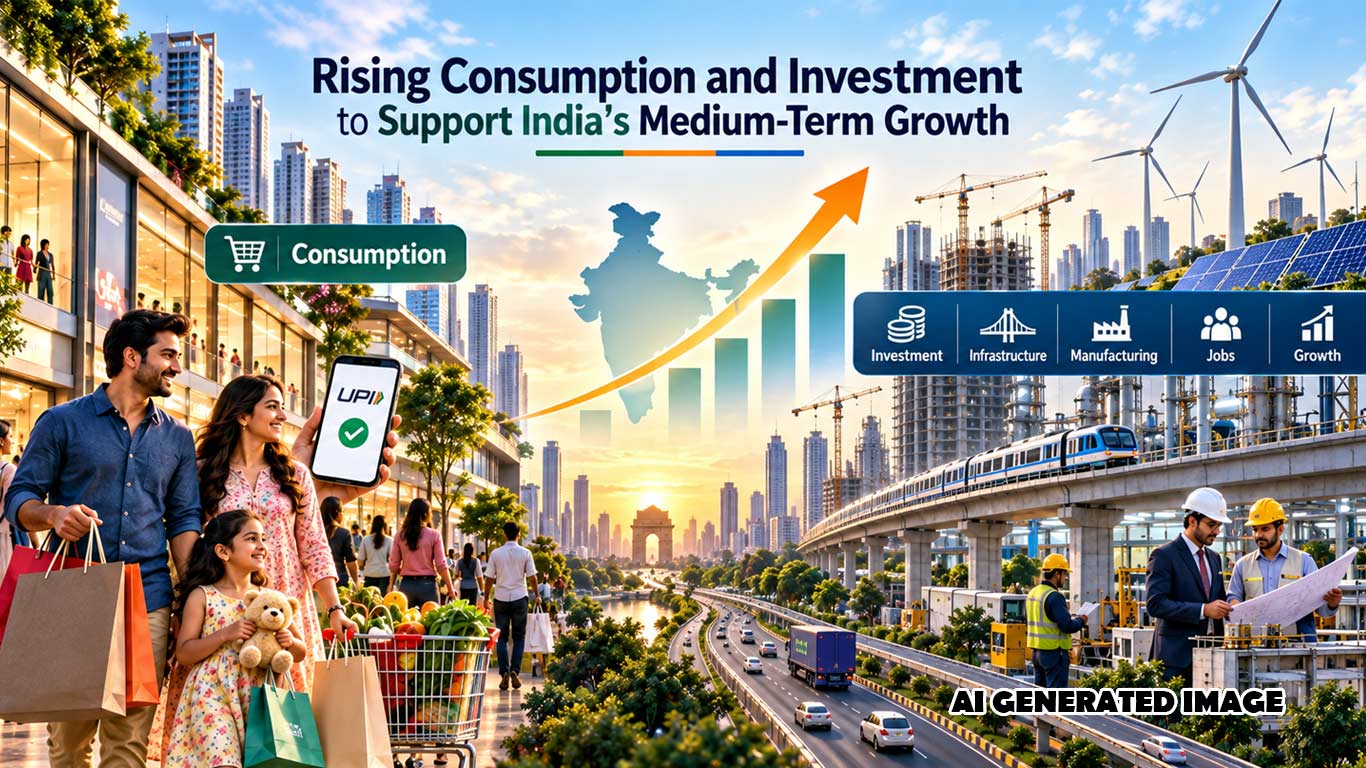
Balance sheets across households, firms and banks are healthier, and public investment continues to support activity. Consumption demand remains resilient, and private investment intentions are improving. These conditions provide resilience against external shocks and support the continuation of growth momentum," it said.
External Environment Uncertain
The Survey highlighted the risks and uncertainties faced by the countries globally. It said that the current financial year has been challenging for India too on the external front. It said that heightened uncertainty in global trade and the imposition of high, penal tariffs created stress for manufacturers, particularly exporters, and affected business confidence.
The survey however noted that the government responded to the challenges by using the crisis as an opportunity to push through key measures such as GST rationalisation, faster progress on deregulation, and further simplification of compliance requirements across sectors.
The survey said that FY27 is expected to be a year of adjustment, as firms and households adapt to these changes, with domestic demand and investment gaining strength.
"That said, it must be acknowledged that the external environment remains uncertain, which shapes the overall outlook," the Economic Survey noted.
Global Economic Outlook Dim
The Survey said that the outlook for the global economy remains dim over the medium-term, with downside risks dominating.
The Survey expects the global economic growth to remain modest, leading to broadly stable commodity price trends. It was noted that inflation across economies has trended downward, and monetary policies are therefore expected to become more accommodative and supportive of growth.
"However, certain key risks persist. If the AI boom fails to deliver the anticipated productivity gains, it could trigger a correction in overly optimistic asset valuations, with the potential for broader financial contagion," the Survey cautioned.
Additionally, the survey said that a protraction of trade conflicts would weigh on investment and further weaken the global growth outlook.
"These forces collectively suggest that downside risks to global growth remain prominent, although a fragile stability holds for now," the Survey said.
Risks Manageable for India
The Economic Survey said that various global conditions translate into external uncertainties rather than immediate macroeconomic stress for India. The key document noted that slower growth in key trading partners, tariff-induced disruptions to trade and volatility in capital flows could intermittently weigh on exports and investor sentiment. But at the same time, it was highlighted that the ongoing trade negotiations with the United States are expected to conclude during the year, which could help reduce uncertainty on the external front.
"While these risks remain manageable, they reinforce the importance of maintaining adequate buffers and policy credibility," the Survey said.
(KNN Bureau)






 Loading...