Government Accepts Industry Demands, Grants Three-Year QCO Relief To Select Cross Recessed Screws
Updated: Jun 24, 2026 05:02:25pm

Government Accepts Industry Demands, Grants Three-Year QCO Relief To Select Cross Recessed Screws
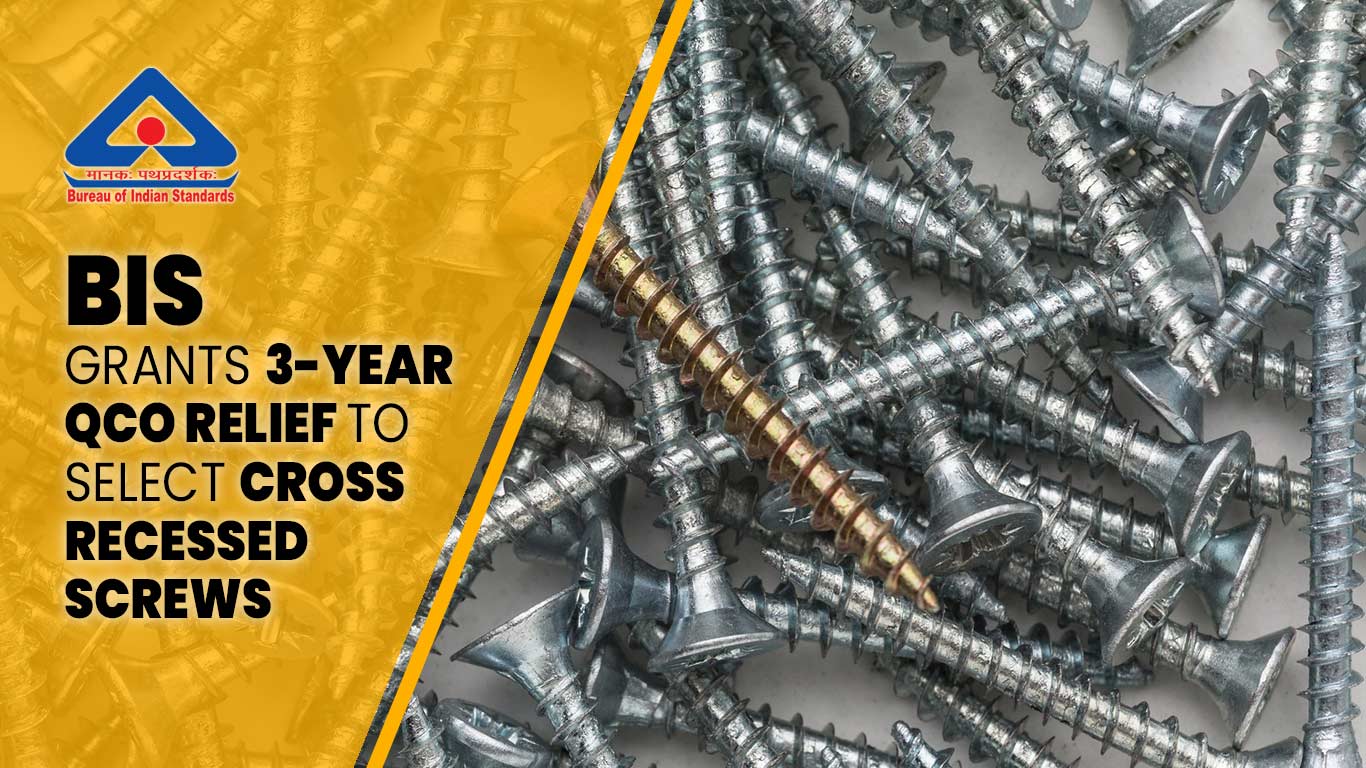
New Delhi, Jun 24 (KNN) The Centre has deferred the implementation of quality control norms for select categories of cross recessed screws for three years, offering relief to the fastener industry and MSMEs that had raised concerns over compliance challenges and supply disruptions.
In a notification issued under the Bureau of Indian Standards (BIS) Act, 2016, the government notified the Cross Recessed Screws (Quality Control) Amendment Order, 2026, superseding the earlier 2025 order.
The amendment provides that the BIS requirements relating to serial numbers 12, 13 and 14 under the quality control framework will remain inoperative for three years from the date of publication in the Official Gazette.
Industry body Federation of Indian Micro and Small & Medium Enterprises (FISME) welcomed the move, stating that sustained representations to multiple ministries and interventions at higher levels had contributed to the decision.
Fastener Industry Faces QCO Challenges
The fastener sector has been grappling with the implementation of two major Quality Control Orders (QCOs) in recent years. While the QCO covering nuts, bolts and fasteners came into force in 2023, another order covering 14 categories of cross recessed screws was notified in 2025.
The latter was initially scheduled to take effect from April 17, 2025, before its implementation was extended to November 2025 following industry representations.
Import Consignments Were Stranded During Transition
During the transition period, several import consignments remained stranded at ports after importers had placed orders before the revised deadline.
FISME subsequently approached the Ministry of Steel and the Central Board of Indirect Taxes and Customs (CBIC), seeking relief for affected importers. A notification issued in January 2026 enabled the clearance of consignments that had arrived in India up to January 12, 2026.
Industry Says Relief Covers Only Part of the Problem
Shaunak Rungta, Director, Vardhan Group, said the latest notification addresses only a part of the industry's concerns, as the suspension applies to only three categories of fasteners, drywall screws, chipboard screws and countersunk wood screws.
He said the fastener industry comprises lakhs of product specifications, with new variants being developed regularly to meet evolving industrial applications.
Several specialised fasteners are either not manufactured domestically or are unavailable in adequate quality and quantity, resulting in continued dependence on imports.
Broad HSN Classifications Add to Compliance Burden
Rungta also pointed to difficulties arising from broad HSN classifications, alleging that products not covered under QCO provisions often face scrutiny at ports because they share tariff classifications with regulated items.
He argued that this creates uncertainty and compliance burdens for genuine importers, particularly MSMEs.
Industry Calls for Wider Review of QCO Framework
Nearly 70 percent of India's fastener imports originate from Japan, the UK, Taiwan and South Korea, while around 25 percent come from China. It should be noted that a minimum import price mechanism is already in place to address concerns related to under-invoicing.
While welcoming the Ministry of Steel's decision as a pragmatic step, industry representatives have called for a wider review of the fastener QCO framework and if possible complete removal of QCOs on all fasteners types.
Amendment Expected to Ease Immediate Pressures
They urged policymakers to align quality regulations with actual domestic manufacturing capabilities and adopt a more calibrated approach that safeguards quality standards without disrupting supply chains and downstream industries.
The latest amendment is expected to provide immediate relief to manufacturers, traders and importers operating in the fastener ecosystem, even as discussions continue over broader reforms to the sector's regulatory framework.
(KNN Bureau)










 Loading...