India’s Progress Driven By Strong Safety Nets & Growth-Oriented Reforms: NITI Aayog VC
Updated: Jul 21, 2025 02:10:39pm

India’s Progress Driven By Strong Safety Nets & Growth-Oriented Reforms: NITI Aayog VC
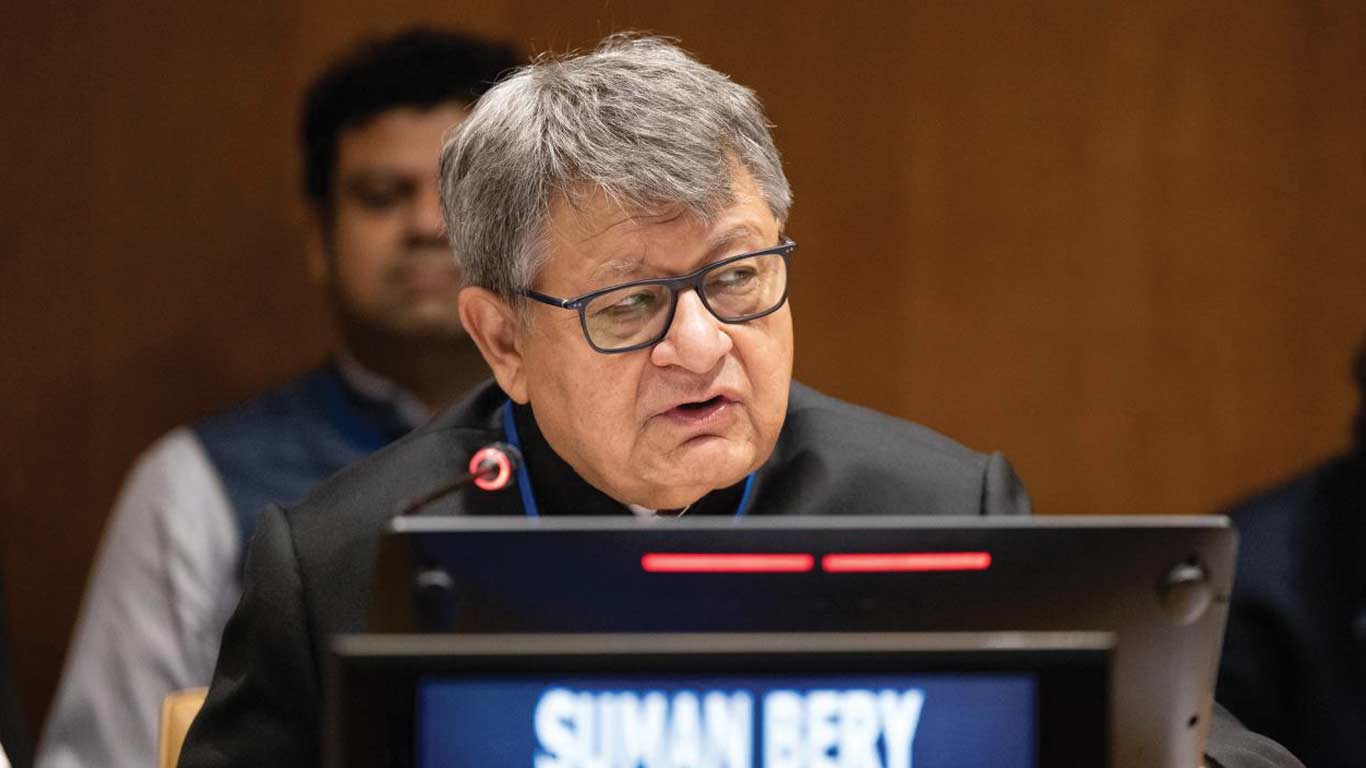
New Delhi, July 21 (KNN) India’s advancement across multiple Sustainable Development Goals (SDGs) has been driven by a dual approach combining strong safety nets with growth-oriented reforms that create a more enabling environment, NITI Aayog Vice Chairman Suman Bery said.
Speaking at a high-level side event titled “SDGs: Keeping up the Momentum for Agenda 2030” on the sidelines of the UN High-Level Political Forum (HLPF) on Sustainable Development, Bery emphasised that India’s development model is both inclusive and self-designed.
“India’s progress has been enabled by a dual strategy: strong safety nets to protect the most vulnerable and structural reforms that foster growth by creating an enabling business environment,” Bery said.
He noted that 240 million people exited multi-dimensional poverty between 2013–14 and 2022–23, while social protection coverage more than doubled since 2015.
India is on track to meet its health-related Sustainable Development Goals (SDGs)—particularly in reducing maternal, infant, and child mortality—well ahead of the 2030 deadline, Bery stated.
He also highlighted India’s success in energy transition, with the country achieving 50 percent of its installed electricity capacity from non-fossil fuel sources five years ahead of its Nationally Determined Contributions (NDC) target under the Paris Agreement.
“India has demonstrated that we take our international commitments seriously. But development in a democracy is a political act, and while guided by global SDG frameworks, our solutions are necessarily homegrown,” Bery remarked.
He emphasised the “confluence” between India’s inclusive growth agenda and global consensus reached in 2015 on both the SDGs and the Paris climate accord.
The event, hosted by India’s Permanent Mission to the UN in collaboration with NITI Aayog, also spotlighted India’s efforts to localise SDGs.
These include state-level indicator frameworks, community participation, and digital governance tools such as Digital Public Infrastructure and the Unified Payments Interface (UPI), which have helped drive financial inclusion and improve service delivery.
Kanni Wignaraja, UN Assistant Secretary-General and Regional Director for Asia-Pacific at the United Nations Development Programme (UNDP), praised India’s SDG progress, calling it the second-fastest among G20 countries.
“SDG localisation is deeply contextual and shaped by how communities interact with policies and institutions,” she said, highlighting India’s dynamic approach and motivated local leadership.
Wignaraja also lauded India’s digital public infrastructure as a ‘game changer’, noting that UPI is now the world’s largest real-time payments system and is being adopted globally.
(KNN Bureau)








 Loading...