India’s WPI Inflation Rises To 9.87% In June On Commodity Price Surge: Finance Ministry
Updated: Aug 03, 2026 05:11:12pm

India’s WPI Inflation Rises To 9.87% In June On Commodity Price Surge: Finance Ministry
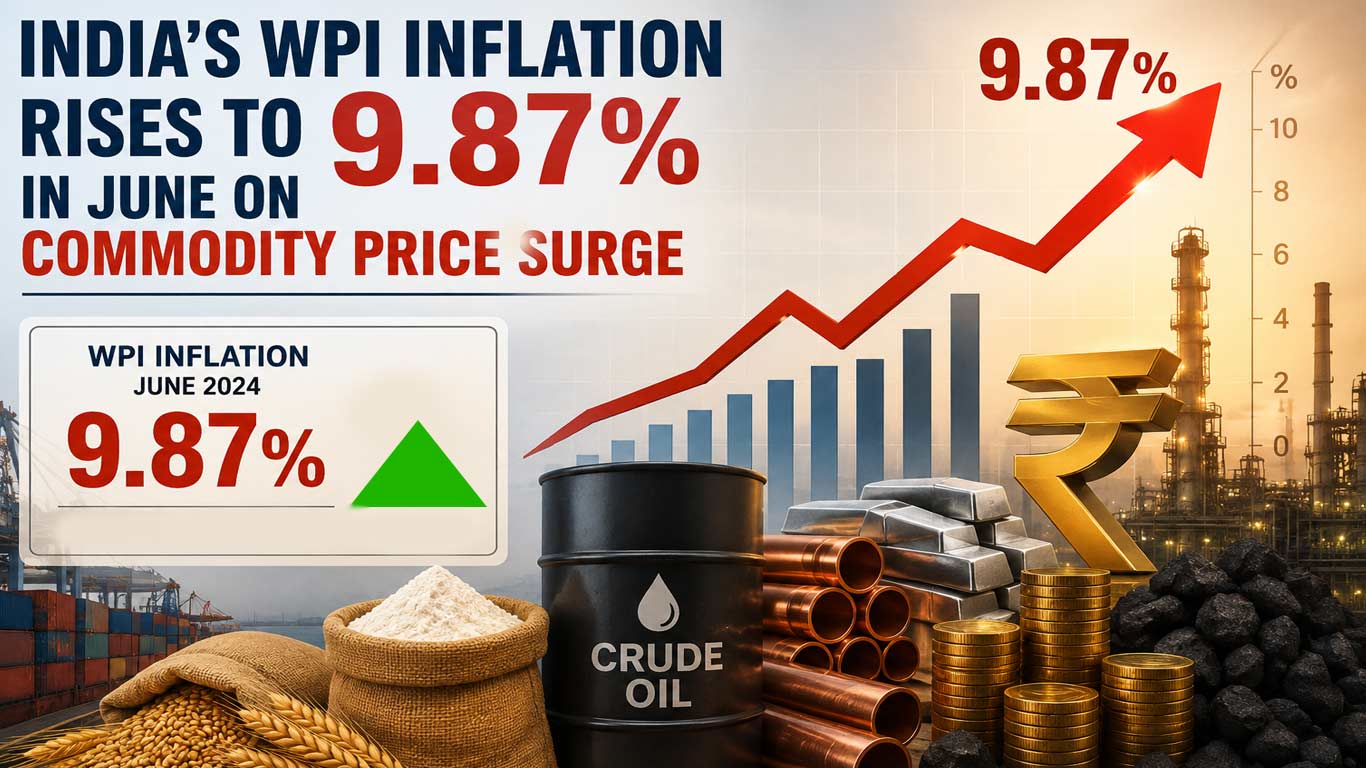
New Delhi, Aug 3 (KNN) India’s wholesale price index (WPI)-based inflation rose to 9.87 per cent in June from 9.68 per cent in May, driven largely by higher prices of globally sensitive commodities, the government informed Parliament on Monday.
In a written reply in the Lok Sabha, Minister of State for Finance Pankaj Chaudhary said the increase was primarily driven by price pressures in mineral oils, food articles, basic metals, and chemicals, all of which are closely linked to global energy and commodity markets.
Government outlines steps to manage inflation
He noted that the government has taken multiple measures to contain inflation and reduce its impact on consumers. These include building buffer stocks of essential food items, releasing grains in the open market, and adjusting trade policies as needed.
Retail inflation remains within target band
Despite elevated wholesale inflation, retail inflation based on the Consumer Price Index (CPI) has remained relatively moderate. It stood at 3.1 per cent in the January–March quarter of FY26 and 3.9 per cent in the April–June quarter of FY27, both below the central target of 4 per cent, Chaudhary said.
However, on a monthly basis, retail inflation rose to a provisional 4.38 per cent in June 2026, up from 3.93 per cent in May, mainly due to higher food and transport costs.
Inflation targeting framework retained
He emphasised that the government, in consultation with the Reserve Bank of India (RBI), sets the CPI inflation target every five years to balance price stability and economic growth.
The current target, notified on March 25, 2026, remains at 4 per cent, with a tolerance band of 2 per cent to 6 per cent for the period from April 1, 2026, to March 31, 2031.
The divergence between wholesale and retail inflation highlights the influence of global commodity trends on producer prices, while domestic policy measures appear to be containing consumer-level price pressures for now.
(KNN Bureau)










 Loading...