NITI Aayog Calls For MSME-Led Manufacturing Push To Integrate India With Global Value Chains
Updated: Aug 14, 2026 12:57:44pm

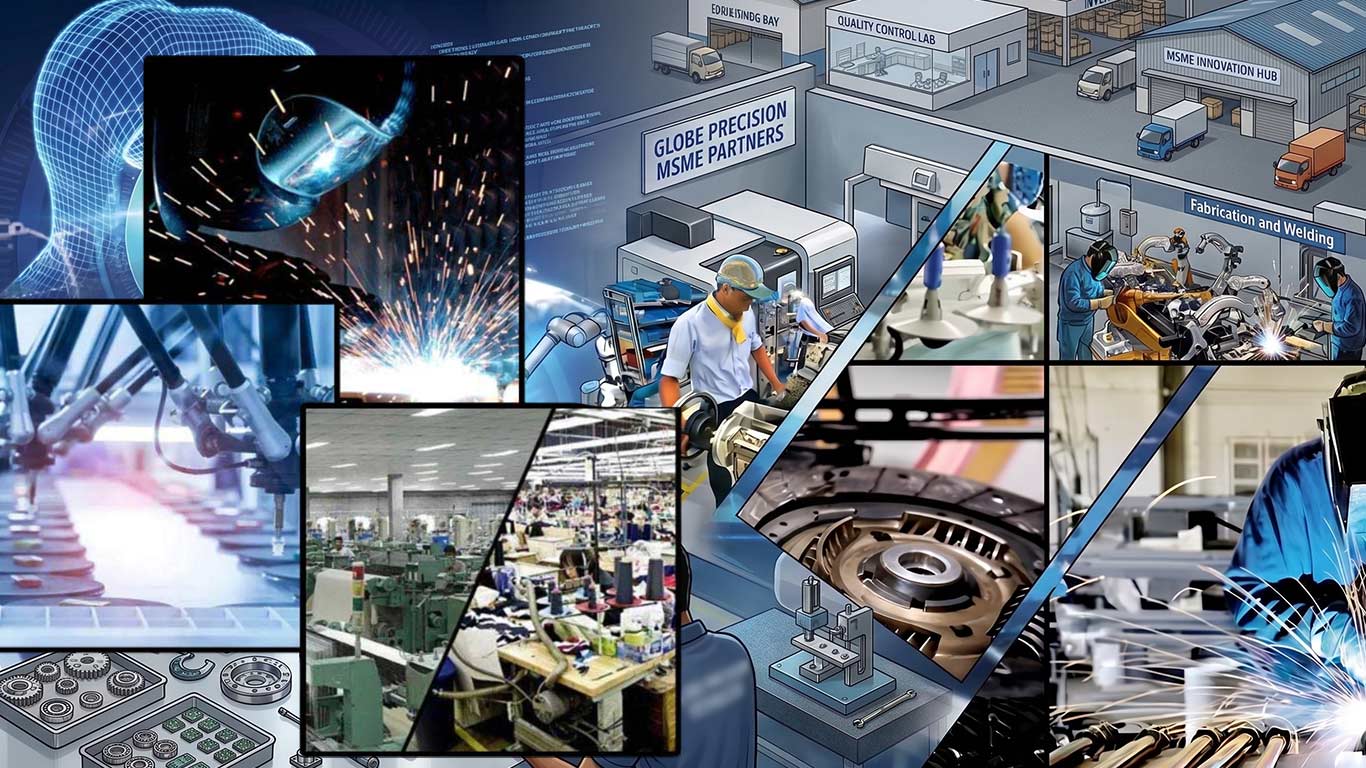
NITI Aayog Calls For MSME-Led Manufacturing Push To Integrate India With Global Value Chains
New Delhi, Aug 14 (KNN) NITI Aayog has released ‘Positioning India as a Global Manufacturing Hub’, outlining a sector-specific roadmap to boost manufacturing competitiveness and global value-chain integration.
The report examines four strategic sectors, chemicals, textiles, telecom and networking equipment, and solar PV, assessing their market and export potential, infrastructure, raw materials, technology readiness and employment potential.
It calls for targeted interventions based on sector-specific market structures, technology, input requirements and global competitiveness.
MSMEs Critical To Manufacturing Expansion
MSMEs account for over 95 percent of India’s manufacturing units but face challenges including outdated technology, limited capital and credit, digitisation, compliance and global supply-chain integration.
The report identifies chemicals, telecom and networking equipment, and solar PV as key export, technology and employment opportunities, focusing on downstream value addition and import reduction in chemicals, localisation and component manufacturing in telecom, and stronger upstream capabilities, R&D and integrated clean-tech ecosystems in solar PV.
Textile Sector Faces Structural Challenges
The report identifies textiles as a key employment-intensive sector, closely linked to MSMEs, rural economies and global trade. The industry contributes 2 percent to GDP, 11 percent to manufacturing GVA and 9 percent of merchandise exports, supporting over 45 million livelihoods.
India exported USD 37.7 billion in textiles in FY2025, accounting for 4.1 percent of global exports and ranking sixth globally.
However, the sector faces challenges including cotton dependence, costly MMF feedstocks, fragmented capacity, low productivity and weaker market access than competitors such as Bangladesh and Vietnam.
Report Calls For Technology Upgradation
The report recommends improving raw material competitiveness by addressing MMF feedstock constraints, boosting cotton productivity and rationalising duties.
It also calls for MSME infrastructure support, technology upgrades, expanded weaving and processing capacity, greater foreign investment, deeper trade integration, skilling and development of technical, MMF-based, sustainable textiles and premium Indian weaves.
With 80 percent of producers being MSMEs, PM MITRA Parks could help address infrastructure and technology gaps through plug-and-play facilities, transport links and e-commerce support across seven planned parks of at least 1,000 acres each.
Focus On Innovation And Certification
To accelerate modernisation, the report recommends support for replacing outdated machinery, adopting automation and advanced production technologies and integrating resource-efficient and sustainable manufacturing practices.
It also proposes cluster-level certification centres as one-stop facilities to help MSMEs obtain testing, certification and compliance documentation required for domestic and international markets.
Deeper Value-Chain Integration Needed Across Sectors
The report highlights telecom and networking equipment challenges such as limited semiconductor fabrication access, high prototyping costs and weak post-training incubation and commercialisation support.
It calls for deeper value-chain participation beyond assembly-led manufacturing across all four sectors.
Priorities include stronger feedstock and downstream capacity in chemicals, MMF competitiveness and MSME modernisation in textiles, component localisation and technology development in telecom, and expanded upstream capabilities, R&D and lower import dependence in solar PV.
(KNN Bureau)





 Loading...