China’s Proposed Solar Technology Export Curbs May Have Limited Impact On India’s Rooftop Prices
Updated: Nov 10, 2026 05:16:31pm

China’s Proposed Solar Technology Export Curbs May Have Limited Impact On India’s Rooftop Prices
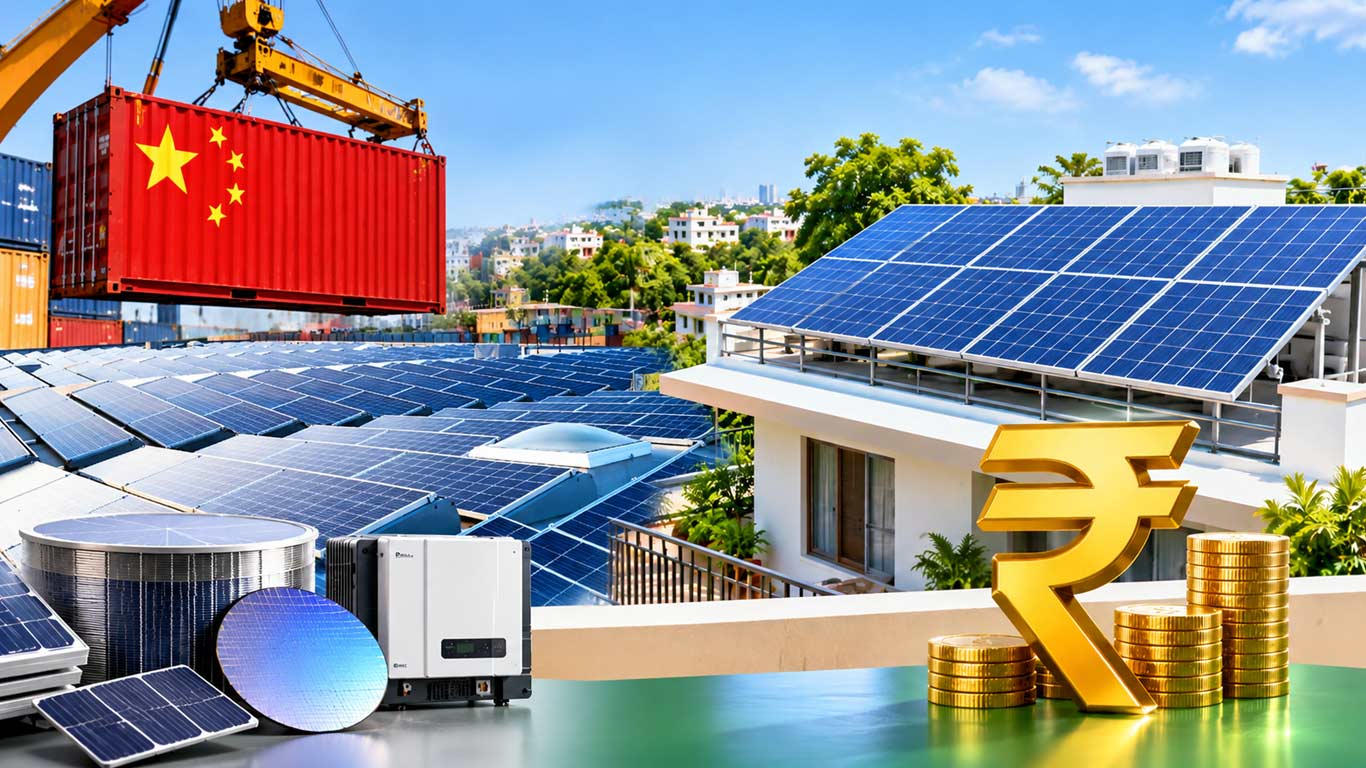
New Delhi, Nov 10 (KNN) China’s proposed restrictions on exports of solar manufacturing technologies are unlikely to significantly increase residential rooftop solar prices in India in the near term, but could affect domestic manufacturers’ access to production equipment and advanced technologies.
China has proposed export controls on 12 solar manufacturing technologies, including processes used in silicon wafer production and advanced solar cells. The proposals cover TOPCon, heterojunction and back-contact technologies, while exports of certain emerging technologies, including perovskite and tandem cells, could be prohibited.
The proposed measures are part of a revision of China’s export-control framework and do not cover a blanket ban on finished solar panels. The public consultation is scheduled to close on November 15, 2026.
Rakesh Malhotra, Founder of Livguard (SAR Group), told NDTV, "India is better insulated than it was a few years ago," citing investments in domestic manufacturing supported by the PM Surya Ghar Muft Bijli Yojana and PM-KUSUM, which include Domestic Content Requirement (DCR) provisions.
Malhotra expects India’s solar cell manufacturing capacity to reach around 25 GW by FY26 and increase towards 60 GW by FY27.
"It is difficult to put a precise percentage on it, as it depends on the final scope and timing of any restrictions," he said, adding that the impact on residential rooftop solar prices is expected to be minimal.
Vijay Menon, Chief Operating Officer of Navitas Solar, said the restrictions were unlikely to cause a significant immediate change in rooftop solar prices. However, he said they could affect manufacturers’ access to production equipment and technology.
"The proposed restrictions could, however, delay access to manufacturing machinery, technical support and advanced production processes," Menon said.
According to a Council on Energy, Environment and Water (CEEW) analysis, India had approximately 173 GW of solar module manufacturing capacity as of March 2026, compared with around 30 GW of solar cell manufacturing capacity.
India also remains dependent on imports for solar cells and upstream materials, including wafers and polysilicon.
Menon said domestic manufacturing would need to expand across cells, wafers, ingots, polysilicon and production equipment.
"2027 can be an important milestone for strengthening domestic cell availability, provided projects under development are commissioned and stabilise production," he said.
He added that developing domestic capabilities in polysilicon, manufacturing equipment and intellectual property could take beyond 2030.
Malhotra identified inverter technology as another area requiring domestic manufacturing capacity. "India needs to build deeper capability in inverter design and set up manufacturing at scale," he said.
Menon also recommended that solar manufacturers allocate around 2-3 per cent of their annual revenue to research and development (R&D), with government support for shared laboratories, pilot production lines and industry-academia partnerships.
He identified TOPCon and back-contact solar cells, perovskite-silicon tandem cells, indigenous manufacturing equipment and critical materials as areas for research and development.
(KNN Bureau)










 Loading...