India-EU FTA Opens Export Opportunities for MSMEs, but CBAM and Compliance Requirements Pose Challenges: Report
Updated: Nov 18, 2026 03:52:10pm

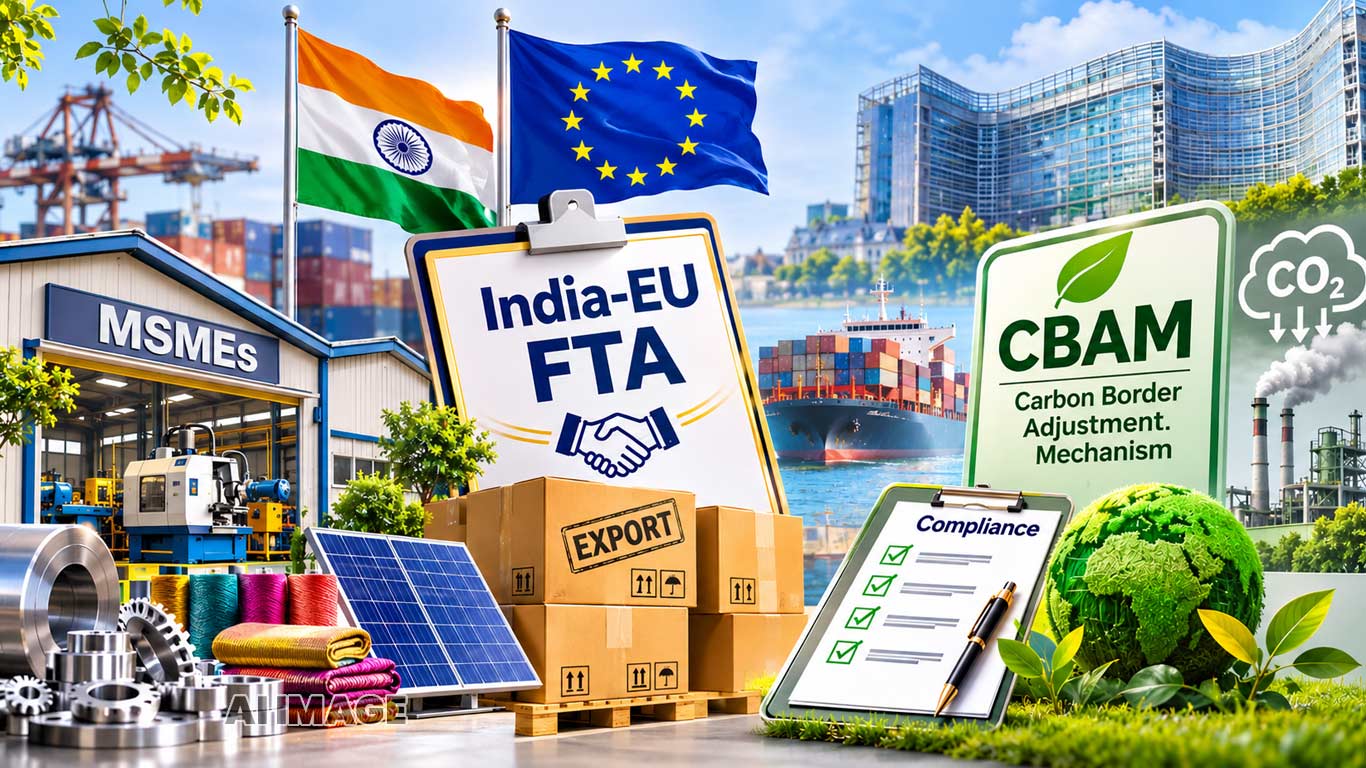
India-EU FTA Opens Export Opportunities for MSMEs, but CBAM and Compliance Requirements Pose Challenges: Report
New Delhi, Nov 18 (KNN) India and the European Union (EU) concluded negotiations on their Free Trade Agreement (FTA) on January 27, 2026. However, the agreement is yet to take effect as it requires approval from the Council of the EU, the European Parliament and completion of India's domestic procedures.
The agreement will reduce or eliminate tariffs on several Indian products, improving their competitiveness in the European market. Duties of up to 12 percent on textiles and clothing and 17 percent on leather and footwear will be removed for qualifying exports.
Tariffs on several chemicals, plastics, rubber products and base metals will also be eliminated immediately or in phases according to a report by The Hindustan Times
Wind-powered generating sets and lithium-ion batteries will benefit from the removal of 2.7 percent import duties, while solar modules will receive no additional advantage as they already enter the EU duty-free.
EU Regulations and CBAM Pose Challenges
Despite the tariff benefits, Indian manufacturers must meet EU requirements covering product quality, safety, environmental protection, energy efficiency, recyclability, waste management, traceability and certification.
The EU's Carbon Border Adjustment Mechanism (CBAM) is another major concern. It imposes a carbon price on emissions embedded in imports of specified iron and steel, aluminium, cement, fertilisers, electricity and hydrogen products.
EU importers must surrender CBAM certificates for covered goods imported from January 1, 2026, with the first surrender due by September 30, 2027.These additional costs could reduce or outweigh the benefits of lower tariffs. The impact is significant for India, as steel and aluminium account for around 6 percent of its merchandise exports to the EU.
Although the FTA does not exempt Indian exports from CBAM, it provides for technical discussions on emissions monitoring, verification, default emission values and recognition of carbon prices paid in India. It also includes provisions for technical assistance and capacity building.
MSMEs Need Support to Meet Compliance Standards
Meeting EU regulations will require investment in testing, certification, emissions monitoring and verification systems. These costs could disproportionately affect micro, small and medium enterprises (MSMEs), limiting their ability to benefit from the agreement.
Government agencies, industry associations and export promotion bodies can support smaller businesses by improving access to affordable testing and certification services. Credible implementation of India's Carbon Credit Trading Scheme could also strengthen the case for recognising domestic carbon prices under CBAM.
Recycling and Green Manufacturing Offer Growth Opportunities
The FTA also creates opportunities for India's recycling and resource-recovery industries. However, gaps in collection, segregation, processing, quality assurance and traceability need to be addressed to meet international standards.
Decarbonising manufacturing will remain essential, particularly in steel, fertilisers and cement, where renewable electricity alone may not be sufficient. Green hydrogen and its derivatives could help reduce emissions in these sectors, while recent tender prices for green hydrogen and ammonia indicate potential for wider adoption.
The agreement could support India's export growth and industrial transformation, but its benefits will depend on manufacturers' ability to meet EU standards and invest in cleaner technologies.
(KNN Bureau)


 Loading...