India Pushes For Deeper Market Access As ASEAN Trade Pact Review Gathers Pace
Updated: Feb 09, 2026 03:23:21pm


India Pushes For Deeper Market Access As ASEAN Trade Pact Review Gathers Pace
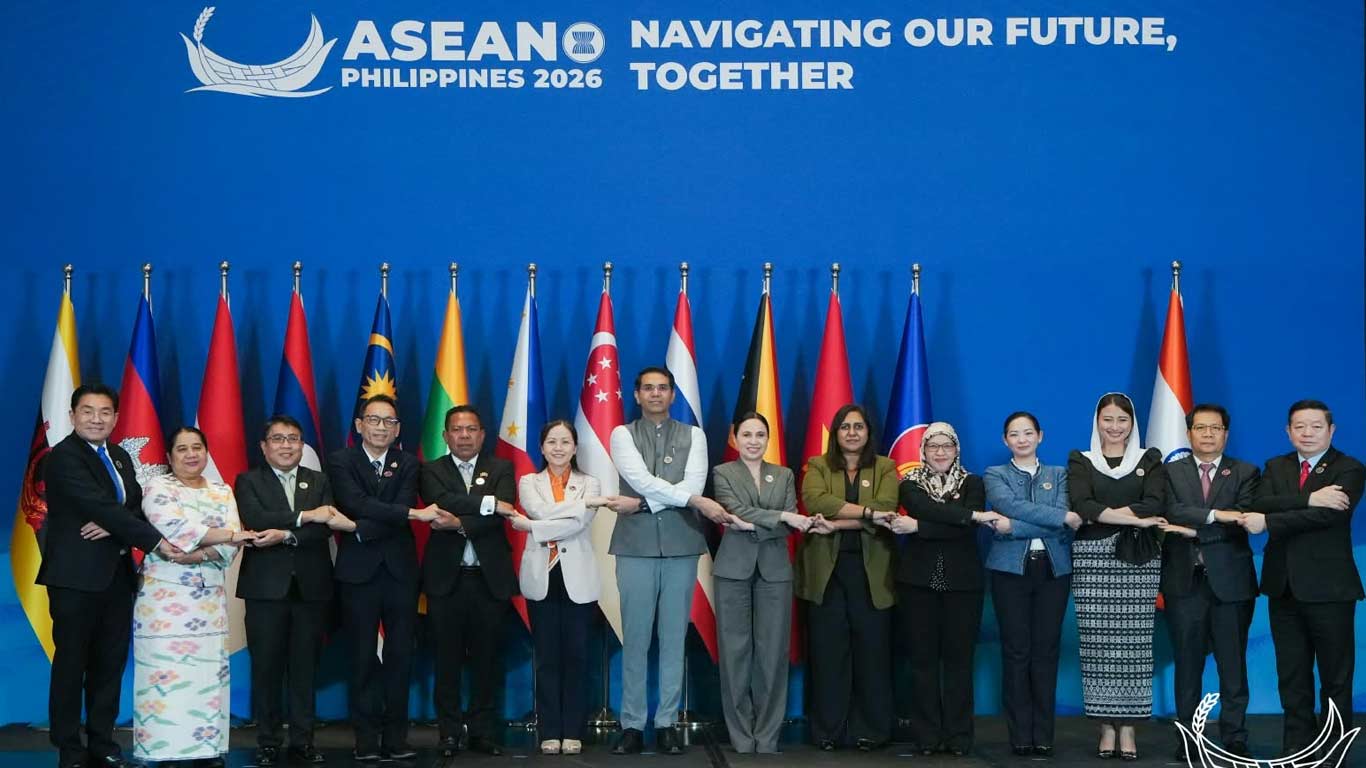
New Delhi, Feb 9 (KNN) India is seeking liberalisation in 80 percent of tariff lines as part of the ongoing review of the ASEAN-India Trade in Goods Agreement (AITIGA), with talks likely to be wrapped up in the next few months, a senior government official said on Sunday.
"Our broad objective is to overall achieve liberalisation of trade in 80 percent tariff lines. At every country level, minimum 70 percent tariff line liberalisation should be achieved. The discussions are on,"said Secretary (East), Ministry of External Affairs, P Kumaran.
He added that for ASEAN's Least Developed Countries (LDCs), flexibility could be extended in terms of tariff concessions and timelines, potentially increasing liberalisation from 70 percent to 80 percent
tariff lines over a longer period.
Focus on Product-Specific Rules of Origin
The review also aims to tighten Rules of Origin by introducing product-specific norms instead of the current uniform 35 percent local value addition requirement under AITIGA. Officials said this would
enable a more calibrated approach for sectors like electronics, where global supply chains limit higher domestic value addition.
The review process began in 2021 after ASEAN agreed in 2019 to revisit the agreement, which came into force in January 2010.
Addressing Trade Imbalance
India's exports to ASEAN increased from USD 18.11 billion in 2009–10 to USD 38.96 billion in 2024–25, while imports rose more sharply from USD 25.79 billion to USD 84.15 billion, widening the trade deficit.
Through the review, India aims to address market access issues and correct trade imbalances.
AITIGA covers over 90 percent of tariff lines traded between India and ASEAN, with about 10,872 of 12,169 lines seeing tariff cuts or elimination, though liberalisation varies across members. Countries like
Singapore and Malaysia have higher coverage, while Vietnam and Myanmar have lower levels. Malaysia is chairing the ASEAN-side negotiations.
Push for Local Currency Trade and Digital Payment Linkages
At the conclusion of the Prime Minister's visit, both sides welcomed ongoing collaboration between the Reserve Bank of India (RBI) and Bank Negara Malaysia to promote local currency settlement in bilateral trade and investment.
"This is still being discussed. It is a matter of priority. Both the PMs expressed support. We will be working very actively in coming months to have this operationalised," Kumaran said.
India has established mechanisms for local currency trade with 22 countries under the RBI framework launched in July 2022. Bilateral trade between India and Russia is now fully settled in national currencies.
The joint statement also noted collaboration between NPCI International Limited (NIPL) and PayNet Malaysia to establish bilateral payment linkages.
"UPI linkage is something we have been discussing for a while. The main purpose is to help tourists and enable workers to send their remittances," Kumaran said.
UPI is currently operational in Singapore, UAE, Qatar, Bhutan, Sri Lanka, Mauritius and France. India is also working with Southeast Asian partners to interlink multiple national payment systems under Project
Nexus, which aims to enable cross-border QR-based payments across the region.
(KNN Bureau)





 Loading...