India–Oman CEPA Takes Effect June 1; Nearly All Exports Get Duty-Free Access
Updated: Jun 01, 2026 05:24:20pm

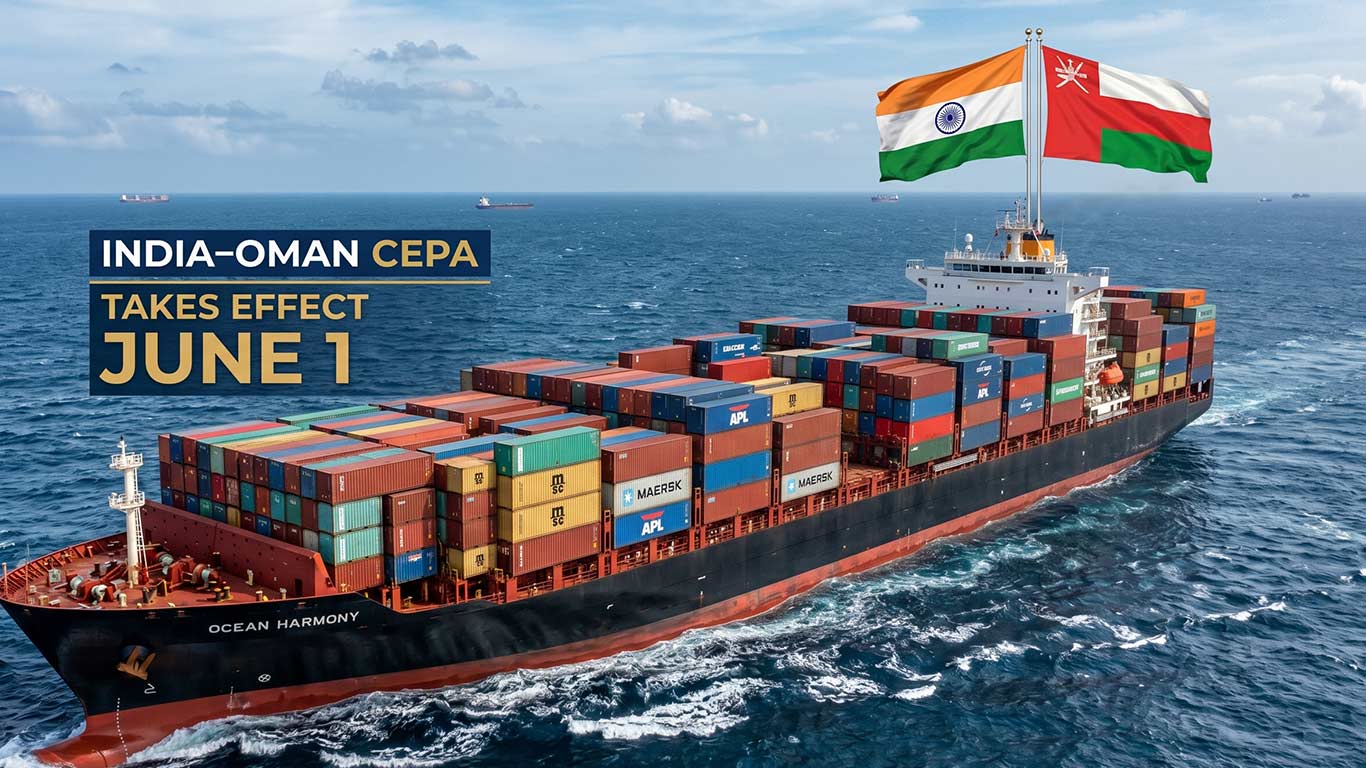
India–Oman CEPA Takes Effect June 1; Nearly All Exports Get Duty-Free Access
New Delhi, Jun 1 (KNN) The India–Oman Comprehensive Economic Partnership Agreement (CEPA), signed in Muscat on December 18, 2025, came into force today, marking a significant step in strengthening bilateral trade and economic relations between the two countries.
The agreement was formally operationalised in New Delhi in the presence of Union Commerce Minister Piyush Goyal and Oman's Ambassador to India, Issa Saleh Al Shibani.
The first consignments availing preferential tariff benefits — covering agriculture and gems and jewellery exports — were flagged off from Mumbai, Kolkata, and Chennai.
Commerce Minister Piyush Goyal described the pact as "a force multiplier in the Gulf region," adding that it would deliver gains for farmers, fishermen, MSMEs, and professionals. Commerce
Secretary Rajesh Agrawal said the agreement went beyond tariff liberalisation to build a long-term economic architecture encompassing trade, services, investment, and logistics.
Sweeping Market Access for Indian Exporters
The centrepiece of the agreement is near-total duty-free access for Indian goods. Under the CEPA, 99.38 per cent of India's exports to Oman by value will now enter duty-free, covering 98.08 per cent of Oman's tariff lines — a dramatic improvement from the earlier position under the Most Favoured Nation (MFN) regime, where only 15.33 per cent of Indian exports entered Oman duty-free.
All zero-duty concessions take effect immediately, providing Indian exporters with instant price competitiveness in Oman's nearly USD 28 billion import market.
Key sectors expected to benefit include gems and jewellery, textiles, leather, footwear, marine products, engineering goods, processed foods, and pharmaceuticals.
Sensitive Sectors Safeguarded
India has offered tariff liberalisation on 77.79 per cent of its tariff lines, covering 94.81 per cent of imports from Oman by value. However, a broad exclusion list protects sensitive domestic sectors including dairy, cereals, fruits, vegetables, edible oils, oilseeds, rubber, and key agricultural products.
Tariff Rate Quotas and Minimum Import Price mechanisms have been incorporated for selected sensitive products to safeguard domestic industry and farmer interests.
Sector-Specific Gains
Under the agreement, import duties of up to 5 per cent on gems and jewellery have been eliminated from day one, giving Indian exporters a structural price advantage over competitors such as Italy, Turkey, Thailand, and China, with exports to Oman valued at USD 25.78 million in 2025 expected to rise to USD 150 million within three years.
All marine products, including shrimp, fish, and cuttlefish, now enjoy immediate duty-free access, replacing earlier duties of up to 5 per cent, a move set to benefit coastal states such as Andhra Pradesh, Kerala, Tamil Nadu, and Gujarat.
In agriculture and processed foods, where India is already Oman’s second-largest supplier with a 17.8 per cent market share, the CEPA enhances competitiveness in products like basmati rice, cashew kernels, honey, butter, bovine meat, and mangoes, thereby supporting farmers and agri-processors across multiple states.
For pharmaceuticals, binding zero-duty access has been secured for medicines, vaccines, and pharmaceutical ingredients, while products approved by major global regulators such as the USFDA and EMA will receive marketing authorisation in Oman within 90 days without prior inspection, significantly easing entry into the market.
Meanwhile, all engineering goods now receive zero-duty access, replacing MFN tariffs of up to 5 per cent, with exports to Oman—valued at USD 875.83 million in FY 2025-26—projected to grow to between USD 1.3 billion and USD 1.6 billion by 2030.
Services and Professional Mobility
Bilateral services trade stood at USD 863 million in 2024, with India running a surplus of USD 447 million.
Under the CEPA, Oman has made market access commitments across 127 services sub-sectors — described as the most comprehensive services offer made by any Gulf Cooperation Council (GCC) country to India. Key sectors include IT, engineering, healthcare, education, financial services, construction, and telecommunications.
For the first time in any bilateral trade agreement with a GCC country, Oman has made binding commitments for defined categories of professionals. Business visitors may stay for up to 90 days, independent professionals for up to 180 days, and intra-corporate transferees for up to four years.
The agreement also provides for future negotiations on a Social Security Agreement to avoid dual contributions for Indian workers.
(KNN Bureau)








 Loading...