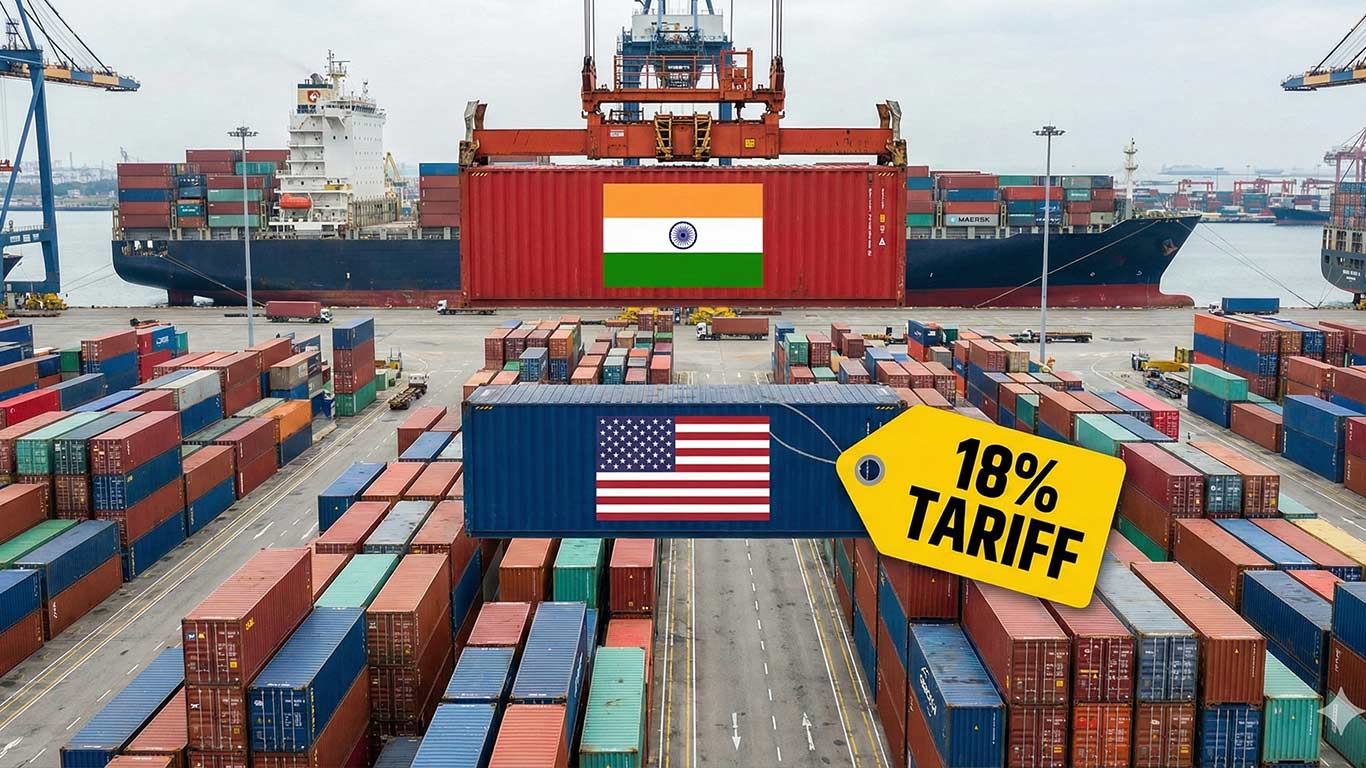
Trump Announces US–India Trade Deal With Tariff Reduction To 18%; GTRI Flags Key Uncertainties
Updated: Feb 03, 2026 04:25:43pm

Trump Announces US–India Trade Deal With Tariff Reduction To 18%; GTRI Flags Key Uncertainties
New Delhi, Feb 3 (KNN) US President Donald Trump announced on February 2 that the United States and India have reached a trade agreement following a phone call with Indian Prime Minister Narendra Modi.
In a Truth Social post, Trump said India agreed to adjust its energy purchases and expand imports of US goods, and in return the United States would reduce tariffs on Indian products.
“Caution, not celebration, is needed,” said Global Trade Research Initiative (GTRI) Founder Ajay Srivastava as the US President’s Truth Social post leaves major questions unanswered.
Trump stated that the US would lower its reciprocal tariff on Indian goods fr0m 25 per cent to 18 per cent. The White House later clarified that this change also involves removing an additional 25 per cent punitive duty that had been applied due to India’s purchases of Russian oil, effectively reducing overall tariffs to 18 per cent.
Trump also claimed that India would cut its tariffs and non-tariff barriers on US products to zero, though details on the scope and timeline for such measures have not been publicly specified.
In his announcement, Trump said Prime Minister Modi agreed to stop buying Russian oil and instead increase purchases fr0m the United States and potentially Venezuela.
He also referenced India importing more than USD 500 billion in US energy, technology, agricultural and other goods, but did not provide specifics on how or when this would be achieved.
Although Prime Minister Modi’s X post corroborated the tariff reduction to 18 per cent, it provided no further details on the trade deal.
GTRI noted that the US has already offered reciprocal tariffs of 10 per cent to the UK, 15 per cent to the EU and Japan, 19 per cent to Indonesia and Malaysia, and 20 per cent to Bangladesh and Vietnam under trade deals concluded between May and October 2025. However, some EU products with Most-Favoured-Nation (MFN) tariffs above 15 per cent will continue to attract the existing MFN rate.
GTRI added that even after these trade deals, US Section 232 tariffs will remain in place at 50 per cent on steel, aluminium, copper and related products, and at 25 per cent on certain auto components. Zero tariffs will also continue for pharmaceuticals, aircraft and parts, and select mechanical and electronic components.
Srivastava emphasised, “Major questions remain unanswered—what products are covered, what the timelines are, and whether India has really agreed to zero tariffs and zero non-tariff barriers, especially in sensitive areas such as agriculture and regulated imports.”
“The headline figure of USD 500 billion in US purchases is also unclear. India currently imports less than USD 50 billion a year fr0m the US, suggesting this is more an aspiration than a firm commitment,” he added.
(KNN Bureau)







 Loading...