US Green Card Sponsorship Suspension Signals Protectionist Shift, Puts Indian IT Exports at Risk: GTRI
Updated: Oct 10, 2026 02:58:05pm

US Green Card Sponsorship Suspension Signals Protectionist Shift, Puts Indian IT Exports at Risk: GTRI
New Delhi, Oct 10 (KNN) The US decision to suspend eight technology companies, including Tata Consultancy Services (TCS), Infosys and Wipro, from a programme used to sponsor foreign workers for green cards signals a more protectionist approach towards foreign technology professionals, with potential implications for India's IT exports, think tank Global Trade Research Initiative (GTRI) said on Friday.
The think tank noted that Indian IT firms should prepare for possible restrictions extending beyond green card sponsorship to H-1B hiring, skilled worker mobility and outsourcing. The US accounts for 54.1 per cent of India's software and IT-enabled services exports, making it the country's largest market for these services.
GTRI Founder Ajay Srivastava said, “The measure signals a more protectionist US approach to foreign technology workers...Indian firms should widen their export markets, strengthen delivery from India and expand local hiring where needed. India should also support AI and higher-value technology work to reduce its vulnerability to sudden US policy changes,” PTI reported.
Freeze Limited to Green Card Process
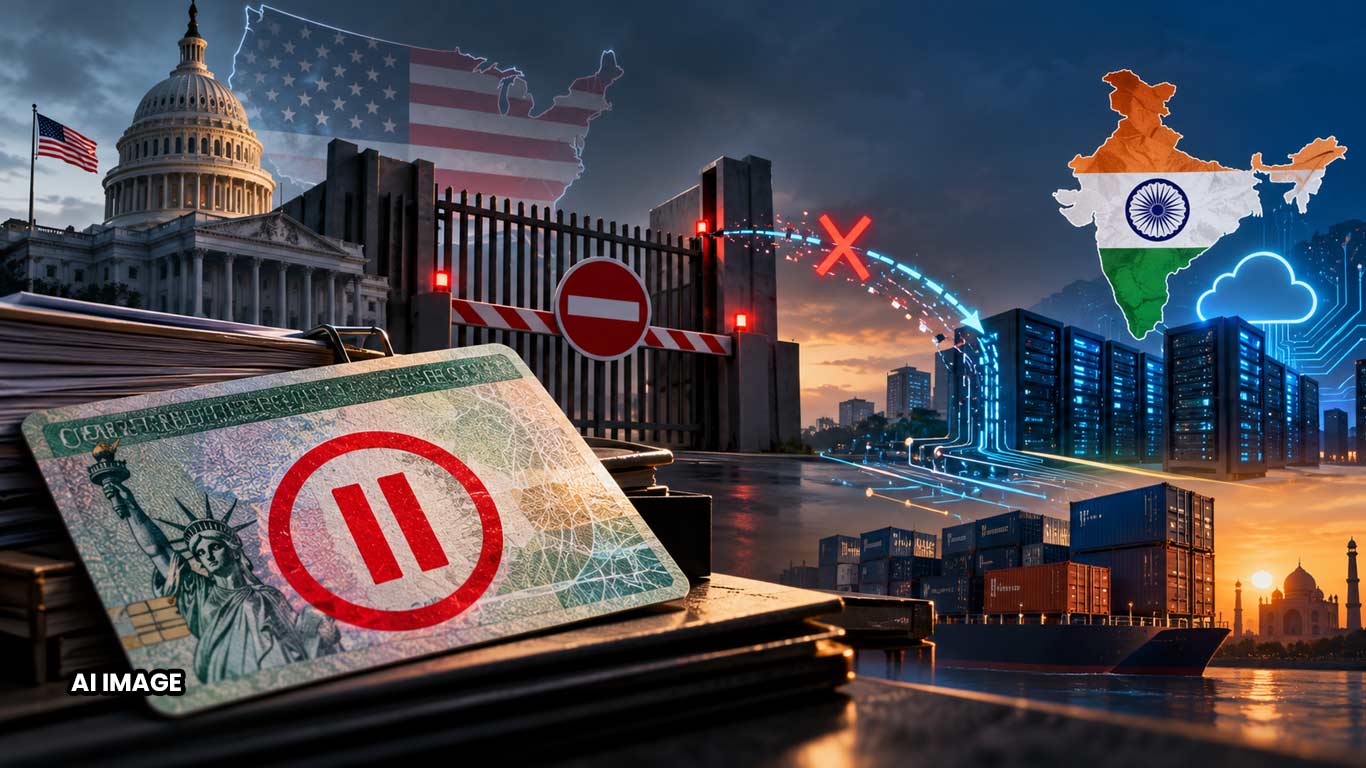
On October 8, the US suspended eight technology companies from the Permanent Labour Certification Programme (PERM), freezing pending applications and blocking new ones. The affected companies are TCS, Infosys, Wipro and HCLTech from India; Microsoft, Adobe and Cognizant from the US; and Capgemini from France.
PERM is a labour certification process used by employers to sponsor eligible foreign workers for employment-based green cards. The measure affects employees seeking permanent residency and could make long-term staffing in the US more uncertain.
However, Srivastava noted, “It does not itself ban H-1B applications, cancel existing H-1B status or block every green card route. These companies can continue applying for H-1B workers under the usual rules. H-1B applications follow a separate process involving a Labour Condition Application (LCA).”
Indian professionals account for more than 70 per cent of approved H-1B petitions annually, he said, adding that “immediate disruption to client projects may therefore be limited, even as firms face greater difficulty attracting and retaining staff for US roles,” as quoted by PTI.
Srivastava emphasised that several major H-1B employers were not included in the supplied ranking. “Amazon, the largest visa recipient, was not included. Neither were Google, IBM, Meta, Apple, Intel or Accenture. Microsoft and Adobe’s inclusion suggests that the action extends beyond outsourcing companies,” he said.
India-Based Delivery May Limit Impact
India's software and IT-enabled services exports stood at USD 221.4 billion in 2025-26, of which the US accounted for USD 119.7 billion, or 54.1 per cent, GTRI said.
The think tank noted that 91.7 per cent of India's software and IT-enabled services exports worldwide were delivered from India in 2025-26, while 8.3 per cent were delivered by professionals working at overseas client locations.
Applying this global delivery split to the US market suggests that around USD 109.8 billion of exports were delivered from India, while USD 9.9 billion was delivered through on-site work. Srivastava cautioned that these estimates are based on worldwide delivery shares rather than US-specific data, and that only a portion of on-site work would depend on employees seeking green cards through the PERM process.
A shift towards India-based delivery, alongside local hiring and training in the US, could help companies maintain project delivery despite the restrictions, he added.
Restrictions Could Boost India's GCC Sector
GTRI said the suspension could also encourage multinational companies to expand their Global Capability Centres (GCCs) in India.
If retaining overseas talent becomes more difficult, companies may shift more engineering work, specialised teams and global projects to their Indian centres. This could create jobs and strengthen India's role in technology development, the think tank said.
However, GTRI cautioned that India's heavy dependence on the US market leaves its IT industry exposed to further policy changes. It recommended diversifying export destinations and moving towards higher-value technology services to improve resilience.
(KNN Bureau)








 Loading...