Runaway price rise in vegetables hit common-woman's budget: Study
Updated: Aug 10, 2015 12:43:29pm

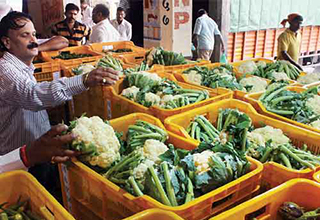
New Delhi, Aug 10 (KNN) Notwithstanding the law of averages which suggests a modest increase in the inflation of vegetables, individual items like tomato, brinjal, cauliflower, garlic, cabbage and okra have witnessed a runaway rise in prices in the first quarter of 2015-16, against the same period of the previous fiscal, according to a study.
It is not only the onion which is tearing apart the household budget; there are others in the vegetable basket punching holes in the common-woman’s pockets, a comprehensive ASSOCHAM study has noted.
Tomato prices, for instance, have seen an increase in prices, as much as 61 per cent in the hybrid variety and 55 per cent in the local variety in the wholesale mandis. Likewise, chilly has become hotter with prices shooting up by 39.5 per cent and brinjal long by 36.8 in these mandis, the study based on the mandi data pointed out.
In the same period, prices of garlic went up by 28,5 per cent, onion by 23.1 per cent, cabbage by 19 per cent and okra by 11 per cent. “What is worrying is that on top of sharp increase in the vegetable prices, there is a huge gap between the wholesale mandis and the retail levels, which clearly point towards urgent need for plugging the supply chain loop holes. Certainly the advantage of price increase is not going to the producers,” ASSOCHAM Secretary General D S Rawat said.
Measured on the retail inflation scale, prices of these vegetables have gone up in a between first quarter of this fiscal and the previous year. What is to be kept in mind is that the scales of measurement for retail and wholesale prices are different and huge gap between the two hurts the consumers more.
Look at these figures would be an eye-opener:
· Cabbage retail price is 76.8 per cent higher than the wholesale price
· Potato Store retail price is 68.3 per cent higher than the wholesale price
· Brinjal Round retail price is 64.8 per cent higher than the wholesale price
· Potato Fresh retail price is 64.2 per cent higher than the wholesale price
· Tomato Local retail price is 61.4 per cent higher than the wholesale price
· Cauliflower retail price is 56.7 per cent higher than the wholesale price
· Tomato Hybrid retail price is 56.0 per cent higher than the wholesale price
· Chilly retail price is 55.4 per cent higher than the wholesale price
· Okra retail price is 55.1 per cent higher than the wholesale price.
The analysis suggests that these markets have recorded 64.5 percent decline in their market arrival in Q1 2015-16 as compared to the same quarter of previous year. This clearly indicates a shortfall in vegetable production despite having peak season for vegetable production. “Here comes the role of government agencies by making effective market intervention through imports, check on hoardings and reducing the turnaround time”.
The ASSOCHAM study covered several vegetables of daily kitchen menu and did a mapping of 28 markets, including Ahmedabad, Amritsar, Bangalore, Bhopal, Bhubaneshwar, Chandigarh, Chennai, Dehradun, Delhi, Gangatok, Guwahati, Hyderabad, Jaipur, Jammu, Kolkata, Lasalgaon, Lucknow, Mumbai, Nagpur, Nasik, Patna, Pimpalgaon, Pune, Raipur, Ranchi, Shimla, Srinagar and Trivandrum. (KNN Bureau)
It is not only the onion which is tearing apart the household budget; there are others in the vegetable basket punching holes in the common-woman’s pockets, a comprehensive ASSOCHAM study has noted.
Tomato prices, for instance, have seen an increase in prices, as much as 61 per cent in the hybrid variety and 55 per cent in the local variety in the wholesale mandis. Likewise, chilly has become hotter with prices shooting up by 39.5 per cent and brinjal long by 36.8 in these mandis, the study based on the mandi data pointed out.
In the same period, prices of garlic went up by 28,5 per cent, onion by 23.1 per cent, cabbage by 19 per cent and okra by 11 per cent. “What is worrying is that on top of sharp increase in the vegetable prices, there is a huge gap between the wholesale mandis and the retail levels, which clearly point towards urgent need for plugging the supply chain loop holes. Certainly the advantage of price increase is not going to the producers,” ASSOCHAM Secretary General D S Rawat said.
Measured on the retail inflation scale, prices of these vegetables have gone up in a between first quarter of this fiscal and the previous year. What is to be kept in mind is that the scales of measurement for retail and wholesale prices are different and huge gap between the two hurts the consumers more.
Look at these figures would be an eye-opener:
· Cabbage retail price is 76.8 per cent higher than the wholesale price
· Potato Store retail price is 68.3 per cent higher than the wholesale price
· Brinjal Round retail price is 64.8 per cent higher than the wholesale price
· Potato Fresh retail price is 64.2 per cent higher than the wholesale price
· Tomato Local retail price is 61.4 per cent higher than the wholesale price
· Cauliflower retail price is 56.7 per cent higher than the wholesale price
· Tomato Hybrid retail price is 56.0 per cent higher than the wholesale price
· Chilly retail price is 55.4 per cent higher than the wholesale price
· Okra retail price is 55.1 per cent higher than the wholesale price.
The analysis suggests that these markets have recorded 64.5 percent decline in their market arrival in Q1 2015-16 as compared to the same quarter of previous year. This clearly indicates a shortfall in vegetable production despite having peak season for vegetable production. “Here comes the role of government agencies by making effective market intervention through imports, check on hoardings and reducing the turnaround time”.
The ASSOCHAM study covered several vegetables of daily kitchen menu and did a mapping of 28 markets, including Ahmedabad, Amritsar, Bangalore, Bhopal, Bhubaneshwar, Chandigarh, Chennai, Dehradun, Delhi, Gangatok, Guwahati, Hyderabad, Jaipur, Jammu, Kolkata, Lasalgaon, Lucknow, Mumbai, Nagpur, Nasik, Patna, Pimpalgaon, Pune, Raipur, Ranchi, Shimla, Srinagar and Trivandrum. (KNN Bureau)










 Loading...