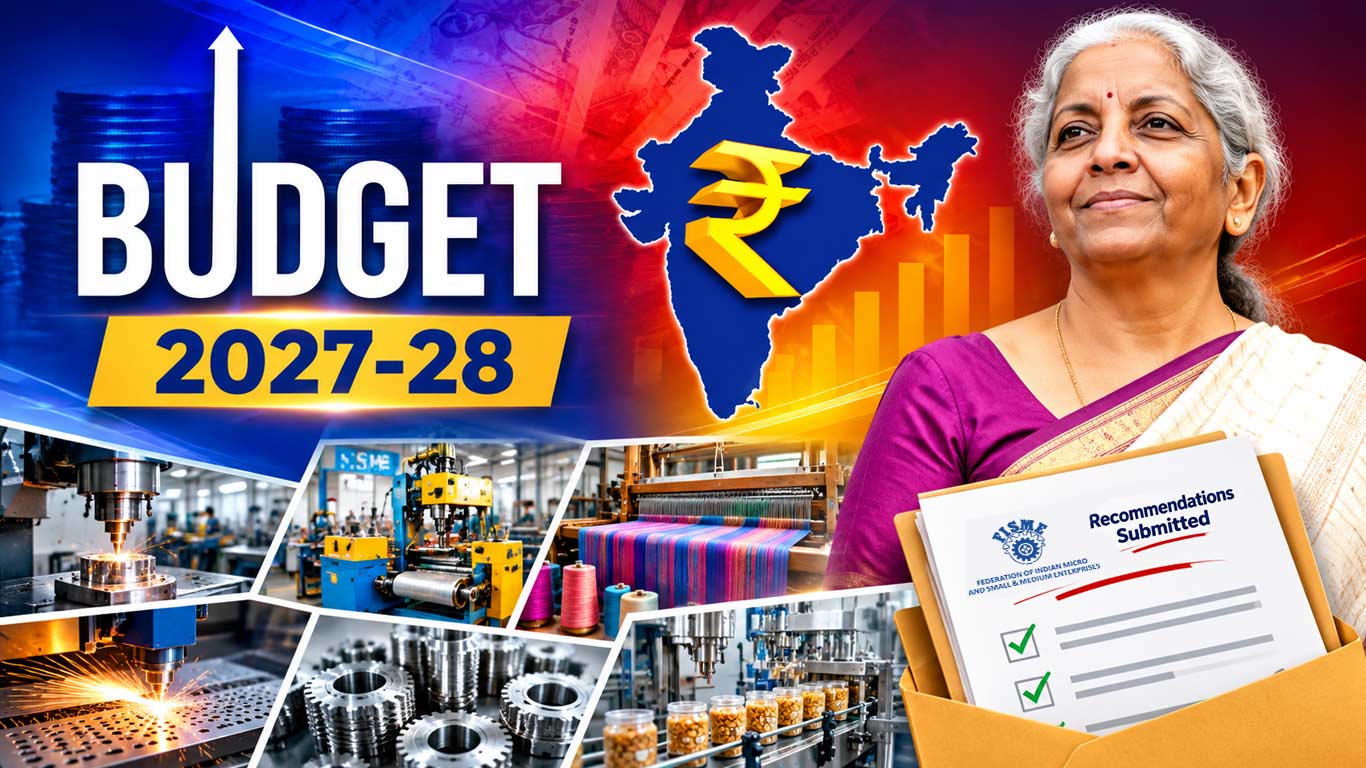
FISME Submits Budget 2027-28 Recommendations to FM; Proposes National Enterprise Graduation Mission to Help MSMEs Formalise, Scale Up
Updated: Nov 17, 2026 04:48:42pm

FISME Submits Budget 2027-28 Recommendations to FM; Proposes National Enterprise Graduation Mission to Help MSMEs Formalise, Scale Up
New Delhi, Nov 17 (KNN) The Federation of Indian Micro and Small & Medium Enterprises (FISME) has proposed a National Enterprise Graduation Mission in its pre-Budget submission for 2027–28 to help informal businesses formalise and enable existing micro, small and medium enterprises (MSMEs) to expand and achieve scale.
In its submission to Finance Minister Nirmala Sitharaman, FISME said India had nearly 10 crore enterprises registered on the Udyam portal but continued to face the challenge of insufficient enterprise graduation.
It attributed informality to the lack of legally recognised workplaces, fragmented permissions, high compliance costs and limited access to finance, while formal MSMEs faced regulatory thresholds, inadequate risk capital, expensive industrial space and taxation barriers to expansion.
The proposed mission would have two tracks — 'Informal to Formal' and 'Formal to Scale' — jointly anchored by the Ministries of Finance and MSME, with States, urban local bodies, Small Industries Development Bank of India (SIDBI), Credit Guarantee Fund Trust for Micro and Small Enterprises (CGTMSE) and financial institutions as partners.
Formalisation and Employment
Under the first track, FISME proposed a Right to Enterprise Urban Reform Programme to permit specified low-risk businesses from residential and mixed-use premises, simplify regularisation of existing shops and workshops, and retain residential property tax rates for eligible home-based enterprises.
It also sought a five-year risk-based Enterprise Graduation Compliance Window, unified registration and compliance systems, and an opt-in Enterprise Pass linked to Udyam or Udyam Assist to provide access to municipal permissions, finance, social protection, skilling and government procurement.
On employment, FISME recommended making employee-side Provident Fund (PF) contributions voluntary while retaining mandatory employer contributions. It also proposed raising the Employees' State Insurance (ESI) applicability threshold from 10 to 20 workers. Units below 20 workers could receive health coverage through the Pradhan Mantri Swasthya Suraksha Yojana (PMSSY), while larger units could choose between ESI and private medical insurance.
FISME estimated these PF and ESI changes could bring 1–2 crore employees into formal employment within a year.
Credit and Expansion Support
To improve collateral-free lending, FISME proposed a CGTMSE Enterprise Guarantee Passport enabling MSMEs to obtain preliminary guarantee-eligibility assessments through a common digital platform and approach multiple banks and NBFCs for loans, with final lending decisions resting with financial institutions.
It also proposed an MSME Growth and Graduation Mission led by the Ministry of MSME and SIDBI to connect selected growth-oriented enterprises with technology, equity and quasi-equity finance, professional management, export support and SME exchange readiness.
While welcoming the Rs 10,000 crore SME Growth Fund, FISME suggested using part of its resources to revive viable stressed MSMEs, including those approaching SMA-2 or NPA classification, against credible revival plans.
For industrial expansion, it proposed a National MSME Expansion Space Programme to develop ready-built factories of 500–5,000 square metres in industrial clusters, offering common infrastructure and long-term leasing or lease-to-own options.
Tax and Export Finance Reforms
FISME sought a three-year transition period for enterprises crossing Micro-to-Small and Small-to-Medium thresholds, with new procedural obligations phased in and specified scheme benefits tapered rather than withdrawn immediately.
It also proposed an Enterprise Graduation Account allowing qualifying MSMEs to defer capital gains tax for 24–36 months on the sale of productive assets, provided proceeds are reinvested in factories, machinery, technology, automation or acquisitions of other productive MSMEs.
Further, it sought tax neutrality for genuine business restructuring, including conversion of proprietorships and partnerships into companies and companies into LLPs, and targeted dividend tax relief for qualifying unlisted entrepreneurial companies to address taxation at both corporate and shareholder levels.
For exporters, FISME proposed a TReDS-like Export Order and Receivables Financing Platform to enable financing against confirmed export orders, irrevocable letters of credit and accepted export receivables, integrating buyer verification, customs and shipping data, ECGC insurance and foreign-exchange compliance.
It also called for a time-bound MSME Threshold Audit by the Finance Ministry to identify compliance-cost barriers arising from turnover, investment and employment thresholds and replace unjustified regulatory cliffs with tapered obligations and transition periods.
Relief for Pending ECLGS 5.0 Applications
FISME further sought additional guarantee allocation under ECLGS 5.0 to clear eligible applications submitted before the scheme's closure but left unprocessed or without guarantee coverage due to exhaustion of funds.
It said some applicants had received loan sanctions but were awaiting guarantee coverage or disbursement, and proposed a one-time clearance window backed by additional budgetary provision.
FISME said MSME policy should be measured not merely by registrations and scheme enrolments but by the number of enterprises moving from informal to formal operations and graduating from micro to small, medium and globally competitive businesses.
(KNN Bureau)






 Loading...