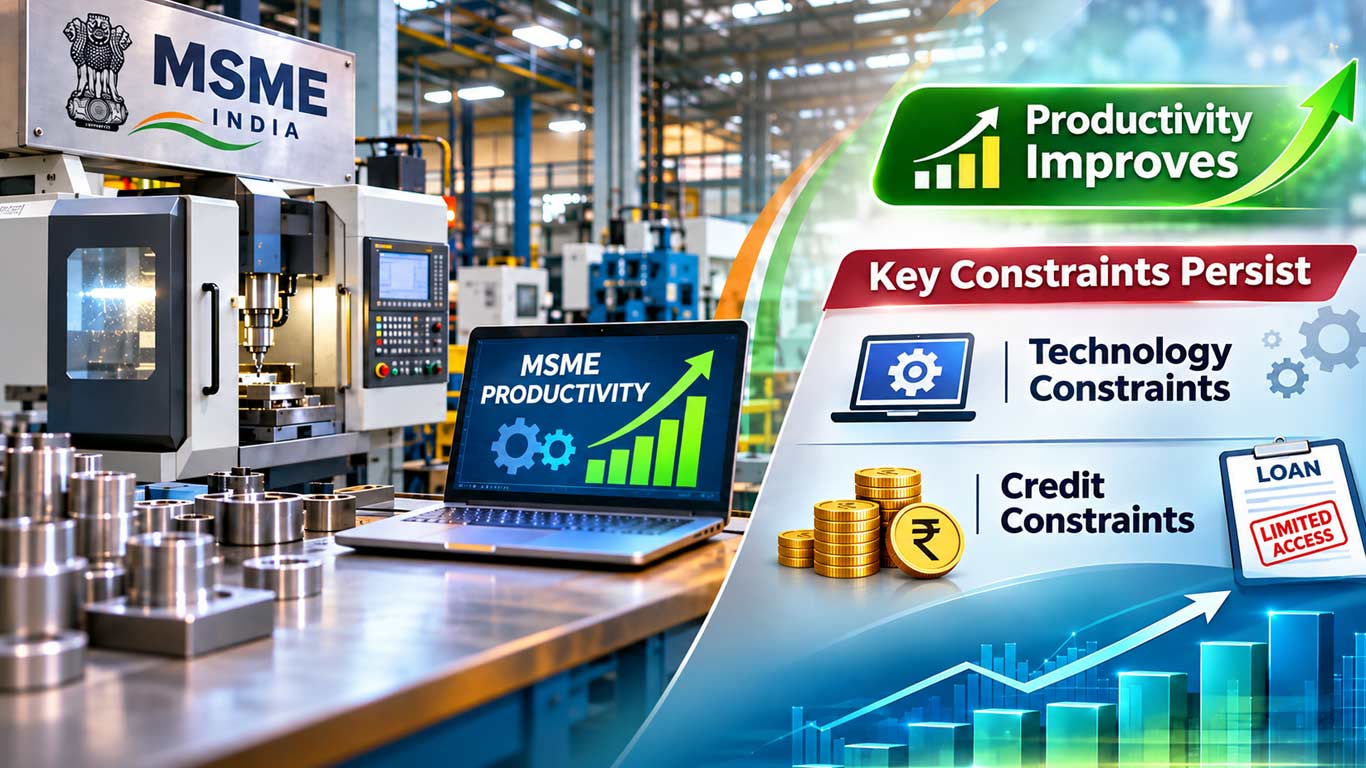
India's MSME Productivity Improves, but Technology and Credit Constraints Persist: ASUSE 2025
Updated: Nov 28, 2026 12:36:11pm

India's MSME Productivity Improves, but Technology and Credit Constraints Persist: ASUSE 2025
New Delhi, Nov 28 (KNN) New data from four rounds of the Annual Survey of Unincorporated Sector Enterprises (ASUSE), covering 2021-22 to 2025, has provided a broader picture of India's MSME sector, including businesses not registered on government portals.
MSMEs contribute 31.1 per cent to GDP, account for 48.58 per cent of exports and generate 43.28 crore employment opportunities, as mentioned by The Economic Times.
The latest survey covers around 10.24 crore enterprises and shows narrowing regional productivity gaps, with manufacturing recording the strongest gains. However, technology, credit, skills and workspace constraints continue to limit growth.
Productivity and Regional Gaps
ASUSE 2025 shows that trade recorded the highest output per worker at Rs 1.92 lakh, followed by services at Rs 1.70 lakh and manufacturing at Rs 1.31 lakh.
Within services, financial services recorded Rs 3.63 lakh per worker and research and development Rs 3.39 lakh, compared with Rs 1.19 lakh in personal services.
Delhi, Haryana and Telangana ranked among the states with the highest productivity, while Odisha and West Bengal showed signs of catching up.
Between 2021-22 and 2025, interstate productivity gaps narrowed by 42 per cent in services, 27.5 per cent in manufacturing and 21.9 per cent in trade. The share of the top three states in total MSMEs and gross value added (GVA) also declined to 31 per cent.
Labour productivity increased across all three sectors, with manufacturing recording the largest proportional gains. However, rural-urban disparities persist, with several regions continuing to lag behind urban centres such as Chandigarh and Delhi.
Technology and Credit Constraints
Econometric analysis of ASUSE 2025 found that a 1 per cent increase in enterprise turnover was associated with a 0.52 per cent rise in productivity. Technology constraints reduced productivity by 8.4 per cent, while credit constraints were associated with a 6.5 per cent decline.
Moving from home-based operations to fixed commercial premises was associated with a 2.2 per cent increase in worker productivity.
The survey also found that reported business constraints declined between 2021 and 2025, alongside improvements in ease of doing business and reduced compliance burdens.
Nearly 40 per cent of MSME manufacturing GVA is concentrated in five traditional activities: food, apparel, machinery and equipment, chemicals, and textiles.
Higher productivity, however, is driven by capital- and technology-intensive segments such as energy, petroleum products, pharmaceuticals and electronics.
Government initiatives to improve productivity include the ZED Certification, Innovative Scheme, Micro and Small Enterprises Cluster Development Programme (MSE-CDP) and expanded Credit Guarantee Scheme. Regional support measures include PMEGP, preferential subsidies and the UNNATI scheme for the Northeast.
CMIE Prowess IQ data also show that the share of MSMEs in the firm sample increased from 24.06 per cent in 2015 to 40.43 per cent in 2022. Their transition rates to higher enterprise categories improved, while the average time taken for upward transition declined.
The findings highlight four priorities: strengthening shared technology infrastructure through Common Facility Centres and testing laboratories, providing dedicated credit support for machinery modernisation, expanding plug-and-play industrial workspaces with reliable power, and aligning skilling programmes with industry needs, particularly technical skills in manufacturing and digital capabilities in services.
(KNN Bureau)









 Loading...