Need to promote growth, build capacity of SMEs to compete with established firms: National Capital Goods Policy
Updated: Feb 16, 2016 09:37:37am

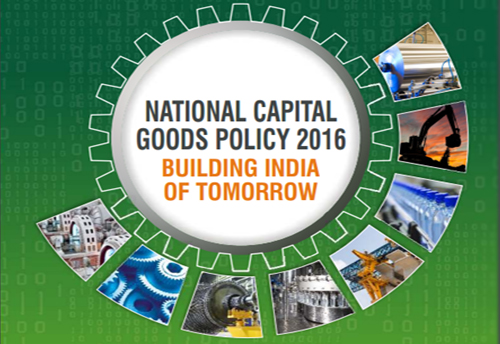
New Delhi, Feb 16 (KNN) There is a need to promote growth and build capacity of SMEs to compete with established domestic and international firms and become national and global champions of capital goods in the future, according to the National Capital Goods Policy 2016, which was unveiled today.
SMEs still face challenges in developing new products and processes due to their smaller scale and inadequate institutional mechanisms, limited access to capital and low awareness and compliance with international standards, the Policy document highlighted.
On issues affecting cost competitiveness, the Policy highlighted that Indian manufacturers are still challenged with respect to cost competitiveness compared to their global peers due to a skewed and state-wise variation in tax and duty structure, prevalence of inverted duty structure for several products and high infrastructure and logistics cost.
The policy envisages increasing production of capital goods from Rs. 230,000 Cr in 2014-15 to Rs. 750,000 Cr in 2025 and raising direct and indirect employment from the current 8.4 million to ~30 million.
It envisages increasing exports from the current 27% to 40% of production while increasing share of domestic production in India's demand from 60% to 80%, thus making India a net exporter of capital goods.
The policy also aims to facilitate improvement in technology depth across sub-sectors, increase skill availability, ensure mandatory standards and promote growth and capacity building of MSMEs.
For the MSME sector, the policy proposes providing schemes for enhancing competitiveness through a cluster approach, especially for CG manufacturing SMEs.
“Thrust to be on critical components of competitiveness such as Quality management, Plant maintenance management, Energy management, Cost management, Human Resource management and prevention of corrosion with the Government support to the extent of 80% of the cost,” said the Policy.
It also proposes to modernize the existing CG manufacturing units, especially SMEs by replacing the modern, computer controlled and energy efficient machineries across capital goods sub-sectors.
“There is need to create a scheme based on capital subsidy to promote the manufacturing of quality products,” it said.
Further, it proposes a robust mechanism for reporting data of production, export and import for all capital goods sub-sectors with minimal time lag to facilitate continuous monitoring of policy effectiveness and timely actions is proposed.
The capital goods market is fragmented with majority of operational units in the Small and Medium Enterprise (SME) sector, beyond few large players. These cater to small segments of a sub-sector, often serving domestic demand only and are significantly challenged vis-à-vis large foreign competitors due to low operating scale.
On issues related to the sub-scale units, the policy highlighted, “The small operating scale of MSMEs inhibits capacities to acquire technology or develop new products and processes and the units get caught in a self-feeding and vicious cycle. Further, there is an absence of institutional mechanisms in public/ private sector to support MSMEs in product/ process development.”
Apart from having limited ability of MSMEs to develop new products & processes, the policy said that the other issues are low awareness of standards and inadequate access to capital.
Pointing out the specific issues being faced by the sub-sectors of the SMEs, the policy said, “High cost of inputs make Indian machines costly to users, especially SMEs.”
The price of machine tools is high due to higher input costs and local factors such as Excise Duty, VAT, and Entry Tax/Octroi, service tax etc. Some financial measures to reduce price to end users will help spur demand and enable more SMEs to adopt the latest CNC machines.
The policy highlights that there is a need to move Infrastructure for promoting SMEs, Research & Development Centre and Testing Labs for Printing and Packaging Sector.
On Policy actions for issues common across the sector, the policy called for a need to extend financial support to SMEs for participation in international delegations, routed via industry associations. It also pointed that there is need to provide wider banking options beyond SIDBI and EXIM, for capital goods manufacturers, especially SMEs.
One of the key recommendations made in the policy is to provide schemess for enhancing competitiveness of Indian Capital Goods industry through a cluster approach, especially for SMEs.
“Thrust to be on critical components of competitiveness such as Quality management, Energy management, Cost management, Human Resource management and prevention of corrosion. DHI will support 80% of the total fee of such cluster projects with the balance cost borne by the SMEs,” it recommended. (KNN Bureau)







 Loading...