Rajasthan’s MSME Potential Held Back By Implementation Gaps, Finance And Talent Shortages
Updated: Sep 08, 2026 12:16:00pm

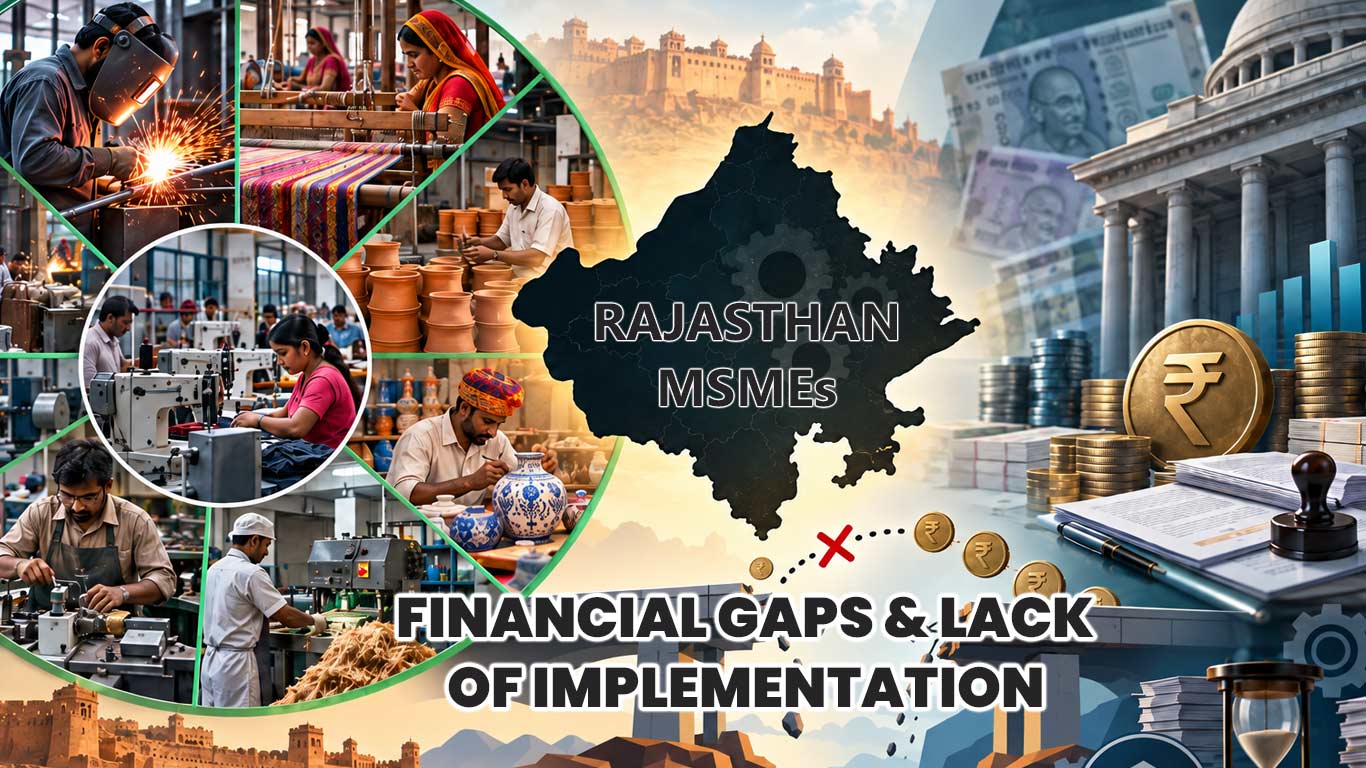
Rajasthan’s MSME Potential Held Back By Implementation Gaps, Finance And Talent Shortages
Jaipur, Sept 8 (KNN) Rajasthan’s strategic location along the DMIC and DFC, strong logistics infrastructure and extensive policy support offer significant industrial opportunities.
However, implementation gaps, limited finance, weak institutional coordination and skilled talent shortages continue to constrain MSME growth.
The state has 18 sector-specific policies and has performed strongly on national logistics parameters, but P.R. Sharma, Director, GTPC and former Joint Director, Industries & Commerce, said effective implementation remains a key challenge, reported Economic Times.
DMIC, DFC Potential Remains Underutilised
Rajasthan has a major infrastructure advantage, with around 39 percent of the DMIC and nearly 40 percent of the DFC passing through the state. Sharma said DFC junctions could have been developed as industrial and investment hubs to create manufacturing and logistics clusters.
Despite its potential to attract manufacturing, logistics and export-oriented businesses, Rajasthan has yet to fully leverage this infrastructure. He also called for better inter-departmental coordination to help businesses access benefits under various schemes and policies.
Export Ecosystem Needs Stronger Support
Rajasthan’s exports have doubled in three years, but stakeholders called for stronger institutional support and field-level outreach to further boost the state’s export contribution.
The government has doubled the export policy grant for technological upgradation to improve competitiveness and technology adoption. Sharma also urged greater assessment of the grassroots impact of programmes such as RAMP.
Land, Credit Remain Key MSME Constraints
Despite land-allotment reforms, Rajasthan’s MSMEs continue to face gaps in accessing industrial land, with Sharma calling for more efficient direct and RIICO allotments, particularly for smaller firms.
Credit access remains another major challenge, especially for exporters, requiring stronger bank-industry engagement at the block, district and state levels.
While the state offers interest subvention of 5-7 percent, and up to 8 percent under some schemes, implementation gaps often prevent MSMEs from fully benefiting.
MSME Registrations Decline, Employment Rises
The state’s latest MSME registration data presents a mixed picture. Registrations on the Udyam Registration Portal (URP) and Udyam Assist Platform (UAP) declined 16 percent to 1.04 million in 2025-26, from 1.25 million in 2024-25. The state had recorded 1.13 million registrations in 2023-24.
At the same time, employment reported by registered MSMEs increased to 5.22 million in 2025-26, from 4.45 million in 2024-25.
Traditional Industries Face Global Pressures
Rajasthan’s traditional industries face labour shortages, rising input costs, geopolitical uncertainty and weaker global demand. Mahavir Pratap Sharma, Founder and CEO of Oscar Exports, said the carpet and handicrafts sector is losing skilled workers and facing higher imported wool costs.
With the US accounting for around 60 percent of the market, exporters remain vulnerable to weaker American demand, particularly in luxury goods, prompting some to shift to lower-cost products and compromise on raw-material quality.
Sharma called for a dedicated carpet textile park with common infrastructure, affordable worker housing, and greater support for wool production and sheep breeding in Bikaner to strengthen the raw-material base and create rural jobs.
Jaipur’s Startup Ecosystem Gains Momentum
While traditional industries face structural pressures, Jaipur is emerging as a startup hub, with businesses shifting from traditional trading to formal companies and new-age ventures, said Astha Katta Sirohiya, Co-Founder, Shyle.
The city’s manufacturing and craftsmanship ecosystem remains a key strength in apparel, jewellery, printing, gemstones and handicrafts. However, limited technology talent pushes startups to recruit from or establish offices in larger hubs such as Bengaluru and Gurgaon.
Higher Education Key To Talent Development
A stronger higher-education ecosystem could help address Jaipur’s technology talent gap, said Sirohiya, highlighting government-backed incubation initiatives at institutions such as JECRC University.
She called for more leading institutions, including IIT- and IIM-level institutes, to deepen the talent pool, expand opportunities for students and businesses, and strengthen Jaipur’s startup and industrial ecosystem.
(KNN Bureau)









 Loading...


