Deregulation, GST, Labour Reforms To Strengthen India’s Business Environment: Goyal
Updated: Aug 05, 2026 01:24:06pm

Deregulation, GST, Labour Reforms To Strengthen India’s Business Environment: Goyal
New Delhi, Aug 5 (KNN) The government has undertaken a series of reforms to improve the ease of doing business, reduce regulatory compliance and strengthen India’s export ecosystem, Commerce and Industry Minister Piyush Goyal said in the Lok Sabha.
Government Pushes Deregulation To Improve Ease Of Doing Business
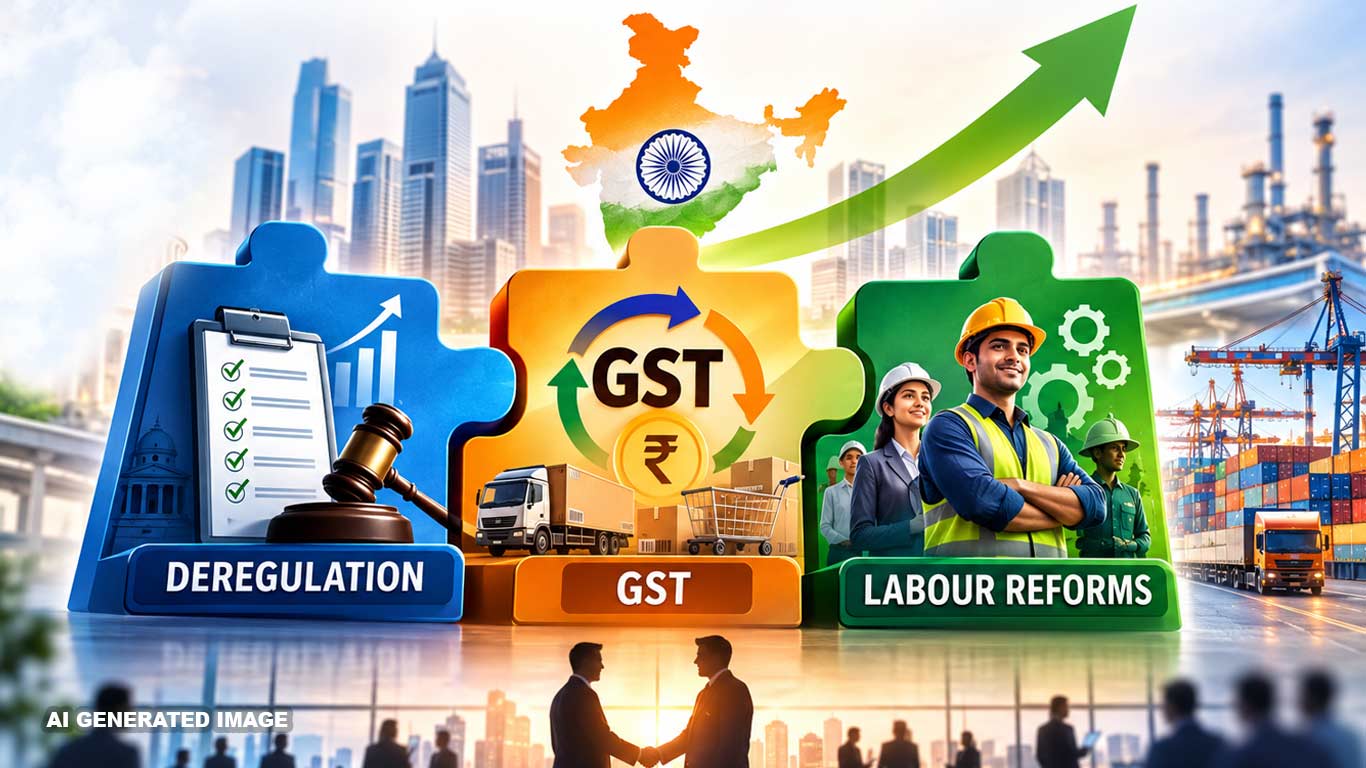
The measures include simplified tax laws, four Labour Codes, PLI schemes, commercial courts and reduced regulatory compliance. A Task Force on Deregulation and Compliance Burden is working with states and UTs on reforms in land use, construction, labour and utilities.
The HLC-NFRR is reviewing central regulations and permissions to create a more flexible, trust-based regulatory framework.
GST, Labour Code Reforms Aim To Cut Compliance Costs
The government said 2025 GST reforms simplified the indirect tax structure, rationalised rates and reduced compliance and transaction costs. The four Labour Codes consolidate 29 central laws and provide single registration, licence and return, with electronic record-keeping.
DPIIT has expanded BRAP and introduced District BRAP to promote digital approvals, time-bound inspections, transparent land administration and investment-ready industrial parks.
Under the Reducing Compliance Burden initiative, multiple regulatory requirements have been simplified or removed.
The Jan Vishwas (Amendment of Provisions) Act, 2023 decriminalised 183 provisions across 42 Acts, while the 2026 legislation amended 784 provisions across 79 Central Acts, including decriminalisation of 717 provisions.
India’s Exports Reach USD 863 Billion In FY26
India’s overall exports of merchandise and services stood at USD 863.05 billion in FY 2025-26, while exports grew 11.37 percent year-on-year during April-June 2026, according to data from the Directorate General of Commercial Intelligence and Statistics (DGCI&S).
The government is pursuing a trade strategy focused on expanding market access, diversifying export destinations and products, strengthening global value-chain integration and improving export competitiveness.
Recent trade agreements with the UAE, Australia, the UK, Oman, New Zealand and EFTA countries are expected to widen market access for Indian exporters.
The Rs 25,060-crore Export Promotion Mission (EPM) for FY26-FY31 focuses on trade finance, credit enhancement, quality compliance, logistics, warehousing, e-commerce and district-level export promotion.
Export Credit Support Strengthened For MSMEs
The government has strengthened export credit support through ECGC, EXIM Bank, SIDBI, CBIC and India Post.
ECGC raised bank insurance cover from 70 percent to 90 percent for eligible export loans up to Rs 80 crore and introduced collateral-free cover for MSEs with working capital limits up to Rs 10 crore.
DGFT is promoting e-commerce exports through partnerships with logistics and e-commerce platforms, while Trade Connect provides exporters with market and trade information through a single window.
State and District Export Promotion Committees, backed by District Export Action Plans, identify export potential and address supply-chain bottlenecks.
65 Export Facilitation Centres Established For MSMEs
The Ministry of MSME has set up 65 Export Facilitation Centres to provide exporters with mentoring, documentation support, compliance guidance and scheme information.
The International Cooperation Scheme supports MSMEs in global exhibitions, trade fairs and buyer-seller meets, while District Export Promotion Committees are integrating FPOs, SHGs, artisan clusters and MSMEs into export value chains.
(KNN Bureau)







 Loading...