DGFT Notifies Framework For Inventory-Based E-Commerce Exports
Updated: Aug 06, 2026 04:08:24pm

DGFT Notifies Framework For Inventory-Based E-Commerce Exports
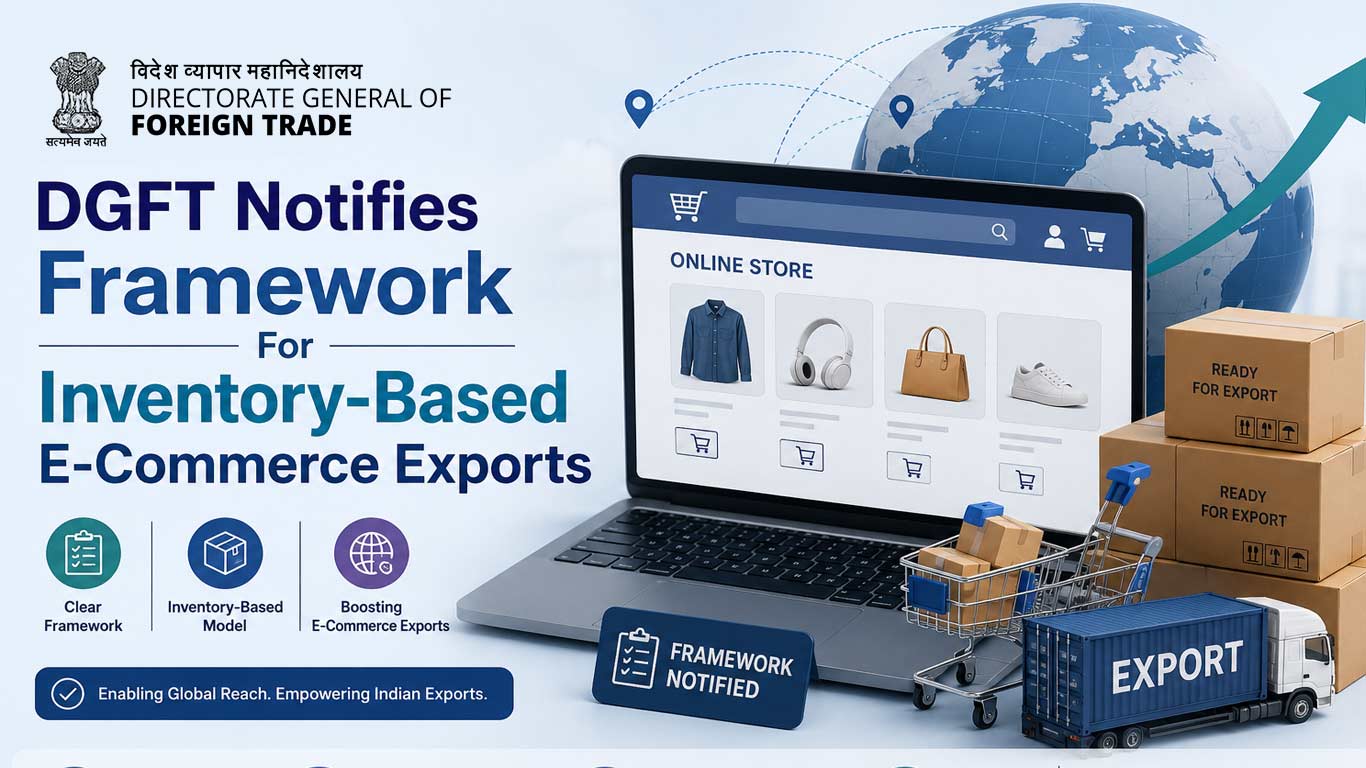
New Delhi, Aug 6 (KNN) The government has notified a framework allowing foreign-owned e-commerce companies such as Amazon and Walmart-owned Flipkart to export India-made products through inventory-based retail e-commerce entities, subject to the establishment of separate legal entities in the country.
Government Notifies Framework For Inventory-Based E-Commerce Exports
The Directorate General of Foreign Trade (DGFT) issued the notification following the Department for Promotion of Industry and Internal Trade's (DPIIT) Press Note 3 of 2026, which permits 100 per cent foreign direct investment (FDI) in inventory-based retail e-commerce entities for the export of domestically manufactured goods.
Under the framework, e-commerce companies must establish a separate legal entity and register it with the DGFT as an Exporter-on-Record (EOR) with an Importer-Exporter Code (IEC) and Goods and Services Tax (GST) registration.
Domestic suppliers, designated as Sellers-on-Record (SORs), must also have GST registration and can supply only goods of Indian origin, reported Business Standard.
Exports Allowed Only Against Confirmed Orders
The notification stipulates that inventory-based e-commerce exporters can procure goods only against confirmed export orders and cannot build inventory based on anticipated demand.
Export inventory must be stored separately and digitally linked to the domestic seller, overseas customer order and export documentation to ensure traceability.
The EOR will be eligible to claim applicable export benefits, excluding those under the Advance Authorisation and Export Promotion Capital Goods (EPCG) schemes, while GST refunds will also be retained by the EOR.
Returned Goods Cannot Be Sold Domestically
The framework further requires the EOR to manage all reverse logistics for returned or rejected consignments. Such goods cannot be sold or supplied in the domestic market under any circumstances, either directly or through another entity.
The notification also mandates maintenance of procurement, inventory and export records and allows exporters to utilise notified E-Commerce Export Hubs (ECEHs) to facilitate cross-border e-commerce operations.
Industry Sees Boost For MSME Exports
Welcoming the move, Amazon said the policy provides clarity on inventory-based e-commerce exports and supports its target of enabling USD 80 billion in cumulative exports from India by 2030.
Trade experts said the framework could strengthen India's export ecosystem by enabling more MSMEs and manufacturers to access overseas markets through large e-commerce platforms.
Experts Compare Framework To Export House Model
Ajay Srivastava, Founder of the Global Trade Research Initiative (GTRI), said the framework resembles the existing export house model under which smaller firms supply products to export houses for overseas sales.
Spencer Cohen, Principal and Founder, High Peak Strategy LLC, said the policy could help Indian MSMEs overcome the costs and complexities of entering international markets by leveraging the logistics, payments and market access capabilities of global e-commerce platforms.
He said the reform has the potential to broaden India's exporter base and strengthen exports of ‘Made in India’ products by connecting manufacturing clusters with global consumers.
(KNN Bureau)






 Loading...