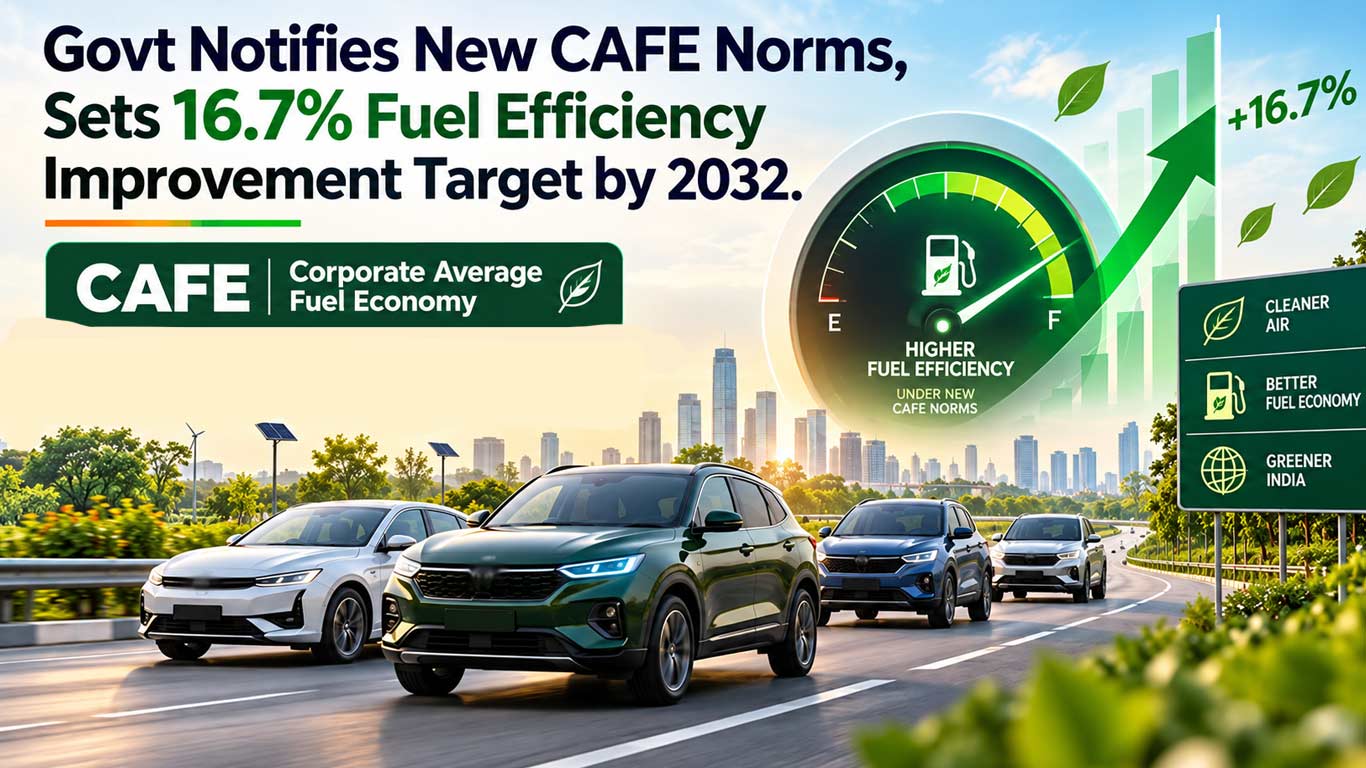
Govt Notifies New CAFE Norms, Sets 16.7% Fuel Efficiency Improvement Target by 2032
Updated: Sep 30, 2026 02:15:41pm

Govt Notifies New CAFE Norms, Sets 16.7% Fuel Efficiency Improvement Target by 2032
New Delhi, Sep 30 (KNN) The Ministry of Power has notified new Corporate Average Fuel Economy (CAFE) norms for passenger vehicles, which will come into effect from April 1, 2027 and remain applicable until March 31, 2032.
The norms will apply to new passenger vehicles manufactured or imported for sale in India and are aimed at progressively improving fleet-level fuel efficiency while giving automakers flexibility to adopt cleaner technologies and alternative fuels.
Fuel Efficiency Target To Tighten By 16.7 per cent
Under the new framework, the fuel-consumption benchmark will be tightened progressively each year, from 3.996 litres per 100 km in 2027-28 to 3.3273 litres per 100 km in 2031-32, representing an improvement of around 16.7 per cent over the five-year period.
The revised target line has also been flattened to adopt a more weight-sensitive approach, with relatively less stringent targets for lighter vehicles and higher efficiency requirements for heavier vehicles.
The reference vehicle weight has been increased from 1,082 kg under the existing norms to 1,229 kg, a rise of around 13.6 per cent.
Greater Flexibility For Automakers
The new framework expands the technology pathways available to manufacturers. It recognises renewable and low-carbon fuels, including ethanol-blended petrol, biofuels and compressed biogas (CBG), through a Carbon Neutrality Factor (CNF).
The number of recognised fuel-conservation technologies has also increased from four to 12. Manufacturers can receive a concession of 1 g CO₂/km for each eligible technology, subject to a maximum concession of 9 g CO₂/km.
Battery electric vehicles (BEVs), range-extended electric vehicles (REEVs), plug-in hybrids (PHEVs), strong hybrids (SHEVs) and flex-fuel vehicles will receive volume derogation factors, or “super credits”, in fleet-average calculations.
The framework also allows manufacturers to meet obligations through specified two- or three-year compliance blocks. Manufacturers exceeding their targets can generate credits, while eligible manufacturers with compliance gaps can use carry-forward provisions, exchange or trade credits, or purchase credits through the Bureau of Energy Efficiency's buyout mechanism.
Focus On Technology And Energy Security
The government said the framework is intended to support India's energy security and reduce fuel consumption as vehicle electrification and alternative fuels expand.
Technologies such as solar-reflective paints, advanced glazing and high-efficiency air-conditioning systems have also been recognised as potential avenues for improving vehicle efficiency.
The ministry said the new norms were finalised after consultations with automobile manufacturers, industry associations, academia and other stakeholders. The framework is intended to provide regulatory certainty while remaining technology-neutral.
(KNN Bureau)







 Loading...