India Makes Strong Progress In EV Manufacturing Localisation: IEEFA-JMK Report
Updated: Jun 23, 2026 03:04:18pm

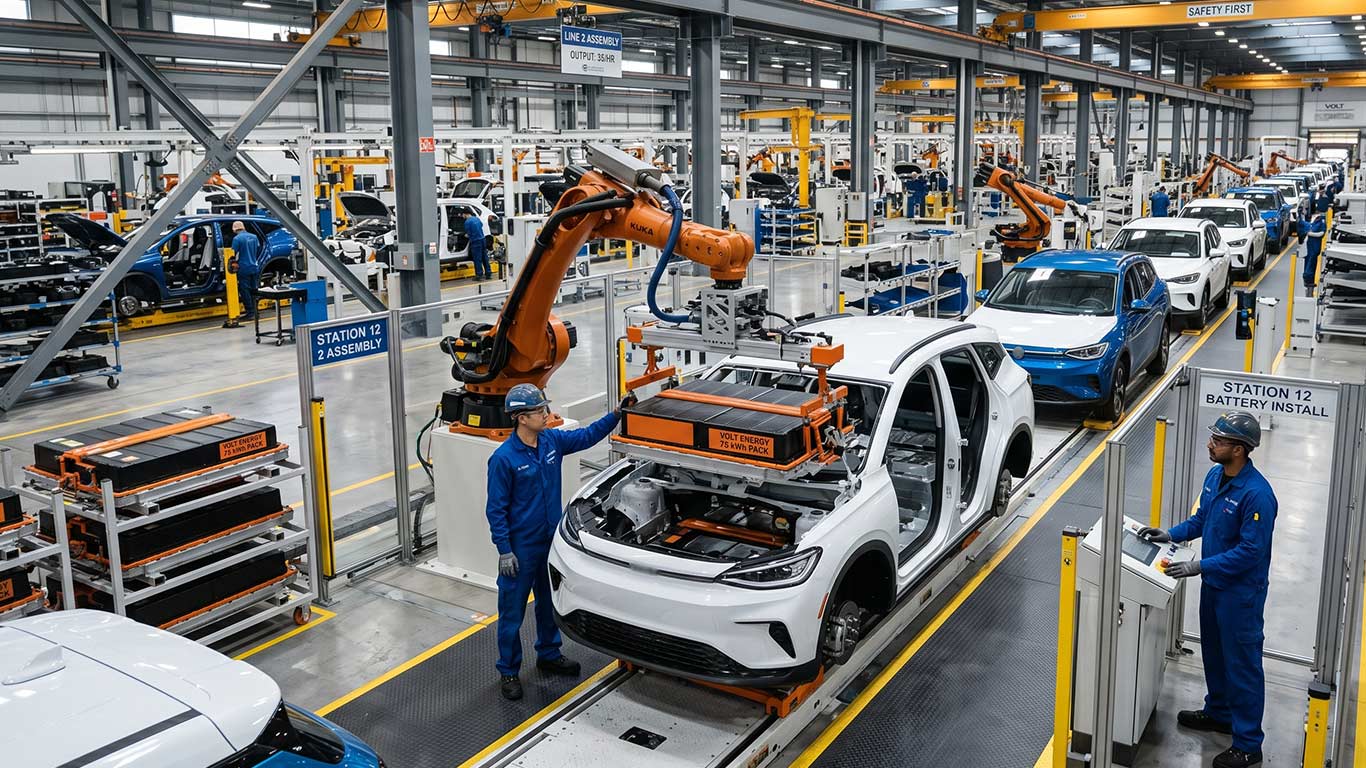
India Makes Strong Progress In EV Manufacturing Localisation: IEEFA-JMK Report
New Delhi, Jun 23 (KNN) India has made notable progress in localising electric vehicle (EV) manufacturing and could achieve 90–100 percent localisation in several high-value non-battery component segments by 2030, according to a new report by the Institute for Energy Economics and Financial Analysis (IEEFA) and JMK Research & Analytics.
Key EV Components Still Depend on Imports
The report, ‘Beyond battery packs: Localisation in manufacturing EV components’, said that while India has built strong capabilities in structural and mechanical EV components, localisation remains uneven across the value chain.
Key areas such as traction motors, power electronics, vehicle control units and charging systems still rely heavily on imported parts and raw materials.
It also noted that India’s EV market has expanded rapidly, with annual sales rising nearly 14-fold since FY20, creating strong opportunities for domestic manufacturing.
Strongest Gains in Traditional Auto Segments
The report said localisation has advanced mainly in segments where India already has automotive strengths, such as structural parts, wiring harnesses, suspension systems and braking systems.
However, it noted that higher localisation does not always mean greater domestic value addition, as many locally assembled components still depend on imported semiconductors, rare-earth magnets and other specialised materials.
PLI Scheme Drives Investment Momentum
Around 60 percent of recent EV component manufacturing announcements have come from companies approved under the Production Linked Incentive (PLI) Scheme for Automobile and Auto Components.
Yet, less than 10 percent of the Rs 25,938 crore allocated under the scheme had been disbursed by early 2026, the report said.
Investment Focus Shifts to Powertrain and Charging
Researchers noted that recent investment momentum is increasingly focused on powertrain systems, power electronics and charging infrastructure, segments that have traditionally been import-dependent.
The report said that if announced projects are implemented on time and supplier ecosystems mature, several of these areas could achieve near-complete localisation by 2030. However, semiconductors and rare-earth magnets remain major bottlenecks, with global supply chains concentrated in China and Taiwan.
It added that India’s progress will depend on access to critical materials, cost competitiveness, supplier scale, standardisation and domestic technological capabilities.
Call for Stronger Ecosystem Development
The report called for faster development of semiconductor and rare-earth supply chains, greater involvement of EV startups in localisation programmes, increased standardisation of components and higher investment in domestic R&D.
It added that recent investments reflect growing industry confidence in India’s EV ecosystem, especially in motors, power electronics and charging equipment, which could significantly boost domestic manufacturing capacity over the next five years.
(KNN Bureau)





 Loading...