India’s Import Dependence For Key Solar Components Persists Despite Manufacturing Growth: NITI Aayog
Updated: Aug 19, 2026 03:47:43pm

India’s Import Dependence For Key Solar Components Persists Despite Manufacturing Growth: NITI Aayog
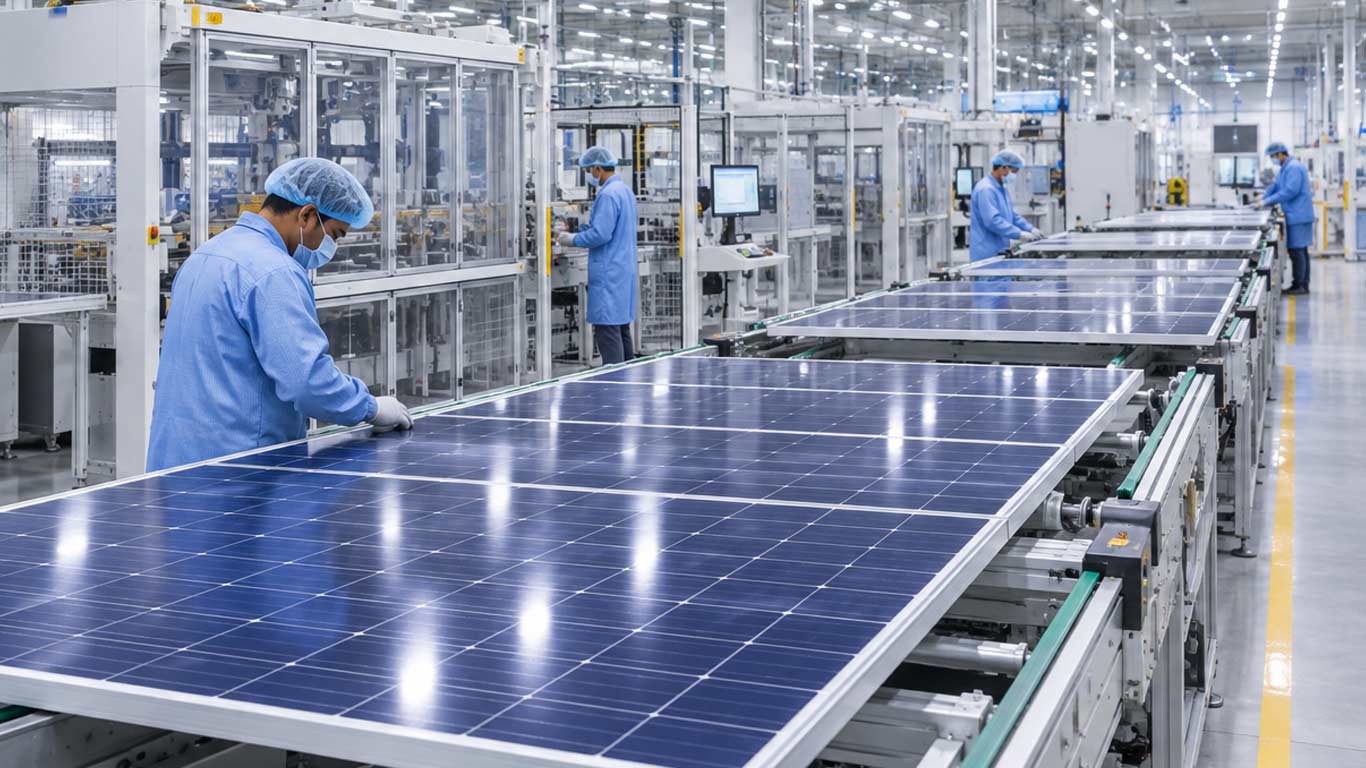
New Delhi, Aug 19 (KNN) India has significantly expanded its photovoltaic (PV) module and cell manufacturing capacity in recent years, but gaps in upstream production continue to leave the industry dependent on imports for key components, according to NITI Aayog.
The report said India’s solar manufacturing industry remains concentrated largely in the cell and module segments, with module manufacturing capacity listed under the Approved List of Models and Manufacturers (ALMM) rising sharply to around 100 GW in August 2025 from about 2.3 GW in 2014, ANI reported.
Despite this expansion, India continues to rely on imports for solar cells and modules, while domestic capacity for manufacturing wafers and polysilicon remains limited.
Dependence on Imports
China accounted for nearly 59 per cent of India’s photovoltaic cell and module imports in 2024, highlighting its dominant position in the global solar manufacturing supply chain. More than 80 per cent of global PV manufacturing capacity was based in China as of December 2024, the report said.
NITI Aayog noted that India has limited presence across the ingot-to-wafer-to-module stages of the value chain, unlike a few global manufacturers that operate across the entire polysilicon-to-module chain.
The report said this gap could expose Indian manufacturers to higher input costs if global polysilicon supplies tighten. Capacity consolidation in China and potential US restrictions on Foreign Entities of Concern could further constrain supply and push up polysilicon prices.
Rising Domestic Demand
India added around 103 GW of solar capacity between FY2015 and FY2025, implying a minimum equivalent demand for solar modules over the period. The country’s installed solar capacity reached around 106 GW in March 2025.
India is expected to add another 174 GW of solar capacity to meet its target of 280 GW by 2030. The expected increase in installations is likely to create sustained demand for solar components and manufacturing capacity.
Need for Backward Integration
The report noted that the current global oversupply and government support measures have provided favourable conditions for Indian manufacturers. However, it said stable market conditions would increasingly benefit companies with integrated value chains.
NITI Aayog stressed that expanding domestic manufacturing beyond cells and modules to include polysilicon, ingots and wafers would be critical to strengthening supply-chain resilience and reducing import dependence.
“Therefore, it will be critical to expand from the polysilicon to cell manufacturing stage in the future,” the report said.
(KNN Bureau)








 Loading...