India’s Space Economy Set to Cross Rs 4 Lakh Cr by 2033, Driven by Commercialisation, Downstream Adoption: EY-CII Report
Updated: Sep 15, 2026 05:15:26pm

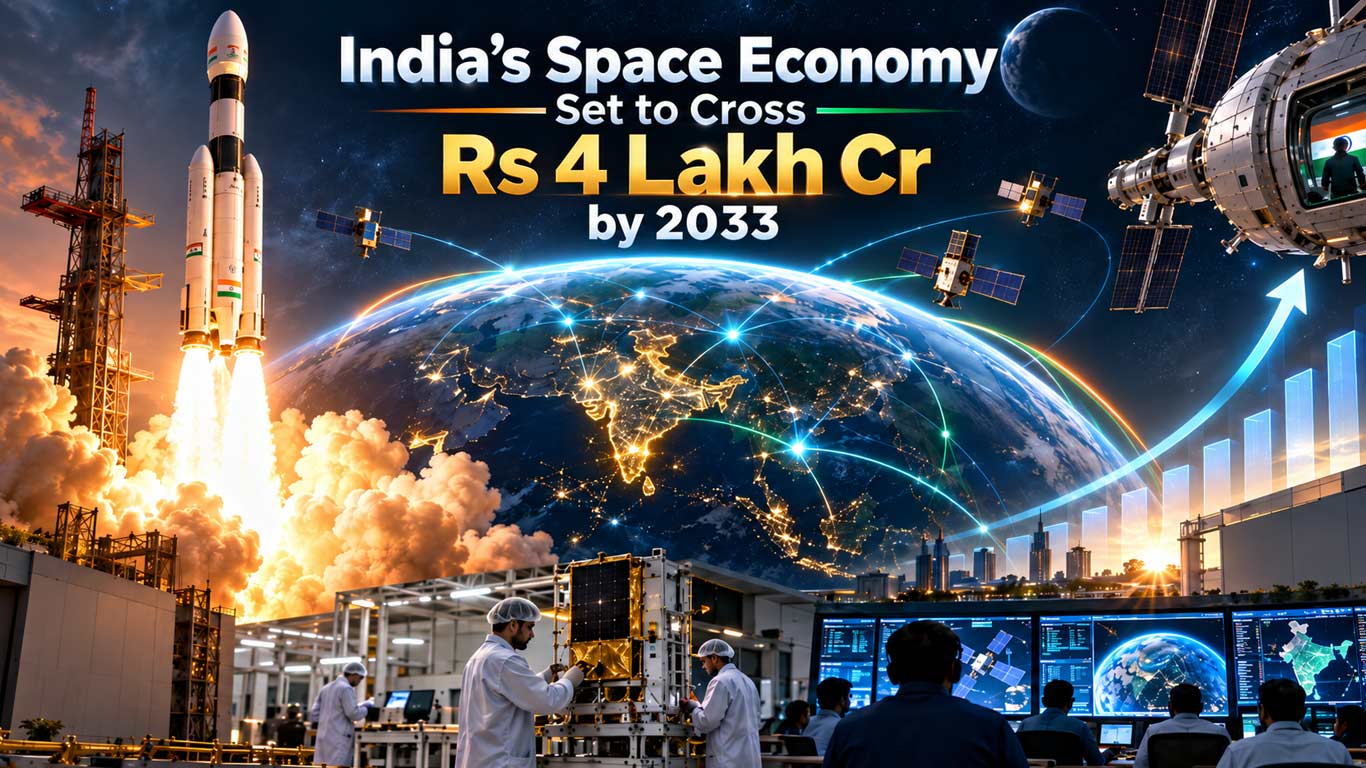
India’s Space Economy Set to Cross Rs 4 Lakh Cr by 2033, Driven by Commercialisation, Downstream Adoption: EY-CII Report
New Delhi, Sep 15 (KNN) India’s space economy is projected to expand more than five-fold to Rs 4.22 lakh crore (USD 44 billion) by 2033 from Rs 0.81 lakh crore (USD 8.4 billion), with commercialisation, private investment and wider adoption of space-enabled applications expected to drive the next phase of growth, according to a joint EY-Confederation of Indian Industry (CII) report.
The report, titled ‘From Escape Velocity to Value: Innovate, Govern and Grow’, said India’s space growth will increasingly depend on converting space capabilities into commercial services, industrial capacity, strategic resilience and economy-wide impact, ANI reported.
200+ Space Applications Identified
The report identified more than 200 use cases across Earth observation, satellite communication and positioning, navigation and timing. These applications span agriculture, logistics, infrastructure, disaster management, urban planning, financial services, fisheries, climate resilience, telecommunications and defence.
It said the biggest economic opportunity lies in moving such solutions beyond pilot projects to programme-level deployment, converting satellite data into decision-grade intelligence, operational tools and sector-specific applications.
Private Capital, Manufacturing Key to Growth
The report highlighted policy reforms, rising private investment, increased startup activity, wider adoption of space-enabled services and growing global demand for cost-effective space solutions as key factors supporting the sector’s expansion.
It also stressed the need to deepen domestic capabilities in satellite manufacturing, propulsion, avionics, sensors, space-grade electronics and testing facilities to strengthen supply chains and support industrial growth.
Streamlined authorisations, timely spectrum access, export facilitation and greater availability of capital would further support innovation and commercialisation, the report added.
Focus Shifts Towards Downstream Adoption
EY India Partner Cdr. Gautam Nanda said, “India's space story is at an exciting inflection point... Over the past few years, we have seen meaningful policy reforms, stronger industry participation and a vibrant startup ecosystem begin to reshape the sector,” as quoted by ANI.
“The next phase of growth will come from translating space capabilities into everyday impact through applications that improve productivity, strengthen resilience and create new business opportunities,” Nanda added.
He emphasised that by boosting downstream adoption, manufacturing and private investment, India can build a globally competitive space economy delivering economic and strategic benefits.
CII National Committee on Space Chairman Mallavarapu Apparao said, “India's space sector is entering a phase where industry participation can play an increasingly important role across manufacturing, launch systems, downstream applications and emerging technologies.”
“With stronger collaboration across industry, startups, research institutions and government, India has the opportunity to build globally competitive capabilities, strengthen its position in international space markets and create new avenues for innovation, investment and high-value employment,” Apparao noted.
Private capital and startup participation will remain central to achieving the projected expansion of India’s space economy, the report said.
(KNN Bureau)










 Loading...