Private Sector Growth Moderates In May; Input Cost Pressures Weigh On Manufacturing
Updated: May 21, 2026 05:26:50pm

Private Sector Growth Moderates In May; Input Cost Pressures Weigh On Manufacturing
New Delhi, May 21 (KNN) India's private sector activity edged lower in May 2026, with growth in new orders, exports, employment, and business output softening slightly, even as the headline index remained comfortably in expansionary territory for the 58th consecutive month, according to the HSBC Flash India Composite Purchasing Managers' Index (PMI), compiled by S&P Global.
The Flash Composite PMI — which tracks combined activity across manufacturing and services — dipped marginally to 58.1 in May from a final reading of 58.2 in April. A reading above 50 denotes expansion, and India's index has stayed above that threshold for nearly five years without interruption.
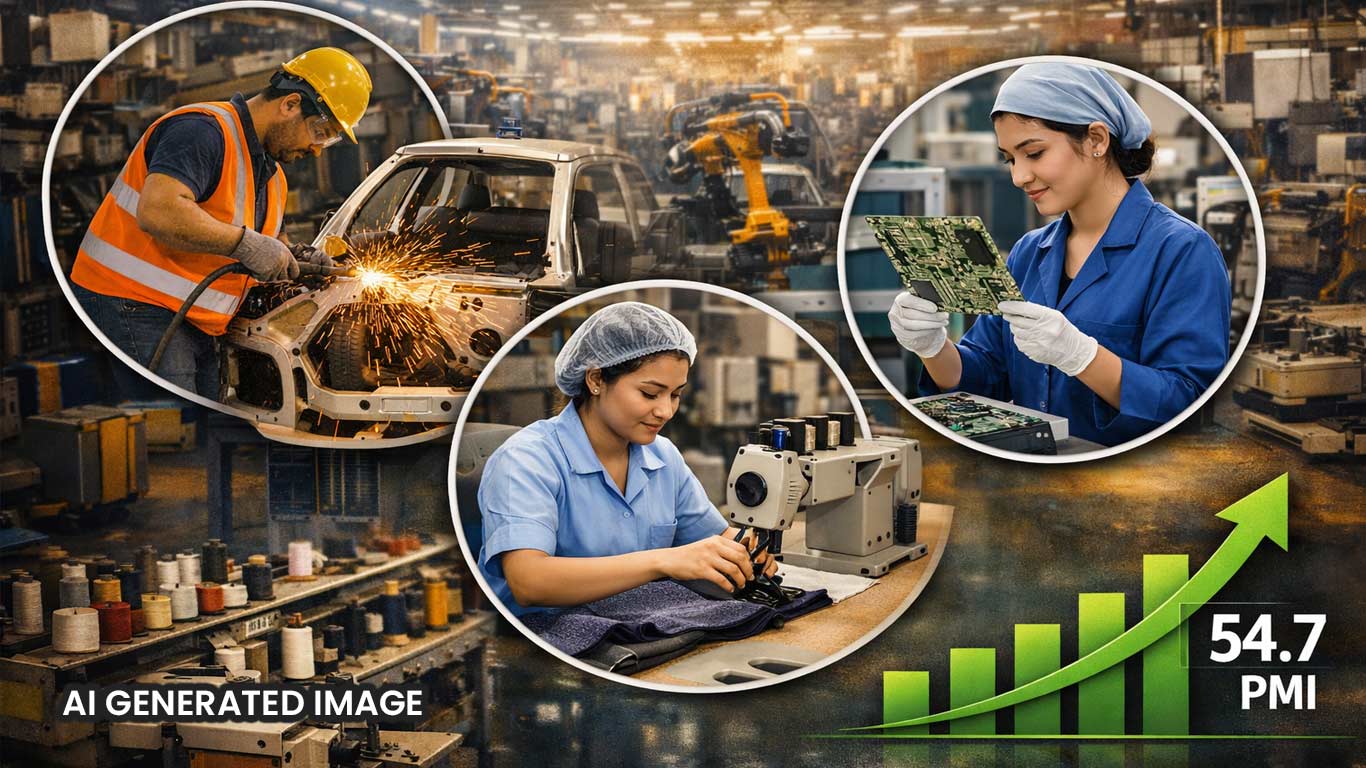
The Flash Manufacturing PMI slipped to 54.3 from 54.7 in April, while the Flash Services PMI Business Activity Index inched up to 58.9 from 58.8, with services firms continuing to outperform their manufacturing counterparts.
Manufacturing Faces Softer Demand
Growth in manufacturing output and new orders moderated in May, with the pace of expansion in new goods orders registering the second-weakest reading in nearly four years.
New export orders for goods producers recorded their second-slowest rise since September 2024. Survey respondents cited competitive pressures, challenging demand conditions, travel disruptions, and the ongoing conflict in the Middle East as factors dampening sales.
At the composite level, growth in new export orders fell to its weakest in 19 months.
Pranjul Bhandari, Chief India Economist, HSBC, said, "Manufacturing activity eased marginally as the rates of expansion in output and new orders moderated, while growth of new export orders softened markedly. Yet, the Manufacturing PMI remained broadly in line with its long-run average, supported by continued inventory building."
Input Cost Pressures Intensify
A more pressing concern emerging from the May survey is the sharp acceleration in input price inflation. Costs rose across a broad range of inputs — including energy, food, fuel, gas, iron, leather, oil, plastics, rubber, steel, and transportation.
The rate of input price inflation at the composite level reached its second-highest level in nearly three years, with manufacturing cost pressures rising at their steepest pace since July 2022.
While companies attempted to pass on higher costs through increased selling prices, they did so cautiously — with output price inflation at its weakest since January and considerably below the pace of input cost increases.
Services Resilient; Hiring Diverges
Services firms continued to show resilience, experiencing softer inflationary pressures relative to manufacturers and hiring additional staff at the strongest pace in nearly a year. In contrast, job creation at goods producers weakened compared to April.
Inventory levels also rose, with finished goods stocks increasing for a second consecutive month and stocks of purchases growing at the fastest rate in three months.
(KNN Bureau)








 Loading...


