Revenue Entries Are Not Proof of Property Ownership or Relinquishment: Supreme Court
Updated: Aug 24, 2026 03:49:47pm

Revenue Entries Are Not Proof of Property Ownership or Relinquishment: Supreme Court
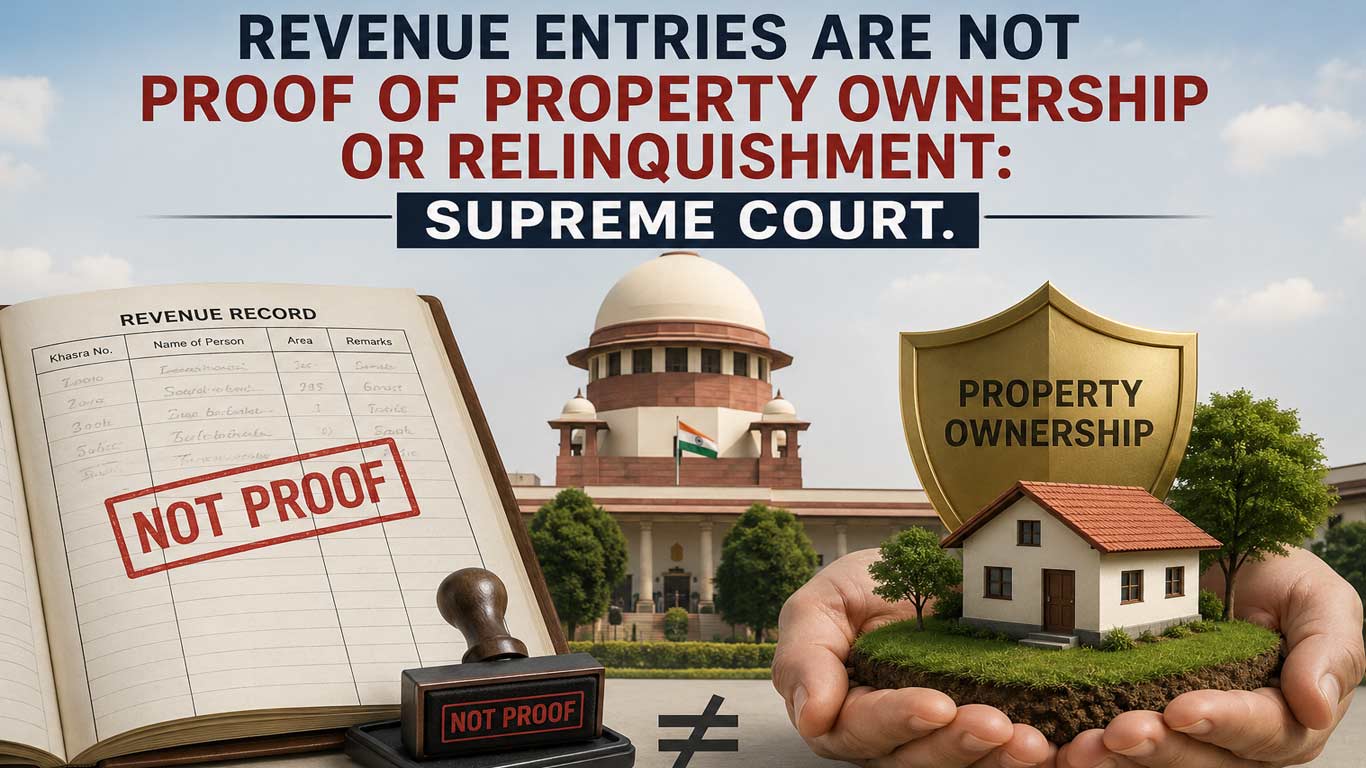
New Delhi, Aug 24 (KNN) The Supreme Court has reiterated that mutation or an entry in revenue records neither creates nor extinguishes ownership of immovable property and cannot, by itself, be used to decide a title dispute.
A bench of Justices Sanjay Karol and Augustine George Masih set aside a Madhya Pradesh High Court order that had relied on revenue records to hold that a co-owner had relinquished his rights in a joint family property.
Background
The case concerned agricultural land originally owned by Bhagwansingh, which devolved on his sons, Ramprasad and Vasudev. The property was initially recorded jointly in their names but was later shown in the names of Vasudev and his son.
Ramprasad’s legal heirs sought a declaration of co-ownership, partition and separate possession. The respondents claimed that Ramprasad had voluntarily relinquished his share through an affidavit, a statement before the Naib Tehsildar and other documents.
Revenue Entry Not Proof of Relinquishment
The trial court and first appellate court ruled in favour of Ramprasad’s heirs, but the Madhya Pradesh High Court reversed the findings. The Supreme Court has now restored the lower courts’ decision.
The bench held that a right in immovable property cannot be treated as voluntarily abandoned merely because a subsequent revenue entry records another person’s name. The party claiming relinquishment must independently establish the transaction through legally sufficient evidence.
Revenue Records Have Fiscal Purpose
The court said revenue entries primarily serve fiscal purposes and do not operate as a conveyance or relinquishment of proprietary rights. A civil court remains competent to determine the underlying title.
It also clarified that the presumption of correctness attached to revenue entries under Section 117 of the Madhya Pradesh Land Revenue Code, 1959, is a rebuttable evidentiary presumption and not a presumption of ownership. Such entries must be assessed along with other evidence.
In the present case, the respondents failed to establish a valid relinquishment deed or produce independent evidence proving that Ramprasad had legally surrendered his interest.
The Supreme Court therefore allowed the appeal, restored the trial court’s decree recognising the appellants’ co-ownership rights and directed that their respective shares be determined through lawful partition.
(KNN Bureau)







 Loading...


