India Must Strengthen Food Safety Systems Ahead Of EU Trade Pact: GTRI Report
Updated: Jul 21, 2026 05:42:08pm

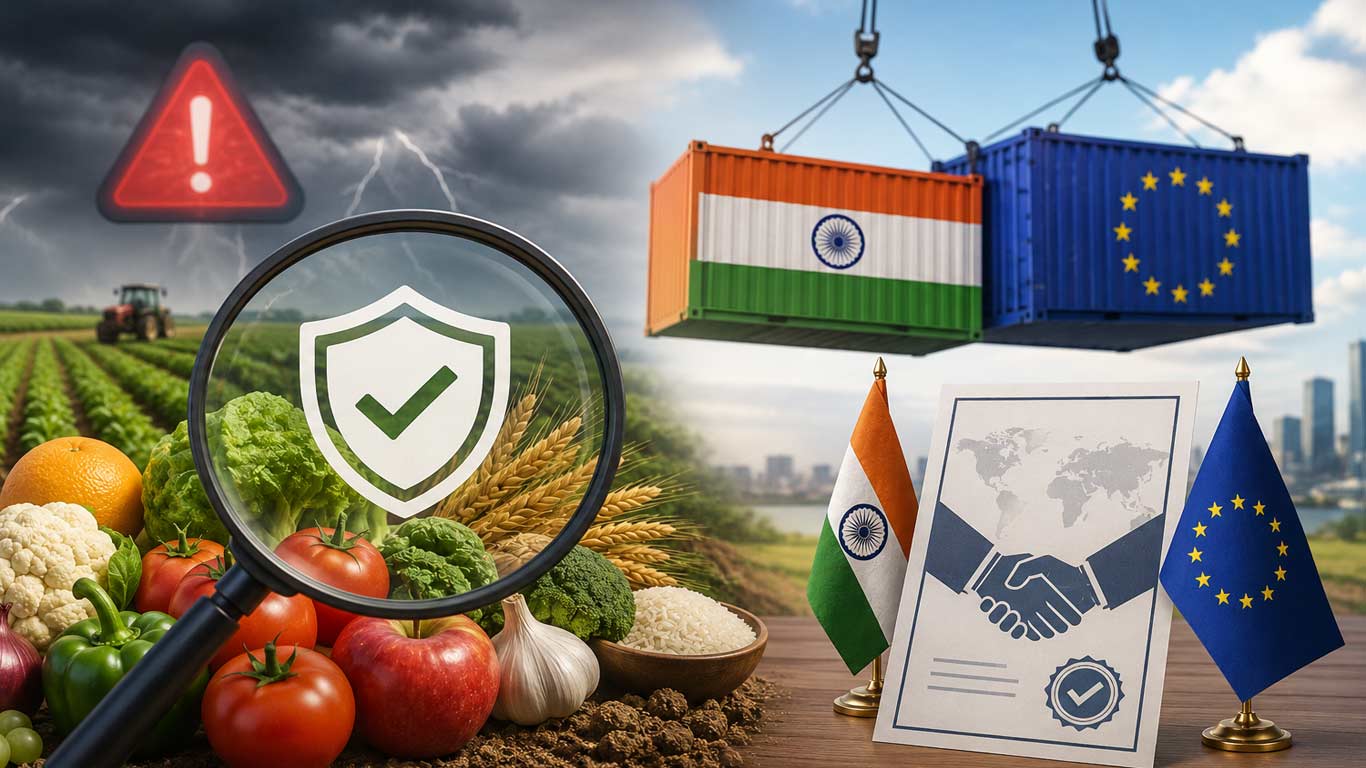
India Must Strengthen Food Safety Systems Ahead Of EU Trade Pact: GTRI Report
New Delhi, Jul 21 (KNN) The Global Trade Research Initiative (GTRI) has cautioned that India may face increased pressure on its agricultural sector if it does not strengthen its food-safety systems, particularly in the context of the proposed India–EU free trade agreement.
The report prepared by GTRI Founder Ajay Srivastava and Shantwna Dixit, Centre for Environment and Agriculture, said, “With the India-EU FTA nearing implementation, India cannot afford to remain weak on both fronts. It must strengthen its own food-safety system while ensuring that foreign regulations are not used as disguised restrictions on Indian exports,” PTI reported.
The report emphasised that India must ensure foreign regulations are not used as disguised trade barriers, while simultaneously improving its domestic compliance systems.
Call for Science-Based and Reciprocal Framework
GTRI recommended the development of a modern, science-based, and reciprocal food safety system to protect consumers and boost export competitiveness.
It emphasised the need for end-to-end traceability from farm to port, clearer guidelines on pesticide use, expansion of internationally accredited laboratories, and routine monitoring of chemical residues.
The report also called for stronger enforcement by agencies such as the Food Safety and Standards Authority of India (FSSAI) and customs authorities, as well as equal scrutiny of imported food consignments through risk-based sampling and mandatory testing, with rejection of shipments that fail to meet Indian standards.
Proposal for Monitoring and Early Warning System
To help exporters adapt to changing global regulations, the report proposed setting up a dedicated Food-Safety Monitoring and Response Cell. This body would track regulatory developments in key markets and provide timely alerts and compliance support to exporters.
Global Comparisons Highlight Enforcement Gaps
Citing international practices, the report noted that China rejected or returned an average of 740 EU food consignments annually between 2013 and 2019 over safety violations, demonstrating that strict enforcement can coexist with active trade.
In contrast, the European Union has issued 365 food-safety notifications against Indian products, leading to rejections, recalls and tighter inspections.
Need for Stronger Domestic Oversight
The report pointed out disparities in pesticide use, noting that the EU’s usage levels are significantly higher than India’s, yet imported food into India faces comparatively less rigorous testing.
It concluded that lowering tariffs under a trade agreement would have limited benefit if Indian agricultural exports continue to face stringent non-tariff barriers, underscoring the need for stronger domestic food-safety enforcement and regulatory parity.
(KNN Bureau)





 Loading...