China's TBM Export Curbs Push India Towards USD 1.2 Billion Manufacturing Scheme
Updated: Oct 21, 2026 01:33:10pm

China's TBM Export Curbs Push India Towards USD 1.2 Billion Manufacturing Scheme
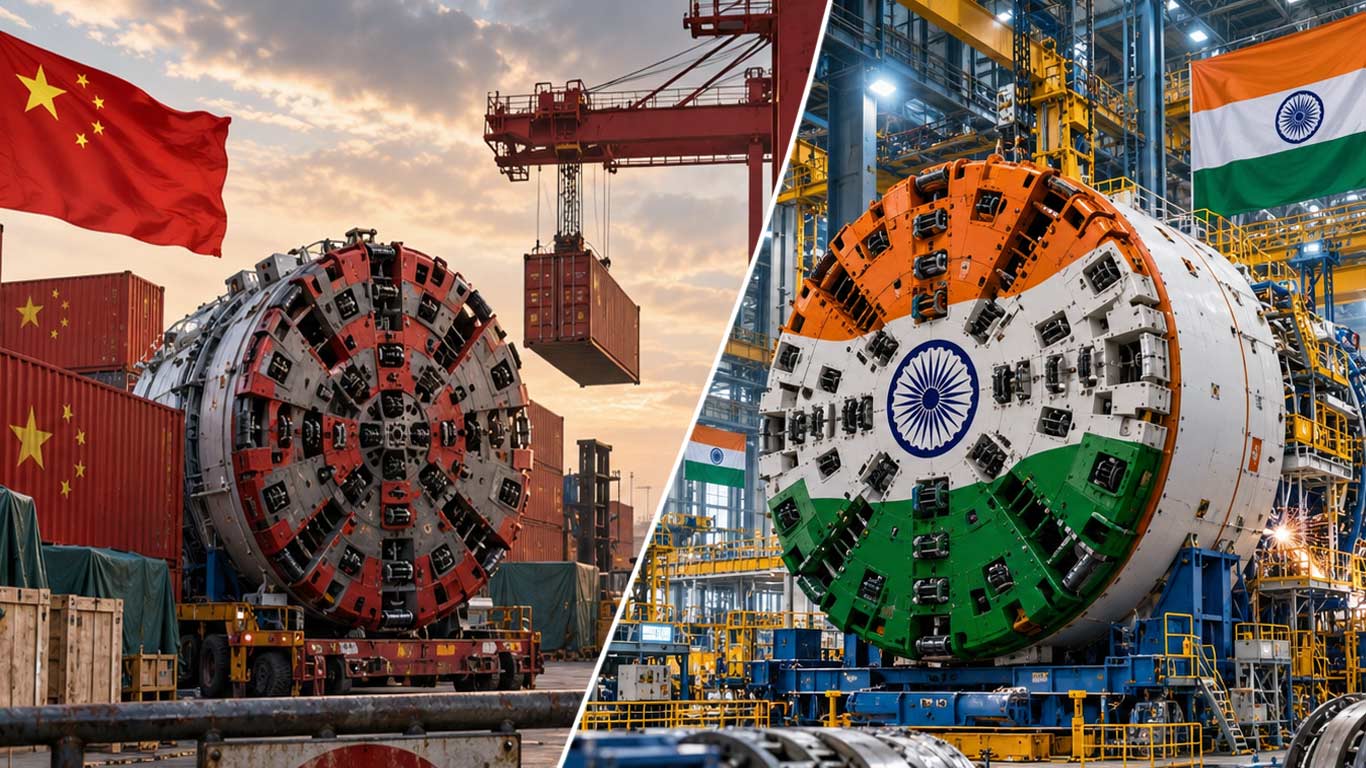
New Delhi, Oct 21 (KNN) China’s export controls on tunnel boring machines (TBMs) have highlighted India’s reliance on imported specialised infrastructure equipment, as the Centre moves towards approving a USD 1.2 billion manufacturing incentive scheme.
Announced on October 19 and effective November 18, the restrictions require export licences for TBMs and other machinery, including walking excavators and plateau-type wet shotcrete machines.
The proposed Indian scheme aims to attract USD 1.8 billion in additional investment over seven years and boost domestic production of high-value construction and infrastructure equipment, reported The Economic Times.
Chinese Export Curbs Highlight India's Equipment Dependence
India’s dependence on imported tunnelling machinery has previously disrupted project timelines. In 2024, Chinese customs delays affected supplies for major projects, including the Mumbai-Ahmedabad bullet train corridor, where German firm Herrenknecht manufactured machines at its Chinese facilities.
Reuters reported that India’s tunnelling machinery imports from China fell from USD 18 million in FY23 to USD 3 million in FY24 and USD 500,000 in FY25, before rising to USD 800,000 in FY26.
Industry executives said the restrictions were unlikely to significantly affect highway construction, given domestic capabilities and alternative suppliers. However, specialised machinery, heavy cranes and high-duty engines remain potential supply-chain risks.
USD 1.2 Billion Scheme To Boost Domestic Manufacturing
Announced in the Union Budget 2026-27, the proposed incentive scheme will cover equipment such as tunnel boring machines (TBMs), firefighting systems and elevators, with localisation targets for import-dependent machinery.
India’s mining and construction equipment market saw domestic demand of around USD 17 billion in 2025, growing 10-12 per cent annually, according to a Boston Consulting Group (BCG)-Confederation of Indian Industry (CII) report.
Localisation in construction equipment stands at around 50 per cent, ranging from 85-90 per cent for backhoe loaders to 55-60 per cent for excavators. Hydraulic systems, electronic controls and undercarriage assemblies remain heavily import-dependent.
Domestic manufacturers such as BEML and Larsen & Toubro could benefit, but experts stressed the need to support component suppliers, technology development and research alongside final assembly.
Infrastructure Spending To Drive Equipment Demand
Infrastructure and mining projects are expected to drive equipment localisation, with capital expenditure across related sectors projected to rise from Rs 5.5 lakh crore in 2025 to Rs 9-10 lakh crore by 2030, according to the BCG-CII report.
Roads, metro rail, freight corridors, airports, ports and mining projects are likely to boost demand for earthmoving, tunnelling, drilling and material-handling equipment.
India’s mining and construction equipment exports nearly tripled over the past decade to USD 4.9 billion in 2025, although export performance varies across product categories.
The global market, valued at USD 420-440 billion, presents opportunities in Southeast Asia, Africa, the Gulf and South America. Expanding exports will require competitive products, reliable after-sales services, spare-parts availability and stronger distribution networks.
The report projects the industry could reach USD 180-200 billion by 2047, with exports potentially accounting for 20 per cent of the global market. The proposed incentive scheme could support domestic manufacturing, reduce supply-chain vulnerabilities and strengthen global competitiveness.
(KNN Bureau)






 Loading...