Currency Hedging Could Raise Green Project Financing Costs By 6-8%: CII-IIM Ahmedabad
Updated: Aug 29, 2026 03:22:37pm

Currency Hedging Could Raise Green Project Financing Costs By 6-8%: CII-IIM Ahmedabad
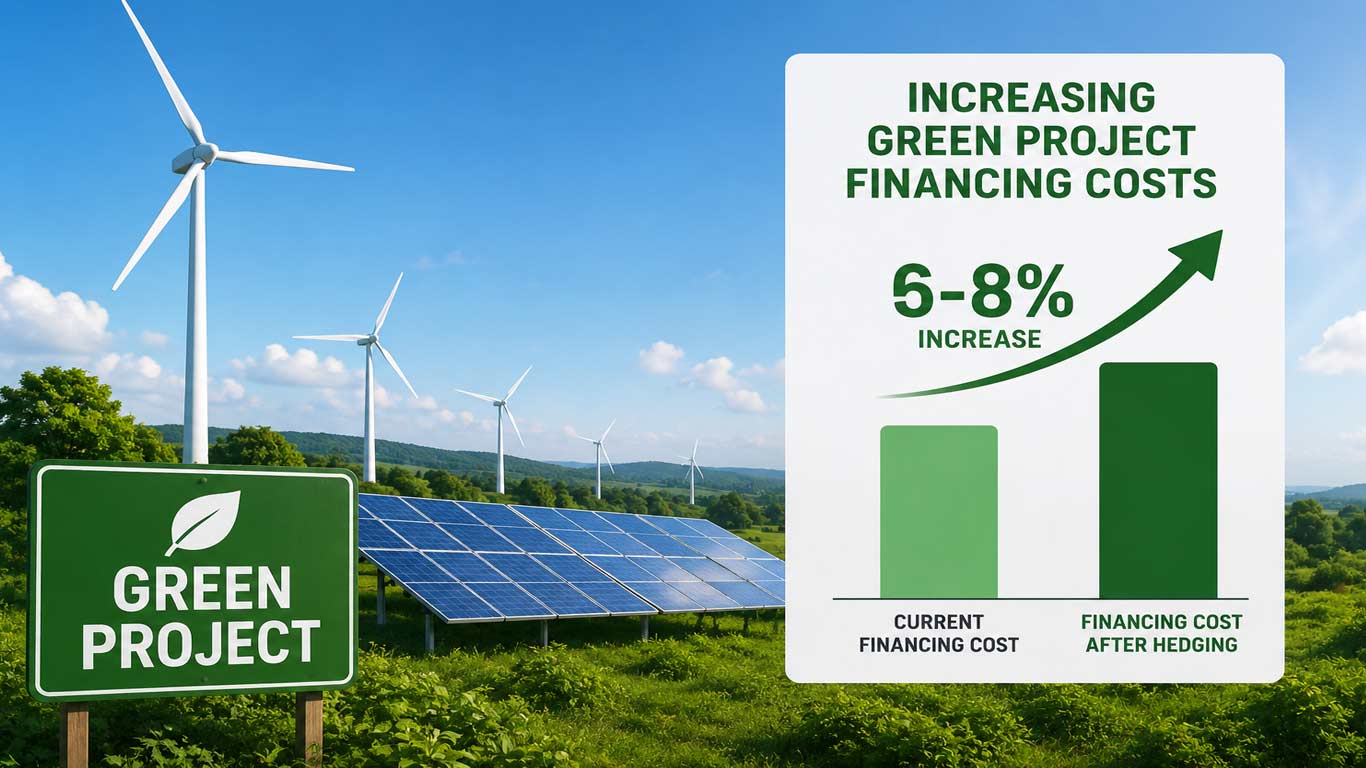
New Delhi, Aug 29 (KNN) Currency hedging could add 6-8 per cent to the annual financing costs of green projects in India, increasing the cost of foreign capital and potentially limiting large-scale investment by global institutional investors, according to the India Sustainability Taskforce, a joint initiative of the Confederation of Indian Industry (CII) and IIM Ahmedabad.
The taskforce said most green projects in India generate revenues in rupees, while international investors typically provide financing in currencies such as the US dollar and euro. This mismatch exposes projects to currency risk and raises the effective cost of overseas funding, ANI reported.
Currency Risk Raises Financing Costs
“Hedging long-term currency exposure is effectively impossible or very costly: rolling short-term hedges can add 6-8% to annual financing costs,” the report noted.
This additional risk comes on top of country-risk perceptions, emerging-market risk premiums and project-specific uncertainties, increasing the overall cost of international capital for Indian clean-energy projects.
The taskforce noted that some global institutional investors, including conservative pension funds in North America and Europe, remain reluctant to invest at scale in India's climate-related projects because of unmitigated currency risk.
Proposed FX Risk Facility
To address the issue, the taskforce has proposed a dedicated foreign exchange (FX) risk facility backed by public, multilateral or blended-finance capital. Such a facility could absorb part of the currency risk more efficiently than individual project investors.
The recommendation forms part of a broader proposal for a Green Finance Institution (GFI), which would operate as an impact-oriented blended-finance platform. The proposed institution could use guarantees, insurance, junior capital and other risk-sharing instruments to attract private investment.
High Cost of Capital a Key Challenge
“Reducing the cost of capital is not a peripheral financing issue; it is a central determinant of whether new green technologies can be adopted at scale,” the report said.
It highlighted the relatively high cost of capital for green investments in India. Financing costs for established segments such as solar and wind are more than twice those in advanced economies, while emerging areas such as battery storage, offshore wind and green hydrogen face even higher costs because of limited operating track records and uncertain revenue models.
The taskforce said reducing the cost of capital would be critical for scaling up green technologies and infrastructure.
The proposed GFI would therefore aim to combine concessional and commercial funding and deploy instruments such as currency-risk solutions, guarantees and climate insurance to reduce investment risks.
The taskforce said the institution's broader objective should be to mobilise domestic and international capital at scale while lowering the weighted-average cost of financing for green infrastructure, energy transition, adaptation and resilience projects.
(KNN Bureau)






 Loading...