DGFT Allows Exporters To Receive Payments In Rupees While Retaining FTP Benefits
Updated: Aug 21, 2026 01:30:22pm

DGFT Allows Exporters To Receive Payments In Rupees While Retaining FTP Benefits
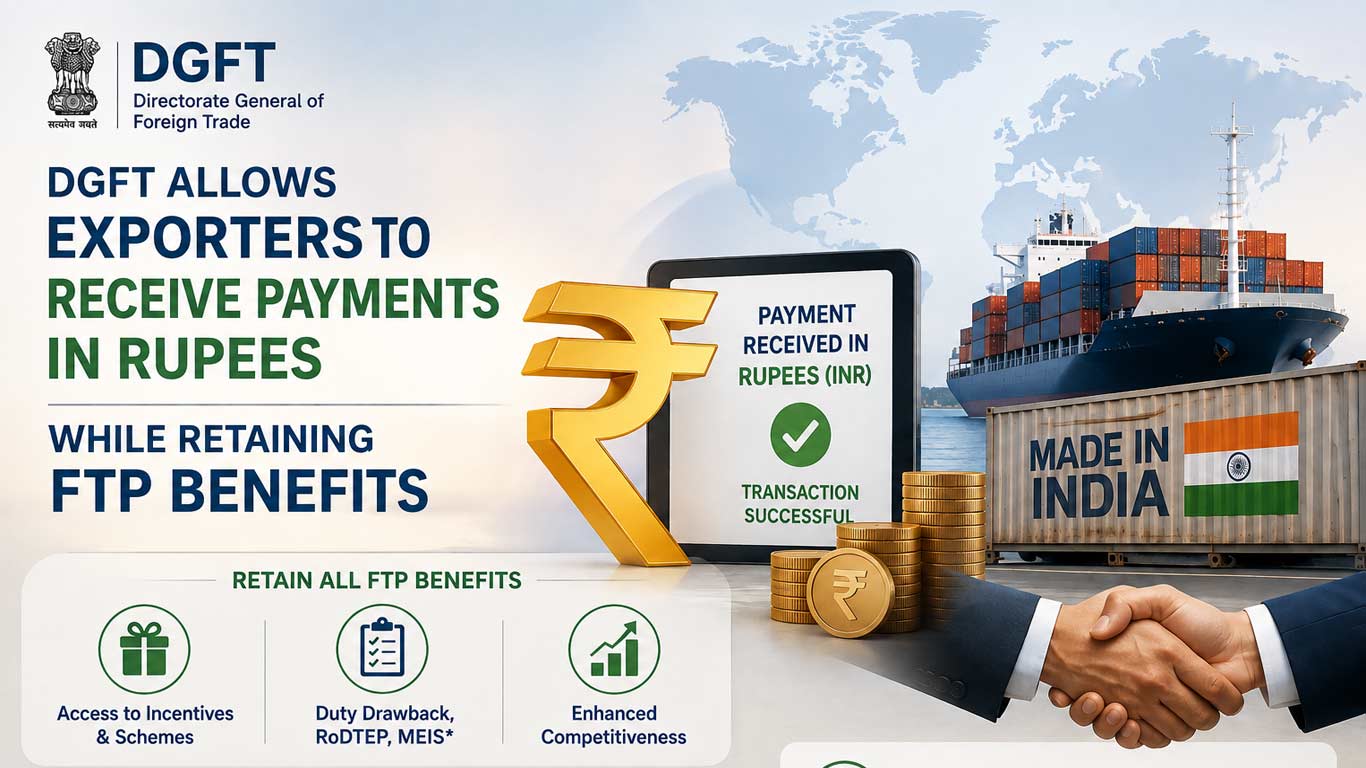
New Delhi, Aug 21 (KNN) India has removed a regulatory hurdle to wider rupee use in international trade by allowing exporters to receive payments in Indian currency while retaining Foreign Trade Policy benefits.
The DGFT amended the FTP 2023 with immediate effect, aligning export payment rules with existing RBI regulations. The move adds the rupee as a payment option alongside freely convertible foreign currencies.
Rupee Receipts to Qualify for FTP Benefits
For countries outside the Asian Clearing Union, exporters can now invoice and receive payments in either Indian rupees or foreign currency, reported Business Standard.
Rupee export proceeds received through authorised banking channels will also qualify for Foreign Trade Policy benefits and count towards export obligations, except for exports to Nepal and Bhutan.
Existing safeguards for specified sensitive goods and technologies to Iran will remain. The amendment also removes uncertainty over whether rupee receipts under the RBI’s international settlement mechanism qualify for export incentives.
Regulatory Framework Began in 2022
The move builds on the RBI’s 2022 framework allowing international trade to be invoiced and settled in rupees through Special Rupee Vostro Accounts (SRVAs).
The RBI later eased rules for banks to open SRVAs for overseas correspondents and, in October 2025, allowed their balances to be invested in specified Indian corporate debt instruments.
The latest DGFT amendment aligns the Foreign Trade Policy with these existing arrangements.
Rupee Settlement Could Support Trade Diversification
The move could provide an alternative for trade with countries facing dollar shortages or limited access to established international payment systems.
Rupee settlement could also reduce currency conversion costs for exporters and overseas buyers.
Wider Adoption Faces Implementation Challenges
Industry experts said regulatory approval alone may not significantly expand rupee-denominated trade.
GTRI founder Ajay Srivastava said wider adoption would require overseas buyers and banks to have easier access to rupees, along with simpler banking procedures, affordable hedging, rupee-based export credit and ECGC protection.
He said country-specific settlement mechanisms would also be needed to enable foreign banks to use, convert, invest or repatriate rupee balances.
India Seeks Gradual Rupee Internationalisation
India has said rupee internationalisation aims to expand the currency’s use in global trade rather than replace existing foreign-currency arrangements.
The RBI noted in its 2023 report that settling trade in rupees with countries where India runs trade deficits could reduce reliance on convertible foreign currencies and the need to hold large reserves in those currencies.
(KNN Bureau)









 Loading...


