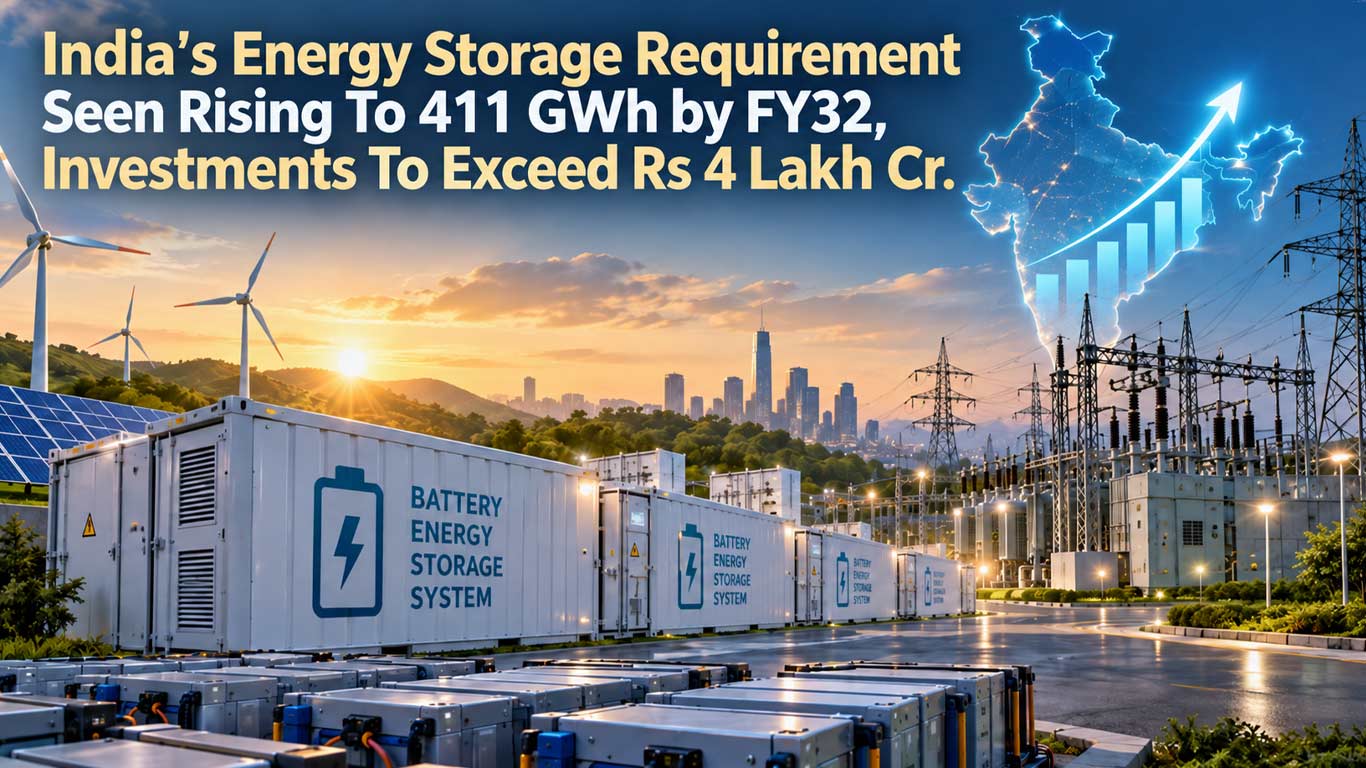
India’s Energy Storage Requirement Seen Rising To 411 GWh by FY32, Investments To Exceed Rs 4 Lakh Cr: Report
Updated: Sep 10, 2026 06:01:16pm

India’s Energy Storage Requirement Seen Rising To 411 GWh by FY32, Investments To Exceed Rs 4 Lakh Cr: Report
New Delhi, Sep 10 (KNN) India's energy storage requirement is expected to rise to around 411 GWh by FY32 from about 54 GWh currently, requiring investments of more than Rs 4 lakh crore over the next six years, CareEdge Ratings said in a report on Tuesday.
The rating agency noted that India's power sector is shifting from the challenge of adding renewable capacity to ensuring its effective integration into the electricity grid, making energy storage increasingly important, ANI reported.
Renewable Integration Poses Grid Challenges
Non-fossil sources account for 50 per cent of India's installed power capacity but contribute only around 29 per cent of electricity generation, reflecting the intermittent nature and lower plant load factors of renewable energy sources, the report said.
The rising share of solar power has also intensified the ‘duck curve’, increasing the need for flexible generation and storage. The morning ramp-down rose from around 28 GW in May 2025 to 50 GW in May 2026, while the evening ramp-up from the day's lowest net load increased from around 68 GW to 80 GW during the same period.
This has increased pressure on conventional generation and contributed to renewable energy curtailment. Around 8.1 TWh of solar generation was curtailed in 3MFY27 due to transmission and grid-stability concerns, CareEdge said.
Storage Capacity to Expand
The National Electricity Plan envisages around 73.9 GW of energy storage capacity by FY32, comprising 47.2 GW of Battery Energy Storage Systems (BESS) and 26.7 GW of Pumped Storage Plants (PSPs). This translates into an energy storage requirement of around 411 GWh.
Energy storage can absorb surplus solar generation during the day and discharge it during evening peak demand, helping smooth the net load curve, reduce renewable curtailment and ease ramping requirements.
Investment momentum is already building, with standalone storage-based tenders rising to around 21 GW in FY26 from 7 GW in FY25.
BESS, PSPs to Play Complementary Roles
CareEdge expects BESS and PSPs to play complementary roles in India's energy transition, with greater storage deployment improving grid flexibility and the reliability of renewable power.
Sachin Gupta, Executive Director and Chief Rating Officer, CareEdge Ratings, said, “India's power sector is moving beyond the challenge of renewable capacity addition towards ensuring that renewable power can be effectively integrated into the grid,” as quoted by ANI.
“As solar and wind capacity increases, the ability to store surplus energy and deploy it during periods of peak demand will become increasingly critical,” he added.
The agency emphasised that a balanced combination of renewable energy, energy storage, transmission infrastructure and conventional generation will remain critical for maintaining grid stability and supporting India's long-term energy transition.
(KNN Bureau)







 Loading...