India's Power Sector To Attract Rs 30 Lakh Crore Investment Over Next 5-6 Years: ICRA
Updated: Oct 24, 2026 04:52:13pm

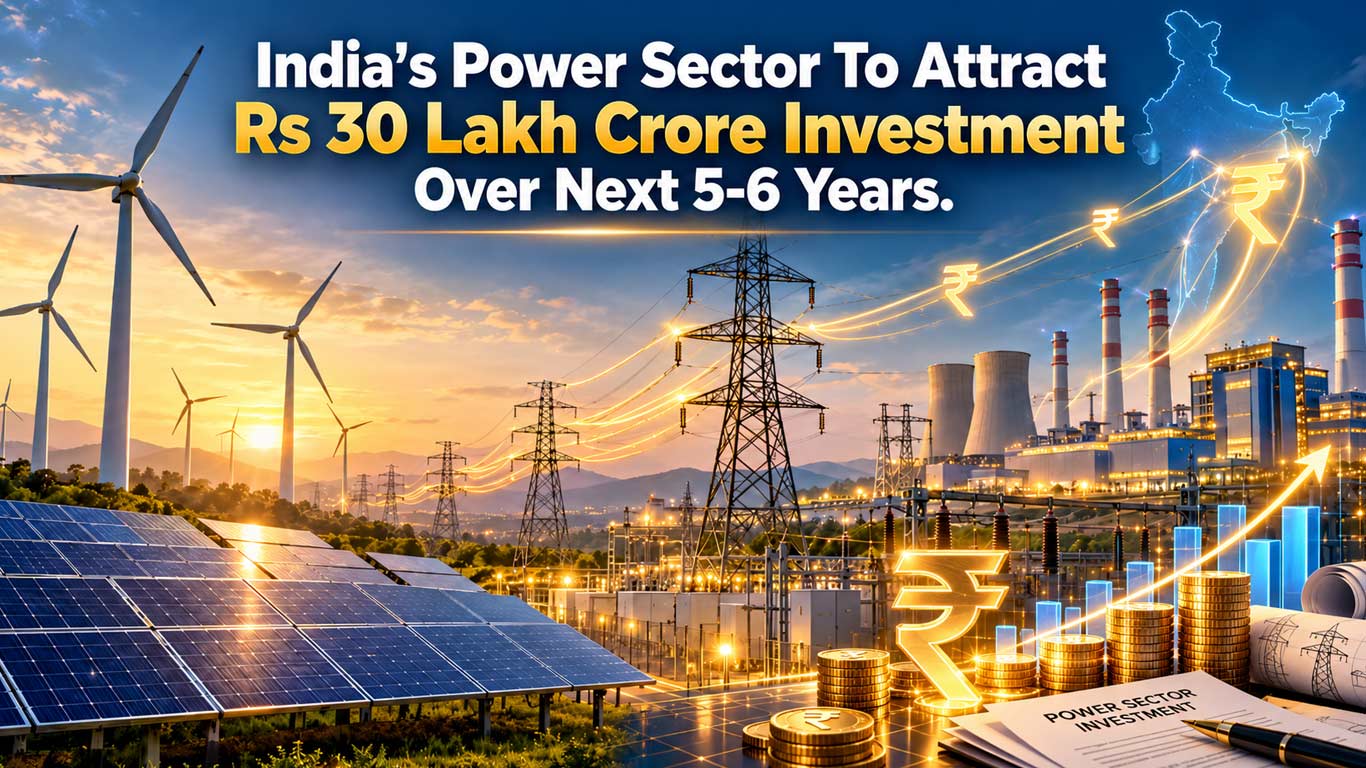
New Delhi, Oct 24 (KNN) India’s power sector is projected to attract Rs 29-30 lakh crore in capital expenditure over the next five to six years, driven by rising electricity demand, capacity additions, grid modernisation and energy storage, according to ICRA.
Annual investment is expected to reach Rs 5-6 lakh crore to meet growing demand and strengthen power infrastructure.
Of the total outlay, Rs 18 lakh crore is earmarked for generation, Rs 5 lakh crore for transmission, Rs 3 lakh crore for distribution and another Rs 3 lakh crore for energy storage.
Electricity Demand Expected To Grow 5-6% In Medium Term
Electricity demand has broadly tracked real GDP growth, recording a 10-year CAGR of 4.7 per cent during FY15-FY25 against GDP growth of 6 per cent, excluding the pandemic period. However, extended and early monsoons limited demand growth to below 1 per cent in FY26.
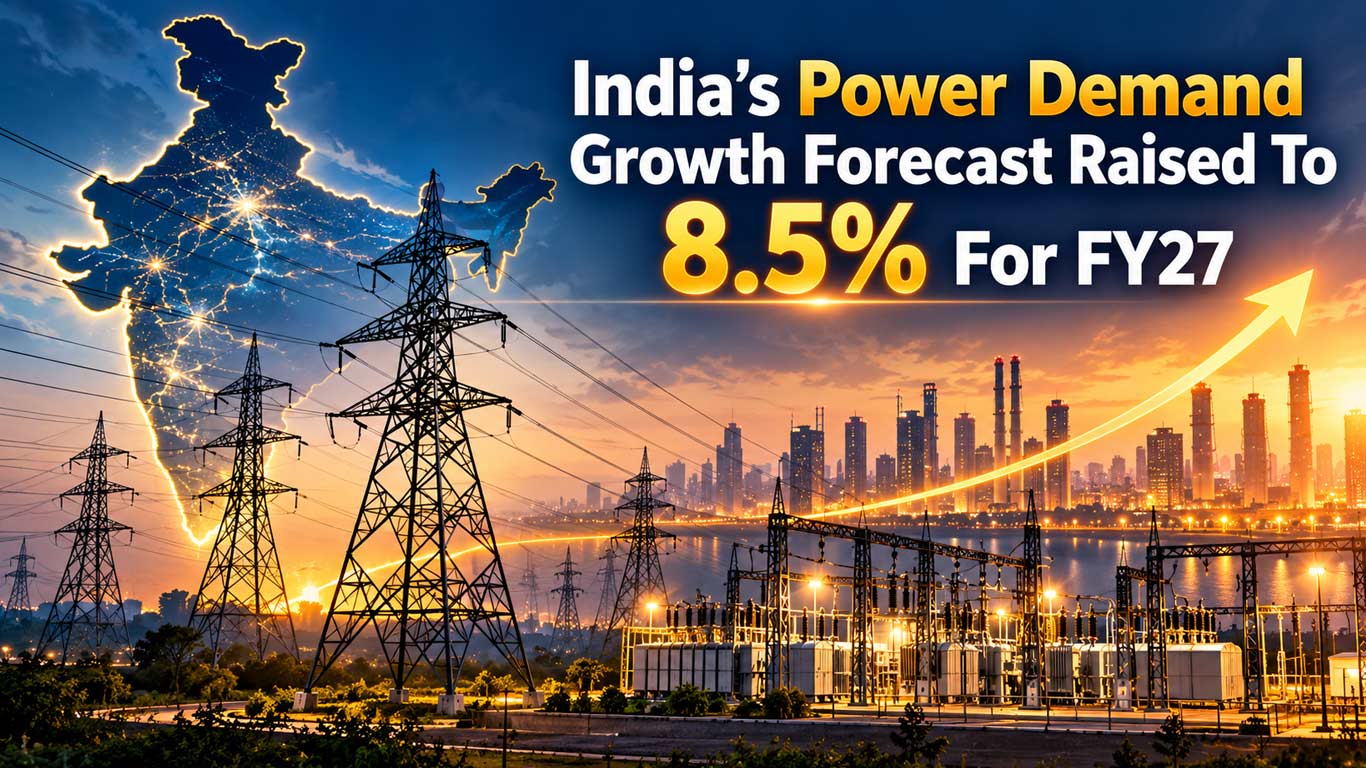
ICRA projects demand growth of 6.5 per cent in FY27 and 5-6 per cent over the medium term, supported by economic growth and emerging sectors such as electric vehicles, data centres and green hydrogen.
Peak demand rose from 160 GW in FY17 to around 270 GW in FY27 so far and is projected to exceed 400 GW by 2030, reported The Economic Times.
Despite rising demand, India’s per-capita electricity consumption remains below that of several developed and emerging economies. Urbanisation and industrialisation are expected to drive further growth, requiring sustained investment in generation capacity.
Renewable Energy To Drive Capacity Expansion
India’s power generation capacity rose from around 270 GW in 2015 to over 550 GW by July 2026, driven by renewable energy expansion. Renewable capacity, excluding large hydro, reached 240 GW, with additions exceeding 50 GW in FY26.
ICRA expects renewables, including large hydro, to account for over 35 per cent of electricity generation by FY30, up from 22 per cent in FY25, while coal’s share is projected to fall below 60 per cent by 2030.
The focus is shifting towards firm, dispatchable and round-the-clock renewable power. However, bidding has slowed due to delays in signing power purchase agreements (PPAs) and power sale agreements (PSAs), as well as transmission constraints.
Renewable capacity awards fell from 40.6 GW in FY25 to 14.7 GW in FY26, with just 4.7 GW awarded up to August 10, 2026, in FY27. Despite over 150 GW of projects under construction as of June 2026, around 40-45 GW of capacity remained without signed PPAs in April 2026.
Thermal Power Investment Gains Momentum
Thermal power is attracting renewed investment as India seeks reliable base-load electricity and grid stability alongside rapid renewable energy expansion.
ICRA expects the sector to add around 6 GW of capacity in FY27, with plant load factors projected at 66-68 per cent. Thermal capacity additions of 50-60 GW are anticipated by 2032.
Transmission Constraints Raise Curtailment Risks
Transmission infrastructure has lagged behind generation capacity additions, causing renewable energy curtailment in congested areas of Rajasthan and Gujarat.
ICRA said around 37 per cent of capacity at substations with over 50 GW of affected capacity across the northern, western and southern regions operates under temporary general network access (T-GNA), facing 50-60 per cent curtailment during peak solar hours.
Expanding intra-state and inter-state transmission networks and storage capacity will be crucial to reducing curtailment and protecting project viability.
The proposed third phase of the Green Energy Corridor (GEC-III) aims to integrate nearly 135 GW of renewable capacity across 13 states through 51,000 circuit kilometres of transmission lines, with an investment of Rs 56,000 crore and 40 per cent central financial assistance.
The programme also plans to integrate 25.2 GW of pumped-storage projects and 44.8 GWh of battery storage capacity.
Battery Storage Capacity Set To Expand
Renewable energy developers are increasingly integrating battery storage into firm and dispatchable renewable energy (FDRE) projects to reduce curtailment risks and capitalise on peak and off-peak price differences.
As of June 2026, around 8.5 GWh of battery energy storage system (BESS) projects were operational, 80 GWh were under development and 70 GWh were at the tendering stage.
Standalone BESS tenders have seen aggressive price competition, with tariffs as low as Rs 1.5 lakh per MW per month with viability gap funding. However, ICRA warned that such low tariffs could undermine project viability amid rising imported battery pack prices.
Rising electricity demand and renewable energy generation will make investment in transmission, storage and conventional capacity critical to ensuring reliable power supply.
(KNN Bureau)






 Loading...