Domestic Notebook Makers Seek MIP, Anti-Dumping Probe Amid Rising Import Pressure
Updated: Sep 09, 2026 01:39:23pm

Domestic Notebook Makers Seek MIP, Anti-Dumping Probe Amid Rising Import Pressure
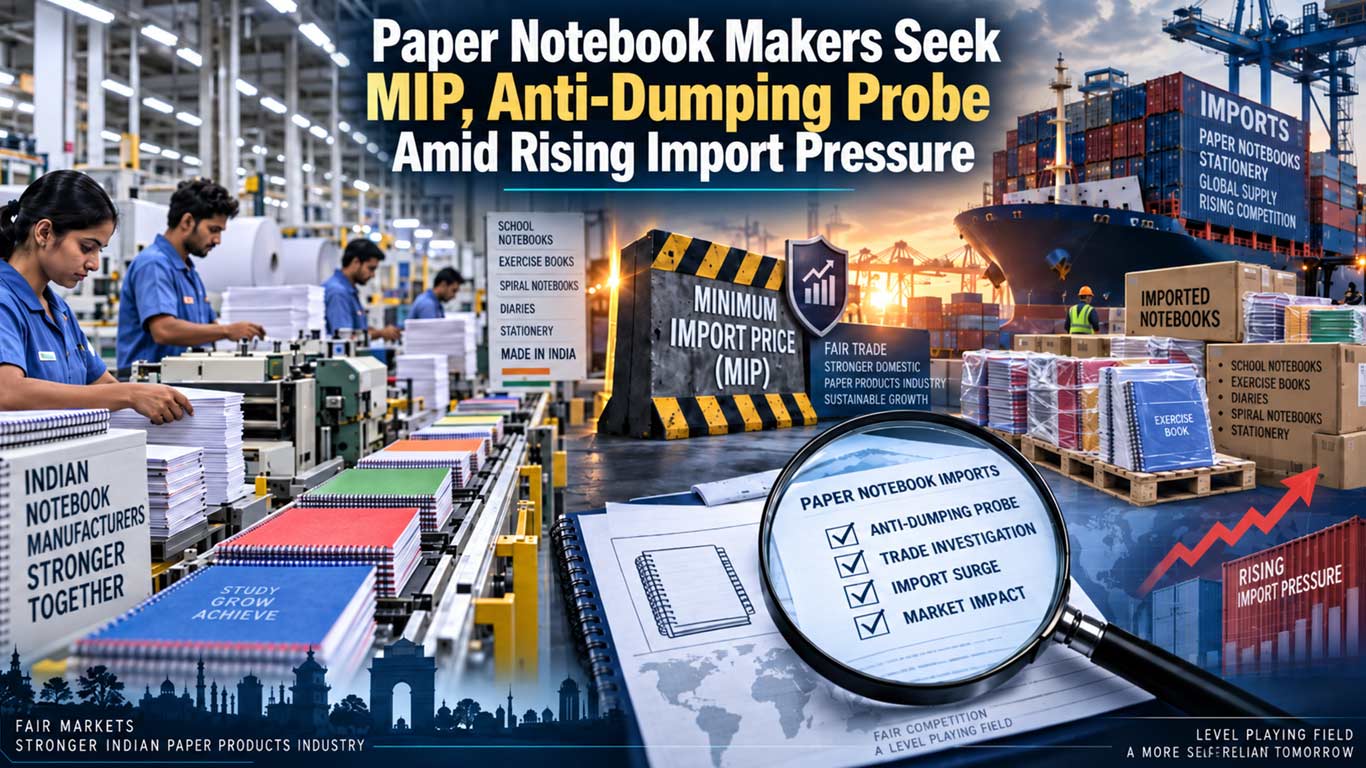
New Delhi, Sept 9 (KNN) The All India Notebook Manufacturers Association (AINMA) has sought a minimum import price (MIP) on finished notebooks and an anti-dumping investigation into imports from Indonesia, citing growing pressure on domestic manufacturers from zero-duty imports from Asean countries.
In a representation to the Ministry of Commerce and Industry, AINMA said the domestic notebook and exercise book industry was facing a combination of cheaper imports and structural disadvantages arising from the Goods and Services Tax (GST) framework.
Finished notebooks imported from countries such as Indonesia attract zero basic Customs duty under the Asean Free Trade Agreement and zero Integrated Goods and Services Tax (IGST), according to the association. Domestic manufacturers, meanwhile, continue to face higher input costs, reported Business Standard.
GST Structure Adds To MSME Costs
AINMA said the GST Council’s decision to reduce GST on notebooks and exercise books to nil was aimed at making educational supplies more affordable, but domestic manufacturers are unable to claim input tax credit (ITC) on raw materials because their finished products are exempt.
The association said essential inputs such as coated paperboard and packaging attract 18 per cent GST, while paper mills also face higher costs because they cannot claim ITC against supplies to exempt products.
This creates a cascading tax impact and puts micro, small and medium enterprise (MSME) notebook manufacturers at a cost disadvantage against foreign suppliers, AINMA said.
The association added that higher input costs have prevented the benefit of GST rationalisation from fully reaching students and could threaten an industry capable of meeting domestic demand.
Exporters Seek IGST Refund Access
AINMA has also sought amendments to the Central Goods and Services Tax (CGST) Rules to allow exporters of domestically exempt goods to voluntarily pay IGST on export supplies.
It said the move would allow such exporters to access the automated Indian Customs Electronic Gateway (ICEGATE) refund mechanism and ease working capital constraints.
The association has further called for an inquiry into pricing practices of domestic paper mills to assess whether the benefits of GST rationalisation are being passed on to the education sector.
AINMA has urged the Ministry of Commerce and Industry, Directorate General of Trade Remedies (DGTR) and GST Council to intervene, including through an MIP on finished notebooks and an anti-dumping probe into imports from Indonesia.
(KNN Bureau)







 Loading...