India’s Copper Imports Surge 350% Amid Rising Domestic Demand
Updated: May 19, 2026 01:42:40pm

India’s Copper Imports Surge 350% Amid Rising Domestic Demand
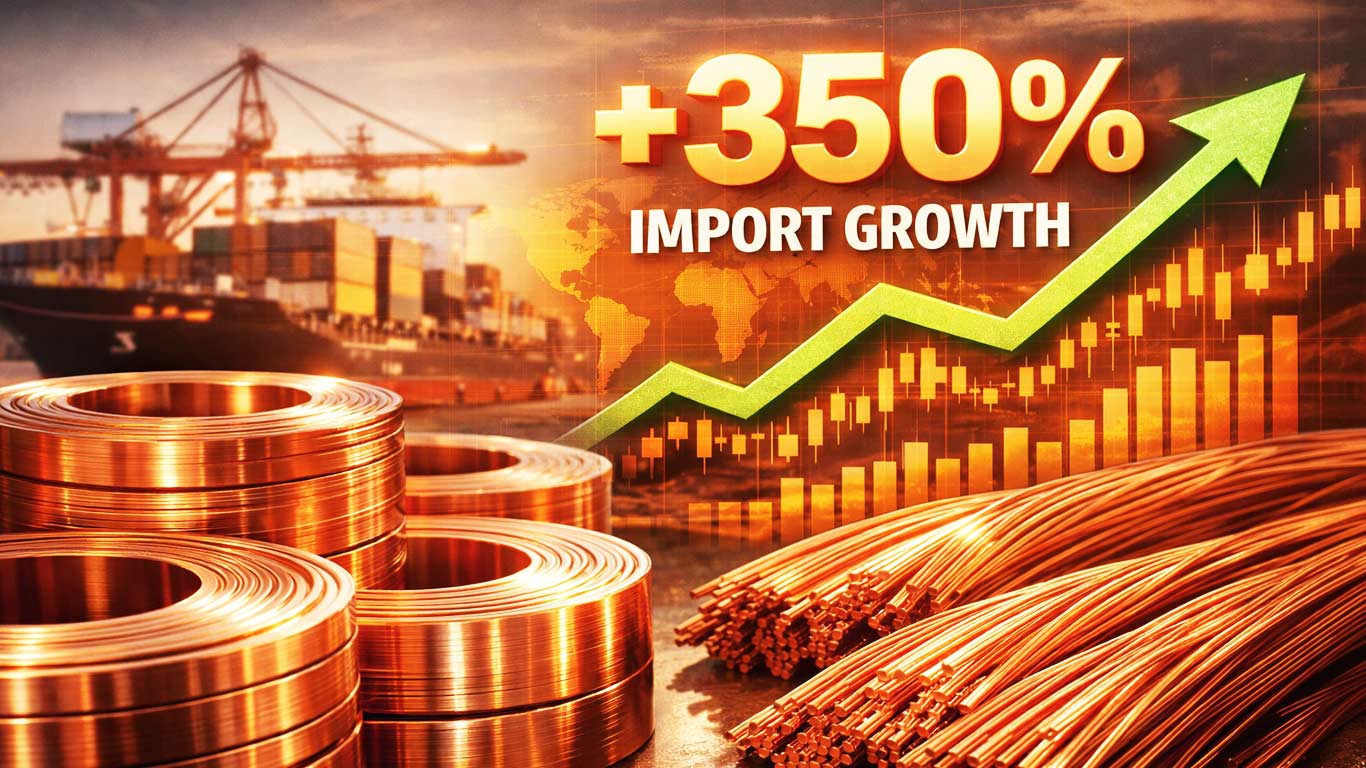
New Delhi, May 19 (KNN) India’s copper imports have surged more than 350 percent over the past decade, reflecting growing structural weaknesses in the domestic copper ecosystem at a time when demand from electric vehicles, renewable energy and electronics manufacturing is rising sharply.
According to trade data quoted by Business Standard, copper imports increased from Rs 22,856 crore in FY17 to Rs 1.03 trillion in FY26 till February.
Prime Minister Narendra Modi recently observed that India had become a net importer of copper after domestic plants shut down amid protests, highlighting the country’s increasing dependence on imports.
Domestic Demand Rises Sharply
According to International Copper Association India (ICA India), India’s copper demand rose from around 1.1 million tonnes in FY18 to nearly 1.8 million tonnes by FY25. During the same period, domestic production declined from around 800,000 tonnes to nearly 600,000 tonnes.
India, which was previously a net exporter of copper cathodes with exports of around 334,000 tonnes in FY18, became a net importer by FY25, with imports reaching nearly 221,000 tonnes.
Industry Flags Structural Challenges
According to Mayur Karmarkar, Managing Director, ICA India, the sector is facing multiple structural pressures, including rising demand, stagnant mining output, weak refining investments, high financing costs and deteriorating global refining economics.
The Centre for Social and Economic Progress (CSEP) noted that despite possessing significant copper reserves, India’s mining production has remained largely stagnant.
The report noted that Hindustan Copper Limited (HCL), India’s only primary copper producer, has struggled to scale up production despite repeated expansion plans.
According to Tanima Pal, Research Associate, CSEP, existing mining and exploration policies have failed to sufficiently attract private sector participation, leaving HCL as the sole primary copper miner in India.
She further noted that ageing mines and declining ore grades are adding to production challenges, resulting in fluctuating and modest output levels.
The report also observed that India accounts for barely 1 percent of global mineral exploration expenditure, limiting the discovery and development of new copper deposits.
High Financing Costs Hurt Refiners
Industry experts said high financing costs continue to constrain domestic refining capacity. Karmarkar noted that Indian refiners borrow at interest rates of 8–9 percent, compared with near-zero rates for Japanese refiners, creating a major cost disadvantage.
He also highlighted the sharp decline in global treatment and refining charges earned by smelters for processing copper concentrate into refined metal.
Stakeholders further raised concerns over India’s free trade agreements with Japan, Association of Southeast Asian Nations members and the United Arab Emirates, which permit duty-free imports of refined copper cathodes.
According to industry representatives, lower financing costs and favourable import structures give foreign refiners a competitive edge over domestic producers.
(KNN Bureau)










 Loading...


