Focus on skill upgradation to strengthen economy, says Ansari
Updated: Apr 17, 2014 03:19:04pm

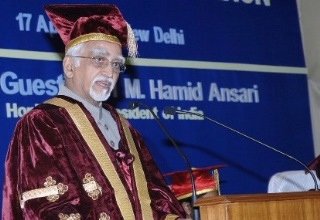
New Delhi, Apr 17 (KNN) India has the second largest working population in the world and their number is far greater than those dependent on them. By providing them with the necessary skills, our economy can be strengthened, said Vice President of India, Hamid Ansari.
Addressing the Golden Jubilee and 48th Convocation of the Indian Institute of Foreign Trade (IIFT), here today, “We have the second largest working population in the world. Our working age population will be, at least till 2040, far in excess of those dependent on them. This would be a potential source of strength for our economy provided we are able to impart and continuously upgrade the skills and knowledge of our workforce,” he said.
He went on to say that we live in an increasingly integrated world where globalisation and new technologies have transformed our planet into a global village.
“While competition has increased, so have fresh opportunities opened up in terms of newer markets and sources of capital, technology and natural resources. Nations have to adapt to these changing realities and rule out isolation or autarky. This holds true of India also,” he said.
He said that our comparative advantage is in our demographic profile and our reservoir of human resources.
The Vice President said that in the last 30 years, world trade in merchandise and commercial services have increased by about 7 per cent per year on average, reaching a peak of USD 18 trillion and USD 4 trillion respectively. In the same period, developing economies raised their share in world exports from 34 per cent to 47 per cent and their share in world imports from 29 per cent to 42 per cent.
Asia is playing an increasing role in world trade, Ansari pointed out.
“Despite the recent global economic slowdown, this trend is likely to get strengthened in the future. We will, therefore, find ourselves living in a more and more interconnected and interdependent global market place with higher levels of trade and capital flows,” he said.
He was of the opinion that with limited fiscal space available for the Government and with protectionist measures of trading partners showing signs of rising, the policy options left with us are more at the micro level.
“These relate to improvement in the poor state of our physical infrastructure, especially ports, airports and highways. Our fiscal regime, including taxes and customs duties, needs to be more efficient. Trade facilitation measures have to be brought at par with the best in the world,” he said.
Today, India is ranked 132nd in the 'ease of doing business' and 127th on 'trading across borders’. Addressing these issues could exponentially promote India's export growth and make our external sector an engine for rapid growth, he said.
The Vice President said that trade remains the most reliable and productive way of integrating into the global economy, owing to the fact that it: helps boost development and reduce poverty by generating growth through increased commercial opportunities and investment, and broadening the productive base.
Trade also creates employment opportunities, generates stable jobs and usually higher incomes, thus improving livelihoods. It allows developing countries to access new markets and new materials, which open up new production possibilities.
It also enhances competitiveness by helping reduce the cost of inputs, acquire finance through investments, increase the value added of their products and move up the global value chain.
Needless to say, trade encourages innovation by facilitating exchange of know-how, technology and investment in research and development. It expands choice and lowers prices for consumers by broadening supply sources.
Finally, trade strengthens relations between nations by bringing people together in peaceful and mutually beneficial exchanges and as such contributes to peace and stability. This aspect could be most relevant in our own South Asian region, Ansari said.
“Each of these remains a primary ingredient of our national objective of attaining faster, sustainable and inclusive socio- economic development,” he added. (KNN/ES)
Addressing the Golden Jubilee and 48th Convocation of the Indian Institute of Foreign Trade (IIFT), here today, “We have the second largest working population in the world. Our working age population will be, at least till 2040, far in excess of those dependent on them. This would be a potential source of strength for our economy provided we are able to impart and continuously upgrade the skills and knowledge of our workforce,” he said.
He went on to say that we live in an increasingly integrated world where globalisation and new technologies have transformed our planet into a global village.
“While competition has increased, so have fresh opportunities opened up in terms of newer markets and sources of capital, technology and natural resources. Nations have to adapt to these changing realities and rule out isolation or autarky. This holds true of India also,” he said.
He said that our comparative advantage is in our demographic profile and our reservoir of human resources.
The Vice President said that in the last 30 years, world trade in merchandise and commercial services have increased by about 7 per cent per year on average, reaching a peak of USD 18 trillion and USD 4 trillion respectively. In the same period, developing economies raised their share in world exports from 34 per cent to 47 per cent and their share in world imports from 29 per cent to 42 per cent.
Asia is playing an increasing role in world trade, Ansari pointed out.
“Despite the recent global economic slowdown, this trend is likely to get strengthened in the future. We will, therefore, find ourselves living in a more and more interconnected and interdependent global market place with higher levels of trade and capital flows,” he said.
He was of the opinion that with limited fiscal space available for the Government and with protectionist measures of trading partners showing signs of rising, the policy options left with us are more at the micro level.
“These relate to improvement in the poor state of our physical infrastructure, especially ports, airports and highways. Our fiscal regime, including taxes and customs duties, needs to be more efficient. Trade facilitation measures have to be brought at par with the best in the world,” he said.
Today, India is ranked 132nd in the 'ease of doing business' and 127th on 'trading across borders’. Addressing these issues could exponentially promote India's export growth and make our external sector an engine for rapid growth, he said.
The Vice President said that trade remains the most reliable and productive way of integrating into the global economy, owing to the fact that it: helps boost development and reduce poverty by generating growth through increased commercial opportunities and investment, and broadening the productive base.
Trade also creates employment opportunities, generates stable jobs and usually higher incomes, thus improving livelihoods. It allows developing countries to access new markets and new materials, which open up new production possibilities.
It also enhances competitiveness by helping reduce the cost of inputs, acquire finance through investments, increase the value added of their products and move up the global value chain.
Needless to say, trade encourages innovation by facilitating exchange of know-how, technology and investment in research and development. It expands choice and lowers prices for consumers by broadening supply sources.
Finally, trade strengthens relations between nations by bringing people together in peaceful and mutually beneficial exchanges and as such contributes to peace and stability. This aspect could be most relevant in our own South Asian region, Ansari said.
“Each of these remains a primary ingredient of our national objective of attaining faster, sustainable and inclusive socio- economic development,” he added. (KNN/ES)



 Loading...