'Food supply chain is marred by infrastructural bottlenecks, low brand consciousness'
Updated: Mar 29, 2014 12:16:19pm

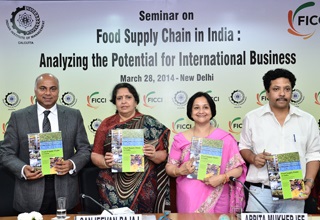
New Delhi, March 29 (KNN) The Indian food supply chain is marred by infrastructural bottlenecks, high food inflation, varied food preferences and low brand consciousness and suggested that a stronger regulation should be made to check anti-competitive practices and consumer protection, Co-author and Professor, ICRIER, Arpita Mukherjee has said.
Addressing a seminar on ‘Food Supply Chain in India: Analyzing the Potential for International Business’ organized here by FICCI in association with IIM Calcutta, she underlined the need to address the policy gaps in the agriculture and food processing industry.
Mukherjee suggested that a stronger regulation to check anti-competitive practices and consumer protection; streamlining sourcing and supply chain; fiscal reforms – implementation of GST and uniform taxes for processed food; efficient implementation of FSSA; rationalizing import duties and trade policies; learning from global best practices and inter-governmental collaboration and information sharing, could be some of the steps in enhancing the efficiency of the value chain.
She added that besides regulatory, fiscal and trade-related barriers, inconsistency in supply of raw material, lack of processable quality agricultural raw material, improper handling of products, lack of cold storage and inadequate working capital and use of inferior technology had emerged as some of the biggest challenges for the food supply chain.
Chairman of the FICCI Retail Committee, Bijou Kurien said, “The role of food in the economic and social development of India cannot be underestimated. Connecting the producers of agricultural products and livestock with the processors and producers of food and finally with the consumers is a mammoth task. Unless, we work in an integrated manner, we will never realize benefits for our farmers and sustained quality and availability for our consumers.”
CEO of FICCI Quality Forum, Sanjeevan Bajaj said that a well-developed food value chain is expected to increase farm gate prices, reduce wastages, ensure value addition, promote crop diversification, generate employment opportunities as well as export earnings. Further, it benefits both the ends of the chain i.e. the farmers and the consumers, as farmers tends to get better price for their products and consumers too need to pay less.
On the occasion, a report on ‘Food Supply Chain in India: Analyzing the Potential for International Business’ was released.
The report analyses the potential for international businesses in the food supply chain of India. Specifically, looks at their modes of entry and operation and their contribution to the Indian economy. It examines regulations in the food supply chain in order to help international businesses understand the regulations. Based on secondary information and a primary survey, it identifies the barriers faced by international businesses and suggests a go-to-market strategy for them.
The report makes policy recommendations to the Indian government so that the country can attract the desired foreign investment and technology, encourage the growth of the organised sector and manufacturing, create quality employment and link Indian suppliers (farmers, manufacturers, etc.) to the global supply chains and production networks of global multinationals in the food supply chain business. The report covers the retailers, manufacturers and food logistics service providers.
Associate Professor from the Indian Institute of Management (Calcutta), Parthapratim Pal said, “There are a number of possible advantages from increased foreign private investment in food supply chain. However, there are a few concerns as well. We tried to look at the issues and come up with some recommendations. We find that the international business must understand the realities of the Indian market and not underestimate the effectiveness of the existing supply chain and operational problems of operating in India. Taking these into account they must develop their go-to-market strategy for India.”
Research Associate, ICRIER, Tanu M Goyal said that the study found there are several implementation issues in the Food Safety and Standard Act (2006), particularly related to packaging and labelling of products. Difference in implementation at different ports, needs to be addressed through great clarity am9onmg port officers and businesses.
Independent Economist, Saubhik Deb said that the report highlights the need for a simplified retail policy and regulations that would ensure competition safeguard consumer interests and create employment. The report focuses on the importance of giving flexibility to foreign investors to decide where they want to invest and recommends that the government should phase out the brand based retail policy and replace it with a consolidated and simplified policy on FDI in retail and is done globally. (KNN/SD)
Addressing a seminar on ‘Food Supply Chain in India: Analyzing the Potential for International Business’ organized here by FICCI in association with IIM Calcutta, she underlined the need to address the policy gaps in the agriculture and food processing industry.
Mukherjee suggested that a stronger regulation to check anti-competitive practices and consumer protection; streamlining sourcing and supply chain; fiscal reforms – implementation of GST and uniform taxes for processed food; efficient implementation of FSSA; rationalizing import duties and trade policies; learning from global best practices and inter-governmental collaboration and information sharing, could be some of the steps in enhancing the efficiency of the value chain.
She added that besides regulatory, fiscal and trade-related barriers, inconsistency in supply of raw material, lack of processable quality agricultural raw material, improper handling of products, lack of cold storage and inadequate working capital and use of inferior technology had emerged as some of the biggest challenges for the food supply chain.
Chairman of the FICCI Retail Committee, Bijou Kurien said, “The role of food in the economic and social development of India cannot be underestimated. Connecting the producers of agricultural products and livestock with the processors and producers of food and finally with the consumers is a mammoth task. Unless, we work in an integrated manner, we will never realize benefits for our farmers and sustained quality and availability for our consumers.”
CEO of FICCI Quality Forum, Sanjeevan Bajaj said that a well-developed food value chain is expected to increase farm gate prices, reduce wastages, ensure value addition, promote crop diversification, generate employment opportunities as well as export earnings. Further, it benefits both the ends of the chain i.e. the farmers and the consumers, as farmers tends to get better price for their products and consumers too need to pay less.
On the occasion, a report on ‘Food Supply Chain in India: Analyzing the Potential for International Business’ was released.
The report analyses the potential for international businesses in the food supply chain of India. Specifically, looks at their modes of entry and operation and their contribution to the Indian economy. It examines regulations in the food supply chain in order to help international businesses understand the regulations. Based on secondary information and a primary survey, it identifies the barriers faced by international businesses and suggests a go-to-market strategy for them.
The report makes policy recommendations to the Indian government so that the country can attract the desired foreign investment and technology, encourage the growth of the organised sector and manufacturing, create quality employment and link Indian suppliers (farmers, manufacturers, etc.) to the global supply chains and production networks of global multinationals in the food supply chain business. The report covers the retailers, manufacturers and food logistics service providers.
Associate Professor from the Indian Institute of Management (Calcutta), Parthapratim Pal said, “There are a number of possible advantages from increased foreign private investment in food supply chain. However, there are a few concerns as well. We tried to look at the issues and come up with some recommendations. We find that the international business must understand the realities of the Indian market and not underestimate the effectiveness of the existing supply chain and operational problems of operating in India. Taking these into account they must develop their go-to-market strategy for India.”
Research Associate, ICRIER, Tanu M Goyal said that the study found there are several implementation issues in the Food Safety and Standard Act (2006), particularly related to packaging and labelling of products. Difference in implementation at different ports, needs to be addressed through great clarity am9onmg port officers and businesses.
Independent Economist, Saubhik Deb said that the report highlights the need for a simplified retail policy and regulations that would ensure competition safeguard consumer interests and create employment. The report focuses on the importance of giving flexibility to foreign investors to decide where they want to invest and recommends that the government should phase out the brand based retail policy and replace it with a consolidated and simplified policy on FDI in retail and is done globally. (KNN/SD)





 Loading...