Grid connected agriculture pumps can be solarised under PM-KUSUM scheme
Updated: Dec 05, 2020 10:26:14am

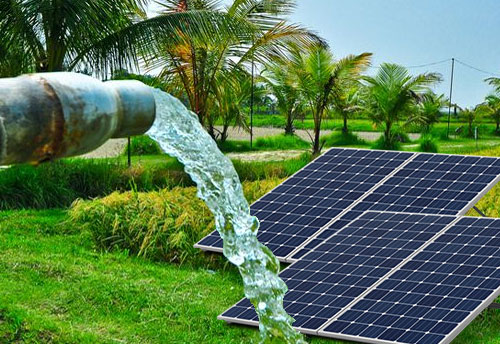
Grid connected agriculture pumps can be solarised under PM-KUSUM scheme
New Delhi, Dec 5 (KNN) Centre has issued guidelines for implementation of feeder-level solarisation under the Pradhan Mantri Kisan Urja Suraksha evam Utthaan Mahabhiyan (PM-KUSUM) scheme. The cabinet committee on economic affairs had approved the launch of the PM-KUSUM scheme in February 2019 to provide financial and water security to farmers.
After consultation with state governments, Ministry of New and Renewable Energy (MNRE) has decided to issue guidelines for implementation of Feeder Level Solarisation under Component-C of PM-KUSUM Scheme, according to an official statement.
The Scheme consists of three components. The Component-A includes installation of Decentralized Ground Mounted Grid Connected Renewable Power Plants, Component-B includes installation of standalone Solar Powered Agriculture Pumps and Component-C includes Solarisation of Grid-connected Agriculture Pumps.
Ministry had issued detailed Guidelines for implementation of Component-C of PM-KUSUM Scheme on 8 November 2019. As per provisions of the PM-KUSUM Scheme, the grid connected agriculture pumps can be solarised with central and state subsidy of 30% each and farmer’s contribution of 40%.
The solar capacity allowed is upto two times of the pump capacity in kW and surplus power will be purchased by DISCOM. Since this component was to be implemented on pilot mode, flexibility was given to states for using different models like net-metering, replacing pump with BLDC pump or any other innovative model as deemed fit by the states.
Based on discussions held with states it has been decided to also include feeder level solarisation under Component-C of PM-KUSUM Scheme. Accordingly, these guidelines are being issued to provide broad implementation framework for feeder level solarisation.
The Distribution Company (DISCOM)/Power Department will be the implementing agency for feeder level solarisation in their respective areas. However, state Government may appoint any other expert agency to help DISCOM for tendering and other related activities of installation of solar power plant for feeder level solarisation.
Where agriculture feeders have already been separated the feeders may be solarised under the scheme. This will lead to lower cost both in terms of lower capital cost and cost of power. Feeders having major load for agriculture may also be considered for solarisation under the Scheme.
The requirement of total annual power for an agriculture feeder will be assessed and a solar power plant of capacity that can cater to the requirement of annual power for that agriculture feeder can be installed either through CAPEX mode or RESCO mode, which will supply solar power to that feeder.
For example, a feeder having annual power requirement of say 10 lakh units, the power can be supplied by solar power plant of capacity around 600 kW with CUF of 19%. Higher or lower CUF, depending upon the average solar insolation available in the areas, may be considered for assessing solar power capacity.
Feeder level solar power plant may be installed to cater to the requirement of power for a single feeder or for multiple agriculture feeders emanating from a distribution sub-station (DSS) to feed power at 11 kV or at the higher voltage level side of the DSS depending upon on factors like availability of land, technical feasibility, etc., and there is no cap of the capacity of solar power plant for feeder level solarisation.
The DISCOMs may identify land near DSS, get ownership of land or its lease rights, provide connectivity at DSS and lay sub-transmission line between DSS and solar power plant. For the purpose of calculating CFA, the cost of installation of solar power plant has been estimated as Rs. 3.5 Cr/MW.
Under the Scheme solarisation of pumps of any capacity is allowed, however, in case of pumps of capacity above 7.5 HP, the CFA will be limited to solar capacity for 7.5 HP pumps.
Where agriculture feeders are not separated, loan for feeder separation will be available from NABARD/PFC/REC. Ministry of Power is also in process of finalising a Scheme to provide assistance for feeder separation.
The savings on account of electricity subsidy on agriculture and the income from the surplus electricity generated by the solar power plant when it is not being used for irrigation can also be used to pay off the loan taken for feeder separation.









 Loading...