IBC Recoveries Rise To 28.6% In Q1FY27, But Creditors Face 71.4% Haircut: Report
Updated: Aug 26, 2026 03:54:13pm

IBC Recoveries Rise To 28.6% In Q1FY27, But Creditors Face 71.4% Haircut: Report
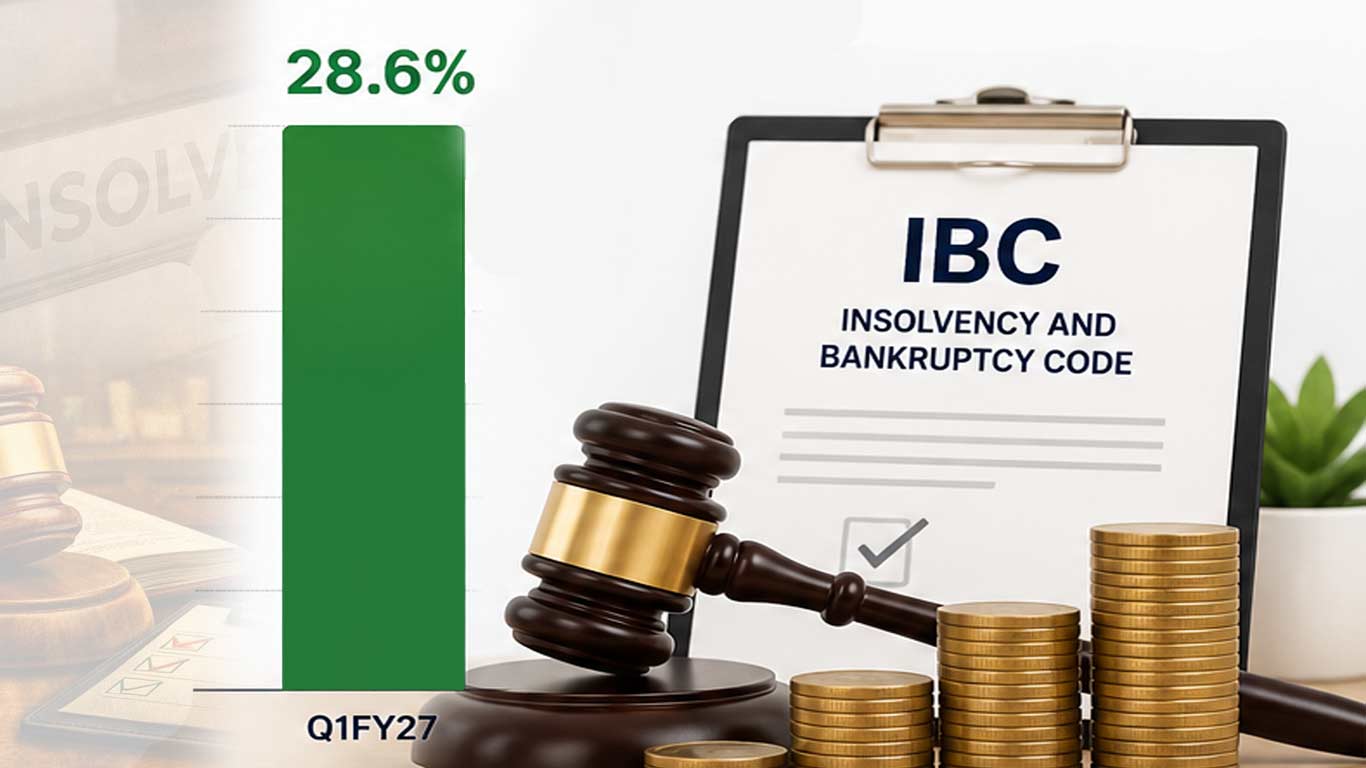
New Delhi, Aug 26 (KNN) Recoveries under the Insolvency and Bankruptcy Code (IBC) improved sequentially in Q1FY27, with financial creditors realising 28.6 per cent of admitted claims, compared with 22.8 per cent in Q4FY26. However, creditors still faced an average haircut of 71.4 per cent, according to CareEdge Ratings.
Financial creditors recovered Rs 3,557 crore against admitted claims of Rs 12,443 crore during the quarter. Recoveries were equivalent to 136.7 per cent of liquidation value, highlighting the higher realisation potential of resolution-led outcomes.
Cumulatively, creditors have recovered Rs 4.35 lakh crore, or 30.5 per cent of admitted claims, and 166.6 per cent of liquidation value through June 2026.
Fresh Admissions Remain Subdued
Fresh corporate insolvency resolution process (CIRP) admissions declined 5.3 per cent year-on-year to 177 cases in Q1FY27, with financial creditors accounting for 65.5 per cent of new admissions.
The number of ongoing CIRPs remained broadly stable at 1,865 as of June 30, 2026, compared with 1,885 at the end of FY26, indicating that closures have broadly kept pace with fresh admissions. Cumulative admissions stood at 9,166.
Successful resolutions increased to 1,484 cases, or 16.2 per cent of total admissions. However, liquidation remained the largest closure route, accounting for 3,074 cases, or 33.5 per cent of admissions. A further 1,410 cases were closed through appeal, review or settlement, while 1,333 cases were withdrawn under Section 12A.
Resolution Delays Remain a Concern
Delays continue to weigh on the effectiveness of the insolvency process. About 76 per cent of ongoing CIRPs have remained pending for more than 270 days, while the average resolution timeline has increased to 757 days.
Liquidation cases took an average of 540 days, with nearly 70 per cent remaining pending for more than two years. Ageing cases, litigation and procedural bottlenecks continue to affect recovery efficiency and value preservation.
Manufacturing, Real Estate Lead Admissions
Manufacturing accounted for the largest share of ongoing CIRPs at 36 per cent. Manufacturing, real estate and construction together represented nearly 70 per cent of cumulative insolvency admissions.
These sectors remain vulnerable to leverage, cash-flow volatility, project execution risks and cyclical demand conditions, contributing to their significant share of insolvency cases.
Recent IBC amendments aimed at improving transparency, information quality and process efficiency could support faster resolutions and better recovery outcomes. However, reducing delays and improving execution will remain critical to strengthening the insolvency framework and limiting creditor losses.
(KNN Bureau)







 Loading...