Indian Cities Need USD 2.4 Trillion Investment By 2050 For Climate Resilience: FICCI-EY
Updated: Jul 30, 2026 01:47:19pm

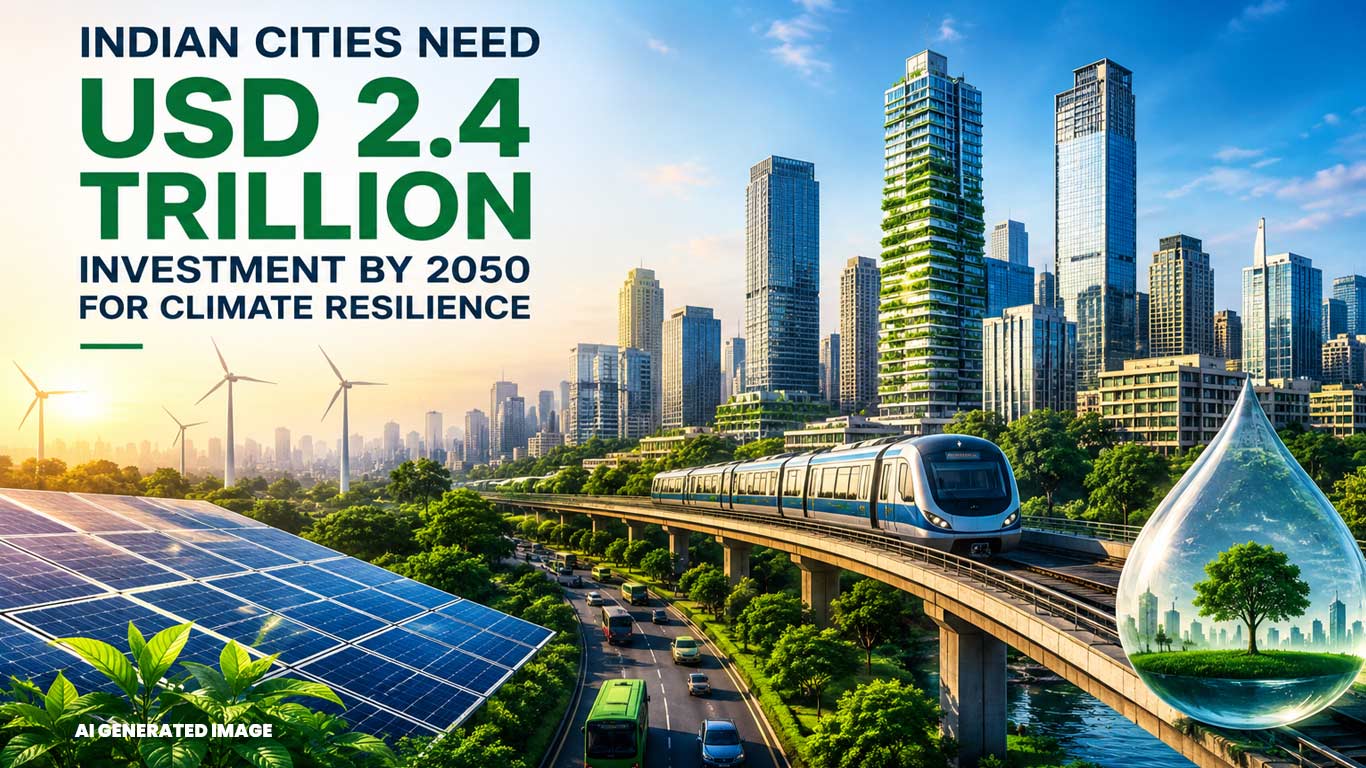
Indian Cities Need USD 2.4 Trillion Investment By 2050 For Climate Resilience: FICCI-EY
New Delhi, Jul 30 (KNN) Indian cities will require an estimated USD 2.4 trillion in investment by 2050 to become climate-resilient and low-carbon, while municipal corporations have raised only a fraction of the required funding, according to a FICCI-EY report.
Indian Cities Need USD 2.4 Trillion Investment by 2050
The report, Cities as Growth Engines: Powering India's Next Leap, noted that only 20 municipal corporations have accessed capital markets so far, collectively raising around USD 476 million.
Urban areas currently generate more than 60 percent of India's GDP while accounting for around one-third of the country's population. However, municipal corporations collectively raise revenues equivalent to only about 0.6 percent of GDP.
Urban Infrastructure Needs USD 840 Billion Over 15 Years
The report estimates India's urban infrastructure requirement at around USD 840 billion over the next 15 years, translating to nearly USD 55 billion annually. Around 70 percent of the urban infrastructure required by 2047 is yet to be developed.
India's urban population is projected to reach nearly 600 million by 2036 and contribute around 70 percent of GDP. By 2050, the urban population is expected to rise to 877 million, accounting for nearly 75 percent of GDP.
Cities Need Stronger Governance and Innovative Financing
Raj Menda, Chairman, FICCI Committee on Urban Development and Real Estate, said cities must move beyond infrastructure creation to become economically competitive and investment-ready through stronger governance, innovative financing and integrated planning.
The report highlighted the Rs 1 lakh crore Urban Challenge Fund, which requires urban local bodies to raise 50 percent of project costs through capital markets and is expected to catalyse nearly Rs 4 lakh crore in investments.
It proposed six strategic shifts, including from service delivery to economic leadership, fiscal dependence to investment readiness, infrastructure creation to economic competitiveness, and climate vulnerability to resilience.
Tier-II and Tier-III Cities Seen as Future Growth Hubs
It also called for a more distributed urban growth model. India's top 10 cities account for nearly 30 percent of national GDP, while 36 mid-to-large cities and around 450 smaller urban centres remain relatively underleveraged.
The report recommended developing Tier-II and Tier-III cities as regional growth hubs through economic corridors and initiatives such as PM Gati Shakti.
Existing Urban Schemes Have Mobilised Major Investments
It highlighted investments under key urban programmes, including over 8,000 Smart Cities Mission projects worth more than Rs 1.64 lakh crore, Rs 2.7 lakh crore committed under AMRUT across nearly 500 cities, and 1.25 crore houses sanctioned under PMAY-Urban.
Menda said achieving Viksit Bharat 2047 would depend heavily on India's cities, with transparent financial systems and investment-ready balance sheets crucial for attracting capital.
(KNN Bureau)







 Loading...