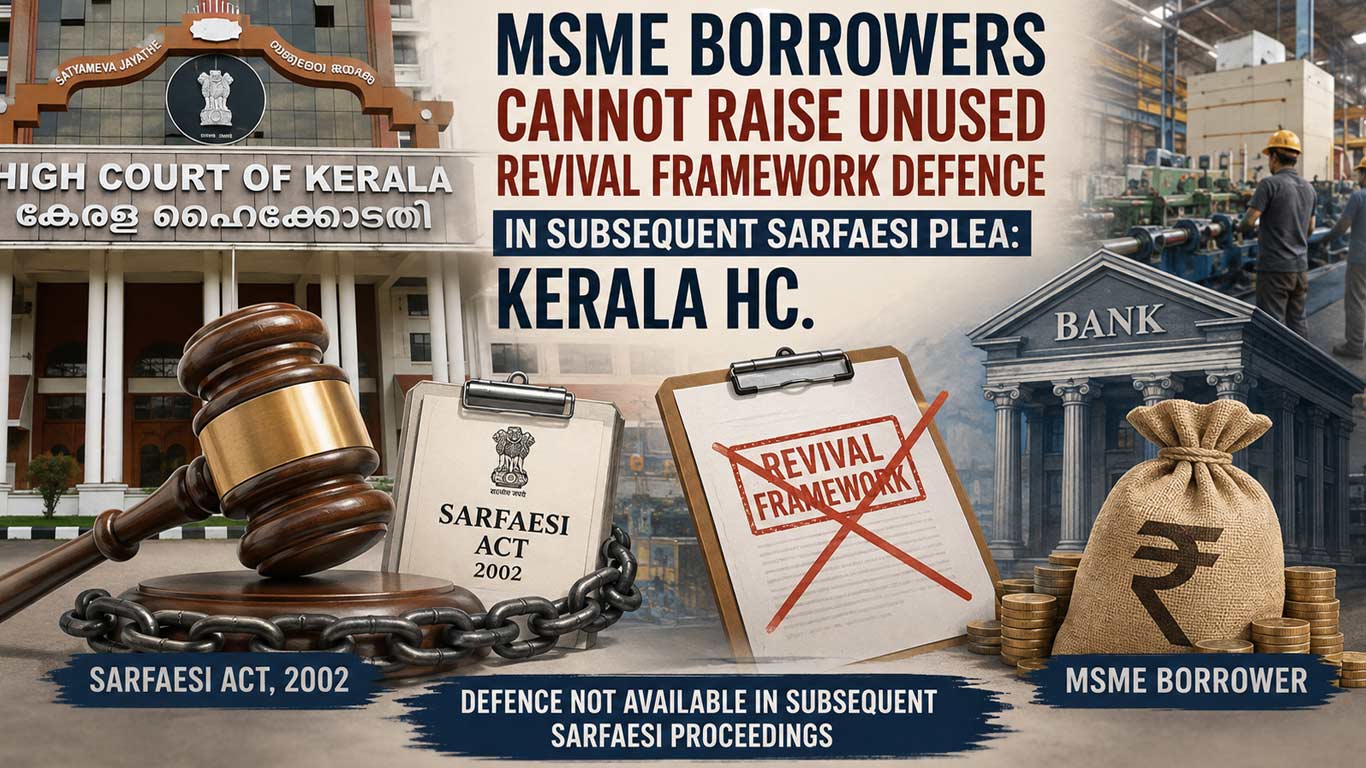
MSME Borrowers Cannot Raise Unused Revival Framework Defence In Subsequent SARFAESI Plea: Kerala HC
Updated: Sep 03, 2026 04:12:57pm

MSME Borrowers Cannot Raise Unused Revival Framework Defence In Subsequent SARFAESI Plea: Kerala HC
New Delhi, Sep 3 (KNN) The Kerala High Court has held that an MSME borrower cannot invoke the MSME revival and rehabilitation framework for the first time in subsequent litigation to challenge SARFAESI proceedings when the ground was available but not raised in the initial proceedings.
A Division Bench of Chief Justice Soumen Sen and Justice Syam Kumar V.M. upheld the dismissal of a writ petition filed by Soubhagye Road Builders and its proprietors against recovery proceedings initiated by Canara Bank under the Securitisation and Reconstruction of Financial Assets and Enforcement of Security Interest Act, 2002.
MSME Protection Raised in Second Round of Litigation
Soubhagye Road Builders claimed MSME status and sought protection under the MSME Notification dated May 29, 2015, and the RBI Circular dated March 17, 2016. It argued that the bank had initiated SARFAESI proceedings without following the prescribed revival and rehabilitation mechanism for stressed MSME accounts.
The bank said the borrowers had availed an overdraft facility of Rs 2 crore, sanctioned on August 14, 2023, for one year. Despite a reminder, they allegedly failed to seek renewal or submit the required documents.
The account was classified as a non-performing asset (NPA) on February 8, 2025, following which the bank issued a demand notice under Section 13(2) of the SARFAESI Act.
The borrowers initially challenged the recovery proceedings before the High Court. After the petition was dismissed with liberty to approach the appropriate forum, they filed another writ petition challenging subsequent recovery and auction proceedings.
They relied on their MSME status and the revival and rehabilitation framework for the first time in the second round of litigation.
A Single Judge dismissed the petition, holding that the borrowers had not invoked the MSME framework after receiving the Section 13(2) notice and could not raise the claim belatedly.
Court Says Enterprise Also Has Responsibility
The Division Bench held that while a bank has an obligation to identify incipient stress in an MSME loan account, the enterprise is also required to voluntarily initiate proceedings under the revival and rehabilitation framework when it apprehends business failure or an inability to repay its debts.
The Court noted that the borrowers had not approached the bank with any rehabilitation package.
It also rejected the argument that the subsequent auction notice created a fresh cause of action. The Bench held that the auction proceedings were a continuation of the SARFAESI action initiated through the Section 13(2) demand notice.
Earlier Grounds Cannot Be Raised in Subsequent Petition
The Court observed that the borrowers were not under any disability when they first approached the High Court and could have challenged the NPA classification and recovery proceedings on the basis of their MSME status.
Referring to the Henderson principle and the Supreme Court’s decision in CELIR LLP v. Mr. Sumati Prasad Bafna, the Bench held that a subsequent writ petition cannot be used to raise a ground that was available in an earlier proceeding arising from the same cause of action.
The Court concluded that no independent ground existed to challenge the auction sale other than the claim for protection under the MSME framework.
The appeal was accordingly dismissed. However, the High Court granted the appellants three weeks’ time to approach the Debts Recovery Tribunal (DRT).
(KNN Bureau)





 Loading...