Supreme Court Releases Draft AI Regulations For Courts; Judges To Retain Final Authority
Updated: Jun 04, 2026 04:08:08pm

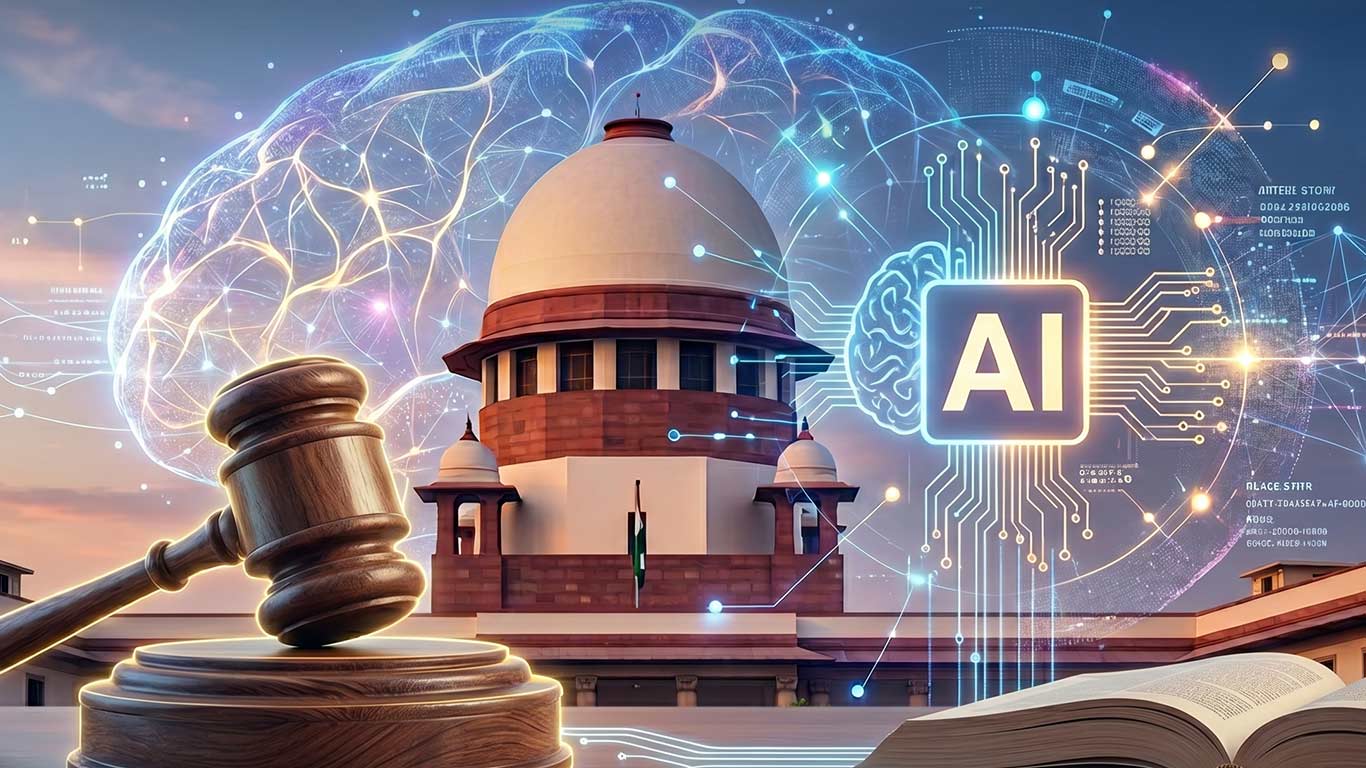
Supreme Court Releases Draft AI Regulations For Courts; Judges To Retain Final Authority
New Delhi, Jun 4 (KNN) The Supreme Court has released draft regulations governing the use of Artificial Intelligence in the country's court system.
The draft ‘Regulations for Use of Artificial Intelligence in Courts, 2026’, published by the Supreme Court's AI Committee, proposes a framework encouraging responsible technology adoption while firmly preserving judicial authority.
It is open for public comments until June 20, 2026, and will apply to the Supreme Court, High Courts, subordinate courts, tribunals, and statutory commissions across India.
What AI Can and Cannot Do
The draft permits AI for legal research, citation verification, summarising pleadings and judgments, translation, transcription, drafting assistance, scheduling, case management, and litigant-facing chatbots.
However, AI is strictly prohibited from deciding cases, passing sentences, determining bail, assessing flight risk or likelihood of reoffending, evaluating witness credibility, predicting conduct of any party, conducting surveillance of court participants, or using opaque black-box systems in matters affecting rights or personal liberty.
Human Primacy and Accountability
The regulations are anchored in human primacy — AI must function solely in an assistive capacity, with all judicial authority remaining exclusively with judges.
Judges and court officials cannot cite AI outputs, system opacity, or AI hallucinations — where AI generates plausible but fabricated information — as a defence for incorrect or harmful decisions.
Parties using AI in preparing pleadings, documents, or evidence must disclose this to the court. Courts may seek details of the system used and the steps taken to verify accuracy.
Crucially, no person can use the AI-generated nature of a filing as a defence if it is found to be false or misleading — full legal responsibility rests with the submitting party.
Governance, Audits and Data Protection
The draft proposes a permanent apex body at the Supreme Court comprising judges, technology experts, cybersecurity specialists, and technology lawyers to set national standards and approve AI systems.
AI Committees and Secretariats are proposed for the Supreme Court and every High Court, alongside a Centre of Research and Excellence on Artificial Intelligence (CoRE-AI) and an AI Content Verification Authority.
All deployed AI systems must undergo annual technical, legal, and ethical audits. Courts will maintain an AI Register and an AI Incident Database, with mandatory reporting of errors or bias with legal consequences.
Data protection measures require compliance with the Digital Personal Data Protection Act, 2023, with sensitive judicial data subject to heightened safeguards. Private vendors must meet strict conditions on data ownership, audit rights, and liability.
A Pro-Adoption Stance
The draft establishes a presumption in favour of responsible AI adoption, encouraging courts to actively explore tools that improve access to justice and reduce delays. Any decision to restrict an AI system must ordinarily be supported by written reasons.
(KNN Bureau)








 Loading...