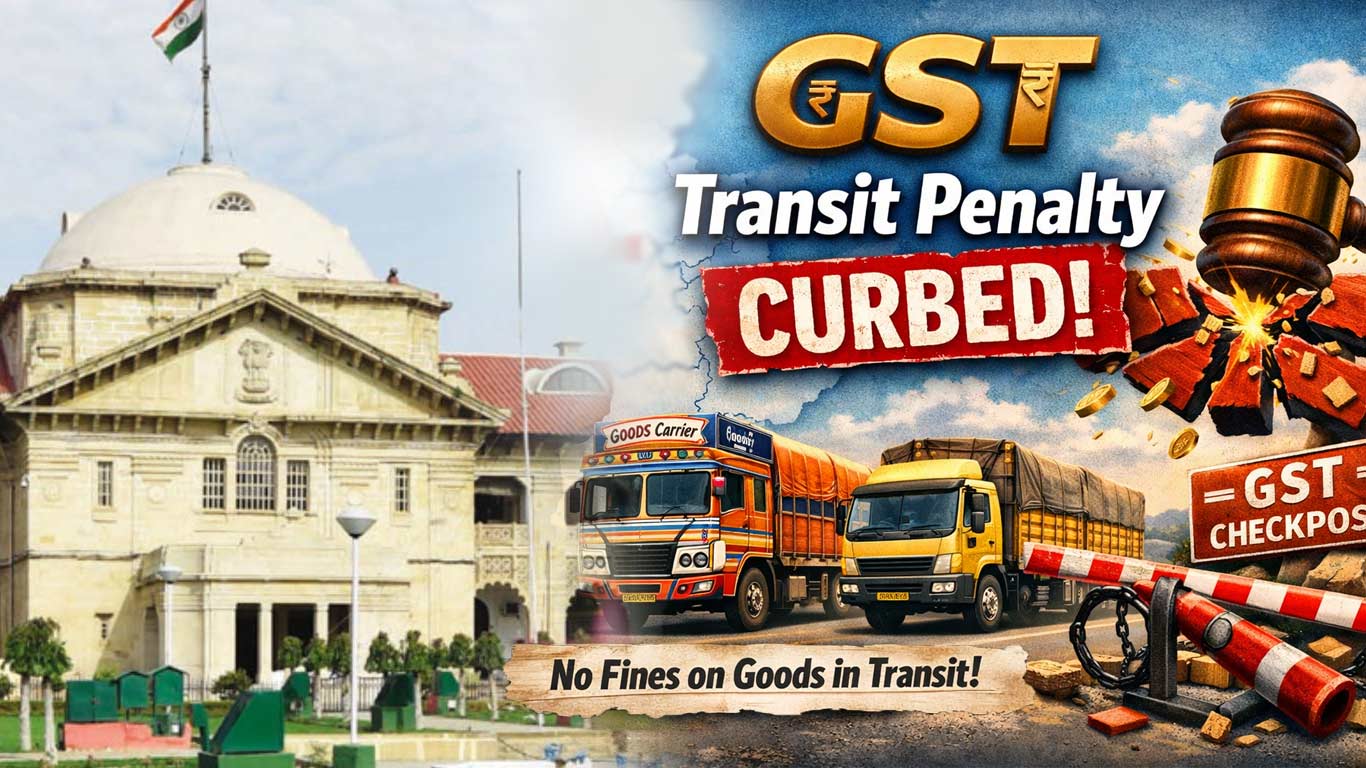
Transit Authorities Cannot Impose Penalties On Goods Passing Through States; GST Action Curbed: Allahabad HC
Updated: Jun 12, 2026 01:59:32pm

Transit Authorities Cannot Impose Penalties On Goods Passing Through States; GST Action Curbed: Allahabad HC
Lucknow, Jun 12 (KNN) The Allahabad High Court has ruled that GST officers in a transit state have no authority to impose penalties on goods passing through their jurisdiction when neither the origin nor the destination of the consignment lies within that state, in a judgment seen as significant for India's ‘One Nation, One Tax’ framework.
The ruling came in Maruti Enterprises vs State of Uttar Pradesh & Others, a batch of writ petitions before the court, Tax India Online reported.
The High Court ruling brings much-needed certainty and protection for traders and MSMEs, especially those engaged in interstate trade, by curbing disruptions by transit-state authorities or GST officials and easing compliance pressures.
Background
Maruti Enterprises, a Delhi-registered trader, had purchased areca nuts from a supplier in West Bengal for transport to Delhi, but the consignment — despite having a valid e-way bill and physical invoice — was intercepted by GST officials in Gautam Buddh Nagar, Uttar Pradesh.
As the supplier’s turnover exceeded the e-invoicing threshold under Rule 48(4) of the CGST Rules, officials treated the absence of an invoice reference number (IRN) as rendering the invoice invalid under Rule 48(5) and imposed a penalty under Section 129.
The trader, however, argued that the e-way bill was valid, quantities matched, and he was merely a buyer in an interstate transaction with no connection to Uttar Pradesh.
Arguments Before the Court
The petitioners argued that while transit-state officers may inspect goods in transit, they cannot exercise penal powers without any tax liability arising in that state. They maintained that the transaction was strictly between West Bengal and Delhi, with no IGST, SGST, or CGST liability accruing to Uttar Pradesh.
The state government, however, cited Sections 6, 68, and 129 of the CGST Act, Section 4 of the IGST Act, and Rules 138A to 138C, arguing that cross-empowerment provisions permit detention and penal action anywhere during transit.
The Court's Findings
The Allahabad High Court rejected the department’s stance, holding that GST under Article 269A is a destination-based tax, and since Uttar Pradesh had no tax stake in the transaction, it lacked authority to impose a penalty.
It clarified that Section 6 of the CGST Act allows cross-empowerment only within the same state and does not permit officers of one state to act as assessing authorities for another.
The court further ruled that the absence of an e-invoice was a lapse by the West Bengal supplier and, in the absence of any evidence of tax evasion or diversion within Uttar Pradesh, such a technical defect could not justify penalty action by transit-state officers. Invoking Article 301, it held that repeated penalties on goods merely passing through states would create unconstitutional barriers to interstate trade.
As there was no indication that the goods were meant for sale in Uttar Pradesh and the e-way bill clearly showed Delhi as the destination, the court concluded that the penalty lacked any legal basis.
Inspection Versus Penalty: A Clear Distinction
The court drew a clear distinction between the inspection powers of transit states and penalty powers under Section 129, holding that while transit states can stop vehicles, verify documents, and inspect goods, penalties can be imposed only where there is a tax liability within the state or evidence of local diversion or evasion.
It ruled that any discrepancies found in transit should be referred to authorities in the origin or destination state rather than triggering penalty proceedings.
The court also addressed the practice of compelling traders to obtain temporary GST registration in transit states for release of detained goods, noting that Section 22 links registration to a place of business and does not permit registration in a state where none exists, rendering such penalties legally unsustainable.
(KNN Bureau)







 Loading...