Wayanad Becomes India’s First Fully Paperless District Court, Enhancing Access To Justice For Litigants & MSMEs
Updated: Jan 08, 2026 05:30:04pm

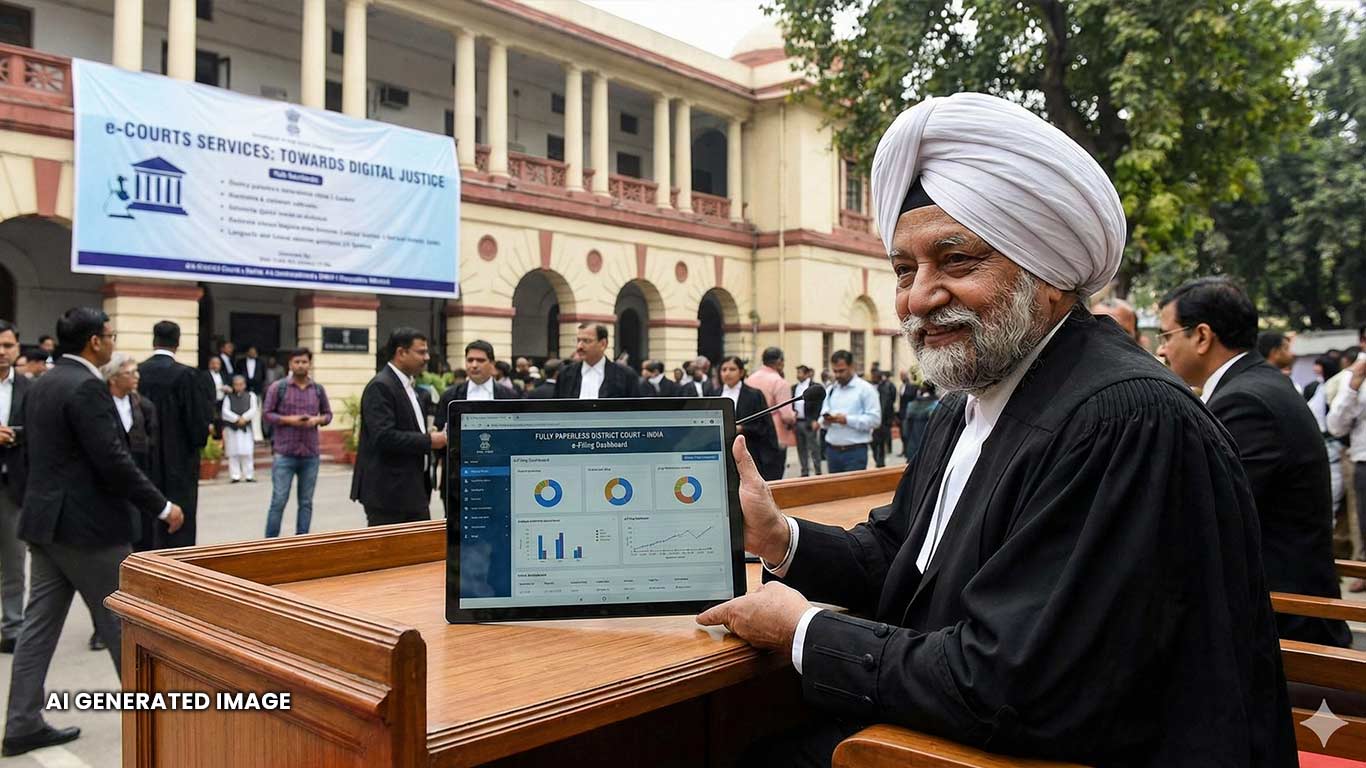
Wayanad Becomes India’s First Fully Paperless District Court, Enhancing Access To Justice For Litigants & MSMEs
Thiruvananthapuram, Jan 8 (KNN) Chief Justice of India (CJI) Surya Kant on January 6 virtually inaugurated India’s first fully paperless district judiciary in Kalpetta, Wayanad, Kerala, marking the first time an entire district court system has shifted to end-to-end digital functioning. The inauguration took place at the Kerala High Court auditorium.
All courts in the Kalpetta district will now function exclusively in digital mode, with filings received electronically, scrutinised digitally, and instantly accessible to judges through the District Court Case Management System (DCMS) developed in-house by the Kerala High Court.
This development improves access to justice in concrete, measurable ways, especially for ordinary litigants and MSMEs. It not only removes geographical barriers and reduces the cost of litigation, but also strengthens transparency and trust in the judicial system.
AI Integration and Digital Tools
The paperless system is supported by AI-based tools enabling judges to generate structured summaries from electronic case records, retrieve case-specific information, annotate documents digitally, and mark statutory provisions.
Voice-to-text technology ensures accurate transcription of witness depositions and judicial dictation, while secure digital signatures grant legal validity and authenticity to orders and judgments.
The system has been entirely developed in-house without reliance on external proprietary platforms.
“Shedding the Tyranny of the File”
In his inaugural address, CJI Kant described the initiative as a transformative shift in justice delivery.
"When we deliberate on the law or the justice system, we often think of it as a monumental edifice, built of stone, tradition, and historically, mountains of parchment. Today, as we inaugurate the paperless courts of Wayanad, we acknowledge a profound shift in our constitutional geometry," he said.
Highlighting environmental and social benefits, the CJI termed the initiative “green jurisprudence,” noting that digitisation eliminates the need for paper while ensuring justice is accessible and transparent.
Enhancing Access and Equality
CJI Kant emphasised that the digital courts bridge physical and logistical barriers, democratising access to justice.
"Whether a litigant is in the heart of Kalpetta or a remote corner of the district, the digital record is equally available, immediate, and incorruptible," he said, adding that the system ensures “algorithmic accountability” with a permanent digital footprint for every entry.
Call to the Bar
Acknowledging the concerns of senior advocates accustomed to physical briefs, CJI Kant urged the legal fraternity to embrace the transformation.
"Tradition is not the worship of ashes but the preservation of fire. We are not changing the law or how it is practised. We are sharpening the tools used to serve it. This is a human-centric transformation where the machine does not replace the mind—it liberates it," he said.
National Significance
Justice Vikram Nath, Chairperson of the Supreme Court eCommittee, delivered the keynote address online, describing the initiative as a purpose-driven reform that brings justice closer to citizens.
"Every reform in the justice system must answer one question: does it bring justice closer to the citizen? Wayanad, often perceived as remote due to its geography, has now become home to one of the most forward-looking judicial reforms in the country," he said.
Justice Nath also noted that courts have historically been major consumers of paper, and the initiative reflects a conscious effort to reduce the judiciary’s ecological footprint.
(KNN Bureau)








 Loading...