Only 20-30% of Eligible Indian Exports Use FTA Benefits: RBI Governor
Updated: Nov 28, 2026 12:41:37pm

Only 20-30% of Eligible Indian Exports Use FTA Benefits: RBI Governor
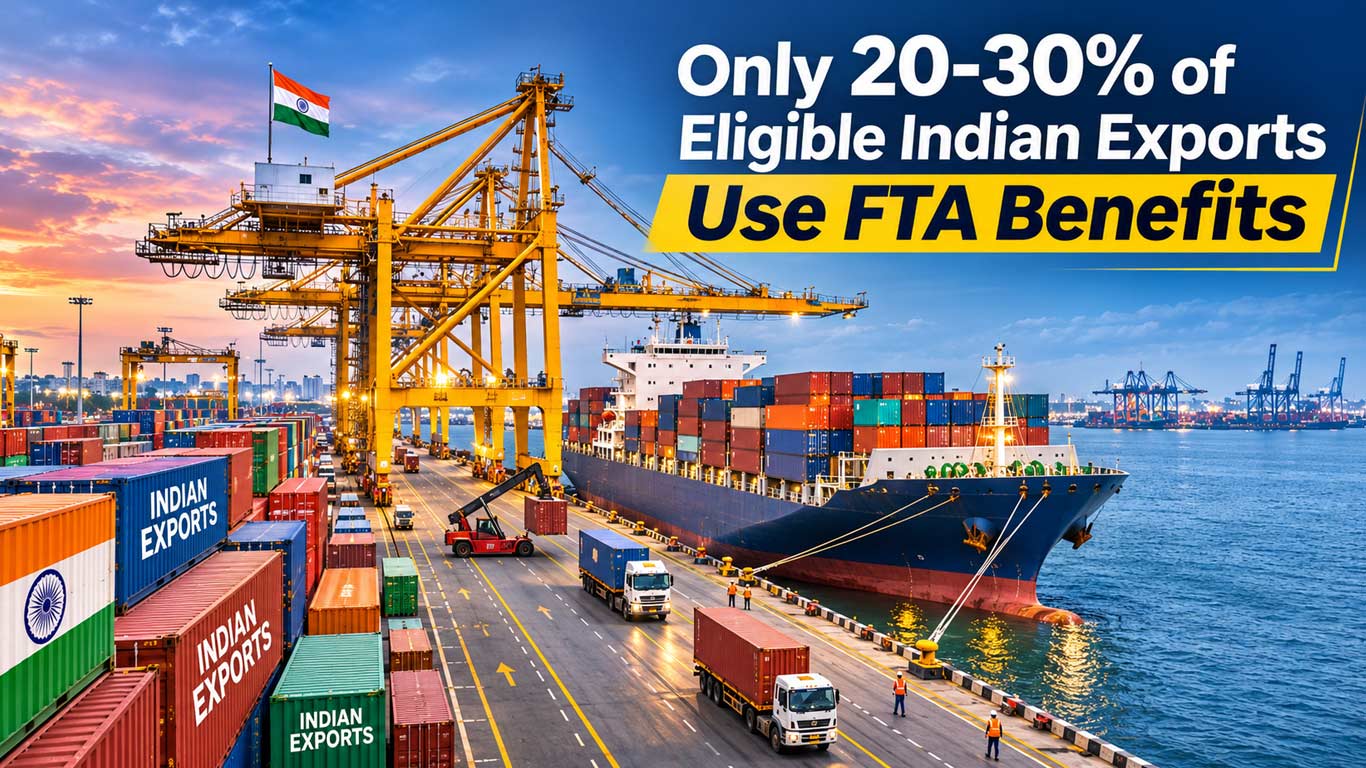
New Delhi, Nov 28 (KNN) Only 20-30 per cent of eligible Indian exports use preferential tariff benefits under the country's free trade agreements (FTAs), compared with 60-70 per cent of partner countries' exports to India, Reserve Bank of India (RBI) Governor Sanjay Malhotra said on Friday.
Addressing the SME Finance & Investment Summit, Malhotra urged micro, small and medium enterprises (MSMEs) to look beyond domestic markets and make better use of trade agreements, as mentioned by Business Standard.
“Look beyond domestic markets. Only about 20-30 per cent of eligible Indian exports take advantage of the lower tariffs available under our FTAs.
It is remarkably low compared with 60-70 per cent utilisation by partner countries’ exports to India,” he said, calling it “an opportunity we are leaving on the table”.
He asked MSMEs to understand relevant FTA provisions and invest in quality, standards and certification to access overseas markets. India has signed 17 FTAs, including agreements with Oman, the UK and New Zealand that came into force this year. The formal signing of the India-EU FTA is scheduled for December 16.
MSME Credit and Productivity
Malhotra said bank credit to MSMEs grew 27 per cent year-on-year in the 12 months ended September 2026, against 19.4 per cent growth in overall bank credit.
Outstanding MSME loans rose from Rs 17.97 trillion in September 2021 to Rs 42.89 trillion in September 2026.
"The credit gap has certainly not disappeared, but it has narrowed considerably, and quickly," he said, adding that lending should increasingly focus on first-time borrowers, micro enterprises, women-led businesses and units in smaller towns and rural areas.
The RBI raised the collateral-free loan limit for micro and small enterprises from Rs 10 lakh to Rs 20 lakh from April 1, 2026. Banks can extend it to Rs 25 lakh for enterprises with a good track record.
He also highlighted the Account Aggregator framework, which facilitated loans worth around Rs 3.5 trillion in FY26, and the Unified Lending Interface, which he expects to transform lending in a way similar to UPI in payments.
Malhotra said MSME productivity, measured by value added per worker, was just 26 per cent of that of large enterprises. Improving productivity to the level of top-quartile firms in advanced economies could add the equivalent of 11 per cent of India's GDP.
He urged MSMEs to invest in technology, innovation and workforce productivity, formalise operations, explore exports and use financing platforms such as the Trade Receivables Discounting System (TReDS). Government support, he said, should be treated as "a catalyst, not a crutch".
AI Adoption and Bank Lending
Malhotra estimated AI adoption among MSMEs at around 15 per cent. Citing a survey, he said 76 per cent of MSME leaders used AI in some form, but only 5 per cent had integrated it into their core operations.
"Overall, AI is estimated to generate $490-685 billion of economic value for the MSME sector," he said.
On industry demands to extend the loan classification period for non-performing assets (NPAs) from 90 to 180 days, Malhotra suggested that borrowers could negotiate longer repayment tenures with banks.
"If you take the repayment period as longer, then the 90-day period will start later," he said.
He also called on banks to establish dedicated help modules at branches to guide entrepreneurs through government schemes and strengthen relationship-based lending.
Banks should assess enterprises' needs and repayment capacity, while credit guarantees should support risk-sharing rather than replace due diligence, he added.
(KNN Bureau)


 Loading...