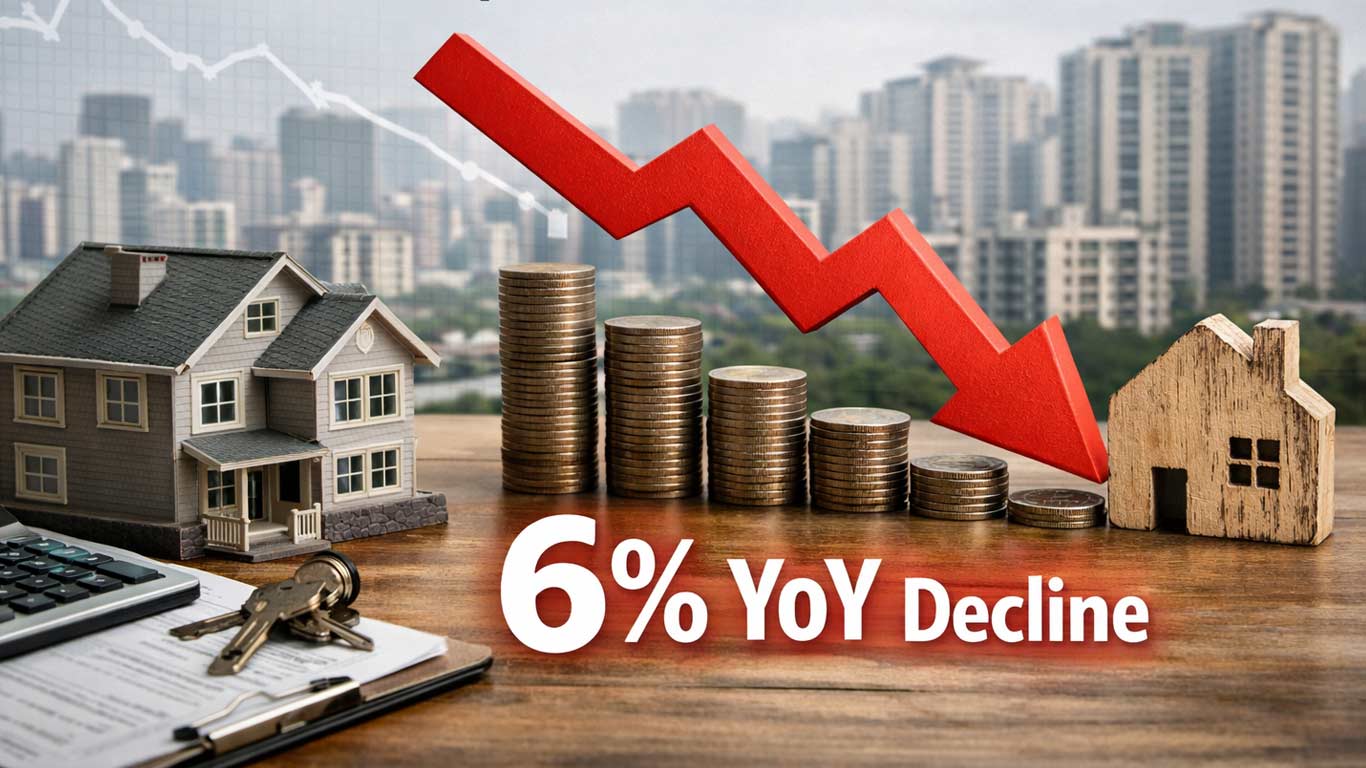
Housing Sales Fall 6% YoY In Q2 2026 Across Top 7 Cities As West Asia Conflict Dampens Buyer Sentiment: ANAROCK
Updated: Jun 29, 2026 04:08:21pm

Housing Sales Fall 6% YoY In Q2 2026 Across Top 7 Cities As West Asia Conflict Dampens Buyer Sentiment: ANAROCK
New Delhi, Jun 29 (KNN) Residential housing sales across India’s top seven cities fell 6 per cent year-on-year (YoY) in the April–June quarter of 2026 to about 90,715 units, down from 96,285 units in the same period last year. On a quarter-on-quarter (QoQ) basis, sales declined 11 per cent, according to data released by property consultancy ANAROCK Research.
ANAROCK attributed the slowdown to the ongoing West Asia conflict and its cascading effects on supply chains, alongside uncertainty in the IT/ITeS sector stemming from artificial intelligence-related disruptions — factors that have pushed a significant share of prospective buyers to the sidelines.
ANAROCK Chairman Anuj Puri said the trends align with expectations amid the impact of the Middle East conflict, as the housing market turns more balanced with supply catching up with absorption and sales growth moderating across major cities.
Growth is now led by premium housing, GCC-driven hubs and infrastructure corridors, he noted, adding that conflict-related disruptions and AI uncertainties in the IT/ITeS sector have made buyers adopt a wait-and-watch approach.
Sales: A Mixed Picture Across Cities
The Mumbai Metropolitan Region (MMR) and Bengaluru together accounted for 48 per cent of total sales in Q2 2026, with approximately 28,710 and 15,285 units sold, respectively.
Of the seven cities tracked, only Kolkata (up 10 per cent), Hyderabad (up 2 per cent), and Bengaluru (up 1 per cent) recorded YoY sales growth. Pune saw the steepest annual decline at 15 per cent, with approximately 13,090 units sold. NCR reported a 6 per cent yearly drop to roughly 13,365 units.
New Launches Rise Annually, Ease Sequentially
New housing supply rose 7 per cent YoY to approximately 1,06,000 units in Q2 2026, up from 98,625 units a year earlier. However, on a quarterly basis, launches fell 16 per cent from approximately 1,26,265 units in Q1 2026.
Hyderabad led annual launch growth at 53 per cent, adding approximately 16,970 units, while Bengaluru recorded a 41 per cent yearly jump to 21,670 units. NCR bucked the trend with a 40 per cent annual decline to approximately 11,205 units — the sharpest fall among the seven cities.
Puri said, “Interestingly, new launches remained strong in Q2 2026 annually as large and listed developers unleashed projects on the massive land parcels they acquired in 2025.”
“However, on quarterly basis, new supply in the top cities dropped by 16% in Q2 2026. Uncertainty-weakened buyer sentiment would also have caused many developers to throttle back new supply,” he added.
Premium Segment Dominates; Affordable Housing Shrinks
Across the top seven cities, homes priced between Rs 80 lakh and Rs 1.5 crore commanded the largest supply share at 27 per cent, followed by the Rs 1.5 crore–Rs 2.5 crore bracket at 25 per cent and the above-Rs 2.5 crore segment at 22 per cent.
The mid-segment (Rs 40 lakh–Rs 80 lakh) held a 19 per cent share. Affordable housing — priced below Rs 40 lakh — has now retreated to a single-digit supply share of just 6 per cent.
Prices Up Annually
Average residential prices across the top seven cities rose 7 per cent YoY in Q2 2026, though quarterly appreciation was a marginal 1 per cent — a notable deceleration from the double-digit annual gains recorded in these markets last year. NCR posted the highest annual price increase at 13 per cent, followed by Bengaluru at 8 per cent.
Inventory Rises
Unsold inventory across the top seven cities rose 10 per cent annually to over 6.16 lakh units by the end of Q2 2026, from approximately 5.62 lakh units a year earlier.
Bengaluru recorded the steepest inventory build-up, with available stock rising 34 per cent YoY to approximately 79,180 units. NCR was the only city where inventory levels remained broadly stable.
(KNN Bureau)









 Loading...