India’s Bioenergy Growth to Accelerate, Capacity Seen at 15.5 GW by FY32
Updated: Apr 01, 2026 05:44:08pm

India’s Bioenergy Growth to Accelerate, Capacity Seen at 15.5 GW by FY32
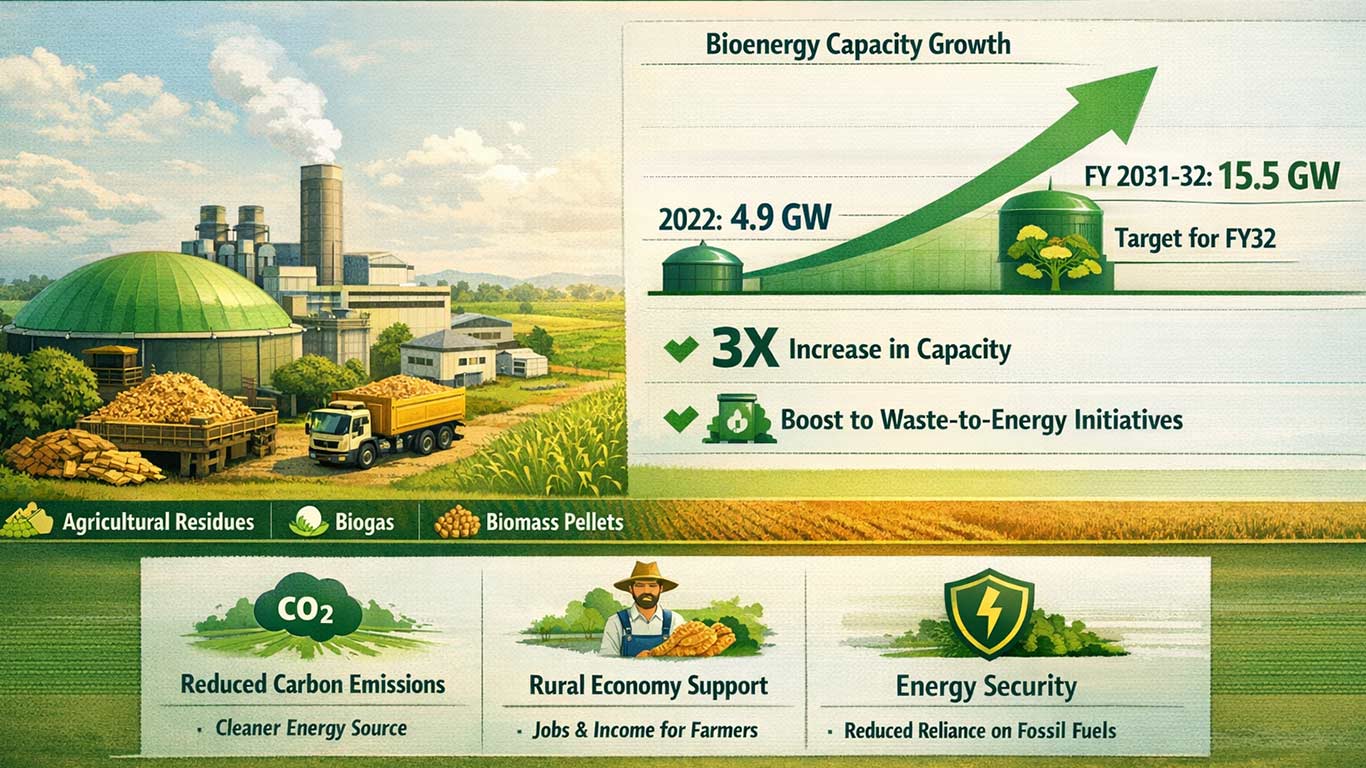
New Delhi, Apr 1 (KNN) India’s bioenergy installed capacity is projected to increase to 15.5 gigawatt (GW) by FY32 from around 11.6 GW as of March 2025, supported by favourable policy measures and abundant biomass availability, though execution challenges remain, according to a report by CareEdge Ratings.
Bioenergy currently contributes about 11.6 GW to India’s renewable energy mix, with bagasse cogeneration accounting for the largest share, followed by biomass and waste-to-energy (WtE) segments.
Over the past five years, the sector has added nearly 868 MW of biomass power and cogeneration capacity, along with 693 MW of WtE capacity, reflecting steady growth driven by policy support, according to financial express
The report highlighted that sectoral expansion is being aided by initiatives such as the National Bioenergy Programme, Waste-to-Energy Programme Guidelines, Biomass Co-firing Policy, and biofuel blending targets, which provide financial support, standardised technology frameworks and assured offtake mechanisms.
India’s strong biomass base continues to underpin long-term growth prospects. The country generates nearly 750 million tonnes of agricultural residue annually, with surplus biomass estimated at around 250 million tonnes in FY24—sufficient to support energy generation of approximately 28 GW. This availability is expected to rise further, with total biomass projected at 948 million tonnes and surplus biomass at 295 million tonnes in FY25.
Despite the resource advantage, the report flagged structural constraints including supply chain inefficiencies, seasonality, logistics and storage limitations, high aggregation costs, and increasing competition from lower-cost solar and wind energy.
Capacity addition has remained moderate, with total bioenergy capacity rising from 10.53 GW in FY21 to 11.58 GW in FY25, translating into a compound annual growth rate (CAGR) of 2.24 per cent. Within this, biomass power and bagasse cogeneration increased from 9.37 GW to 9.82 GW, while non-bagasse biomass rose from 0.77 GW to 0.92 GW. Waste-to-energy capacity nearly doubled from 0.17 GW to 0.31 GW, indicating growing policy emphasis on urban waste utilisation.
The report noted that WtE is emerging as a key segment due to its role in reducing landfill dependency and improving waste management, although it remains capital-intensive, with project costs ranging between Rs 6.38 crore and Rs 7.44 crore per MW—higher than solar but broadly comparable to wind.
Investment requirements are expected to rise in line with capacity expansion targets, with annual funding needs projected to increase from Rs 50.6 billion in FY25 to Rs 58.7 billion by FY30.
Highlighting broader benefits, the report said scaling up bioenergy could help reduce stubble burning, improve waste management, promote decentralised power generation and create additional income streams for farmers. It emphasised the need for coordinated policy alignment, data-driven biomass mapping and stronger institutional frameworks to fully realise the sector’s potential.
(KNN Bureau)









 Loading...


