SC Clarifies ‘Industry’ Definition: 1978 Test to Govern Pending Cases, New Labour Code to Follow Separate Framework
Updated: Aug 21, 2026 04:17:24pm

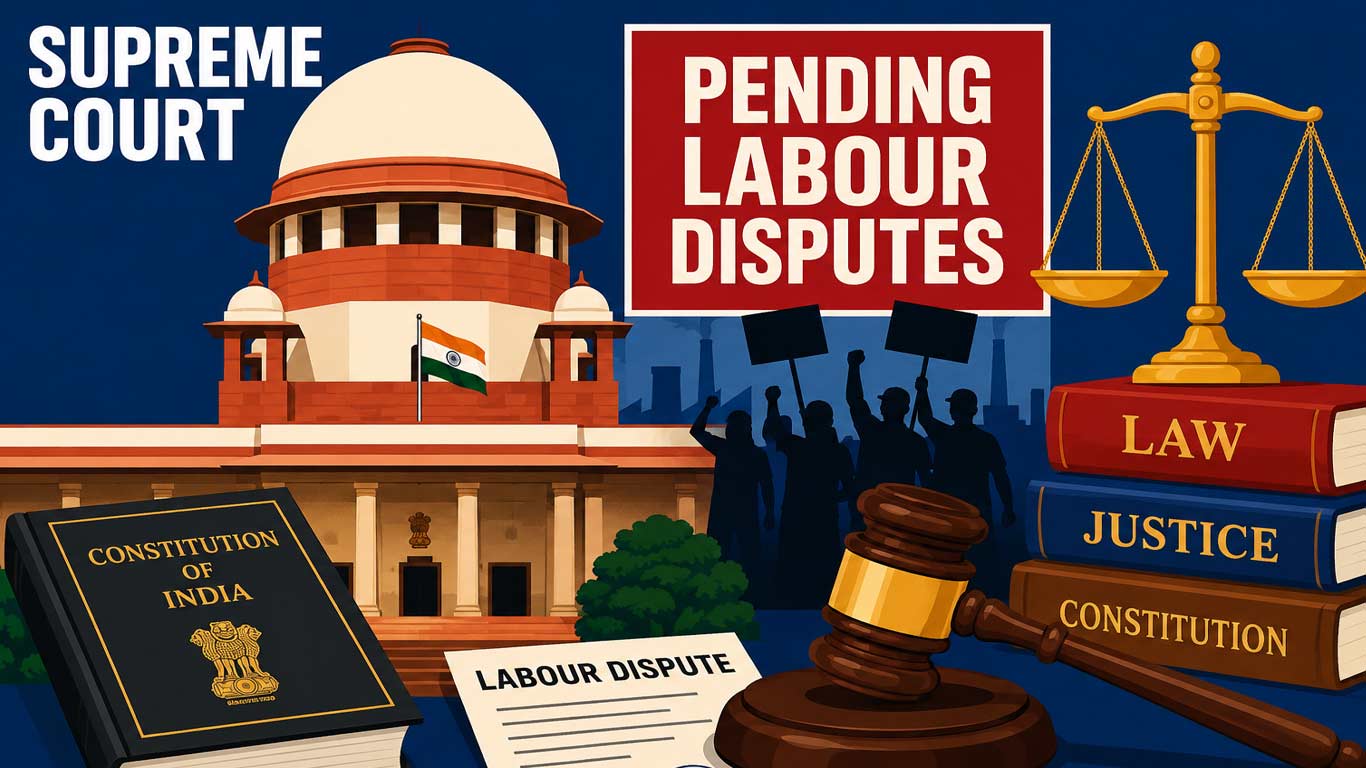
SC Clarifies ‘Industry’ Definition: 1978 Test to Govern Pending Cases, New Labour Code to Follow Separate Framework
New Delhi, Aug 21 (KNN) The Supreme Court has held that the broad interpretation of ‘industry’ laid down in its 1978 Bangalore Water Supply judgment will continue to govern pending disputes under the Industrial Disputes Act, 1947, but will not automatically apply to the Industrial Relations Code (IRC), 2020.
A nine-judge Constitution Bench headed by Chief Justice of India (CJI) Surya Kant and comprising Justices BV Nagarathna, PS Narasimha, Dipankar Datta, Ujjal Bhuyan, Satish Chandra Sharma, Joymalya Bagchi, Alok Aradhe and Vipul M Pancholi, by a 5:4 majority on the maintainability of the reference, held that the earlier judgment could be reconsidered, but clarified that its reformulated test would operate prospectively.
Pending cases under the 1947 Act will continue to be decided using the earlier ‘triple test’, while concluded cases will remain undisturbed.
New Labour Code to Have Separate Framework
The 1978 judgment had defined an ‘industry’ broadly, covering systematic activities involving employer-employee cooperation and the production or distribution of goods and services to meet human needs. The interpretation brought several establishments, including hospitals, educational institutions and municipalities, within labour law.
The majority held that the interpretation of Section 2(j) of the 1947 Act cannot be applied to Section 2(p) of the Industrial Relations Code (IRC), which came into force on November 21, 2025. The CJI observed that the interpretation of ‘industry’ under the Industrial Disputes Act does not bind its meaning under the IRC.
The court also made clear that its conclusions should not be treated as an interpretation of the IRC. The definition of ‘industry’ under the new Code will therefore have to be developed independently on the basis of its own text and context.
Four Judges Disagree
Justice B V Nagarathna, along with Justices Dipankar Datta and Ujjal Bhuyan, dissented on the reference, holding that the 1978 judgment did not require reconsideration.
Justice Nagarathna said its broad interpretation remained important for protecting workers amid liberalisation, privatisation and globalisation.
The verdict therefore preserves the broad 1978 framework for legacy disputes while leaving the scope of ‘industry’ under the new labour regime open for future judicial interpretation.
(KNN Bureau)






 Loading...