India's Textile Industry Set For Multi-Year Growth On China+1 Opportunity: 360 One Capital
Updated: Jul 20, 2026 01:09:52pm

India's Textile Industry Set For Multi-Year Growth On China+1 Opportunity: 360 One Capital
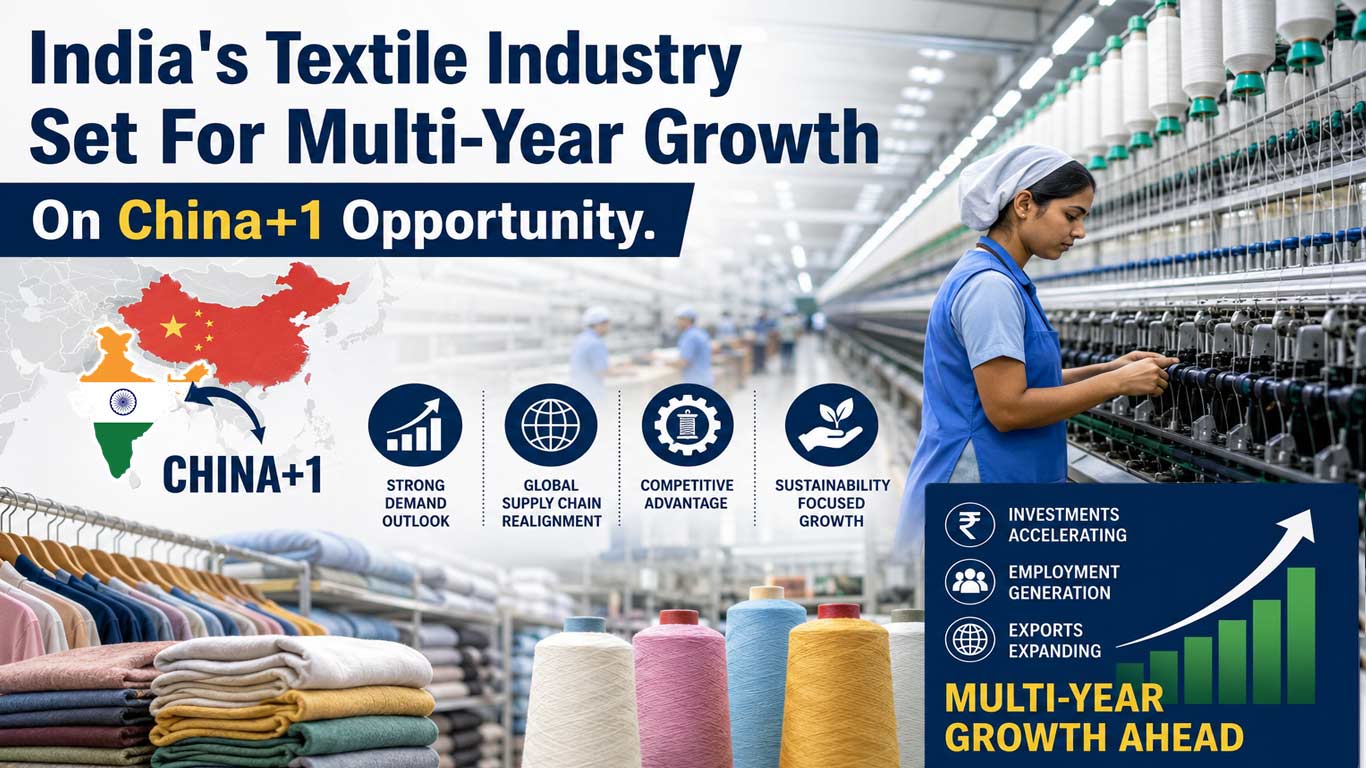
New Delhi, Jul 20 (KNN) India's textile industry is entering a multi-year structural growth phase, supported by the global China+1 sourcing strategy, supply chain diversification and improved market access through trade agreements, according to a report by 360 One Capital.
The report said sustained gains in exports and global market share will depend on manufacturers' ability to improve productivity, scale, technical capabilities and execution rather than relying solely on favourable trade policies.
Manufacturing Competitiveness Crucial
According to the report, global brands are increasingly diversifying sourcing away from China amid geopolitical uncertainties and the need for more resilient supply chains.
However, it noted that India has not fully capitalised on similar opportunities in the past and must strengthen manufacturing competitiveness to attract incremental sourcing.
Companies with scalable garment manufacturing, integrated operations, strong customer relationships and disciplined execution are expected to benefit the most, reported ANI.
Garmenting Remains Key Opportunity
The report highlighted that India's share in global apparel trade has remained around 3 percent, compared with 9-10 percent for Bangladesh and 6-7 percent for Vietnam.
It identified garment manufacturing as India's biggest structural opportunity, noting that fragmented production and limited scale continue to constrain export growth and value addition.
Future competitiveness, it said, will increasingly depend on factory productivity, automation, delivery reliability, product capabilities, compliance and supply chain resilience rather than labour costs alone.
Need To Diversify Beyond Cotton
The report said India also needs to diversify beyond cotton as global demand shifts towards man-made fibres, performance apparel and technical textiles.
It recommended strengthening capabilities in advanced fibres and yarns while improving cotton productivity, quality and traceability.
Trade Agreements Need Operational Readiness
While trade agreements such as the recently implemented India-UK Free Trade Agreement could improve India's export competitiveness, the report said operational readiness will determine whether tariff advantages translate into sustained orders.
It called for additional trade agreements alongside expansion in garment manufacturing capacity, technical capabilities, compliance standards and labour-intensive manufacturing clusters.
According to the report, automation, sustainability and traceability are expected to emerge as key competitive differentiators, with companies combining scale, integration, productivity and product innovation likely to be the biggest beneficiaries of the sector's long-term growth.
(KNN Bureau)







 Loading...


