Khadi Schemes Help Boost Artisan Incomes, Support Rural Employment & Sustainable Production
Updated: Oct 09, 2026 03:54:09pm

Khadi Schemes Help Boost Artisan Incomes, Support Rural Employment & Sustainable Production
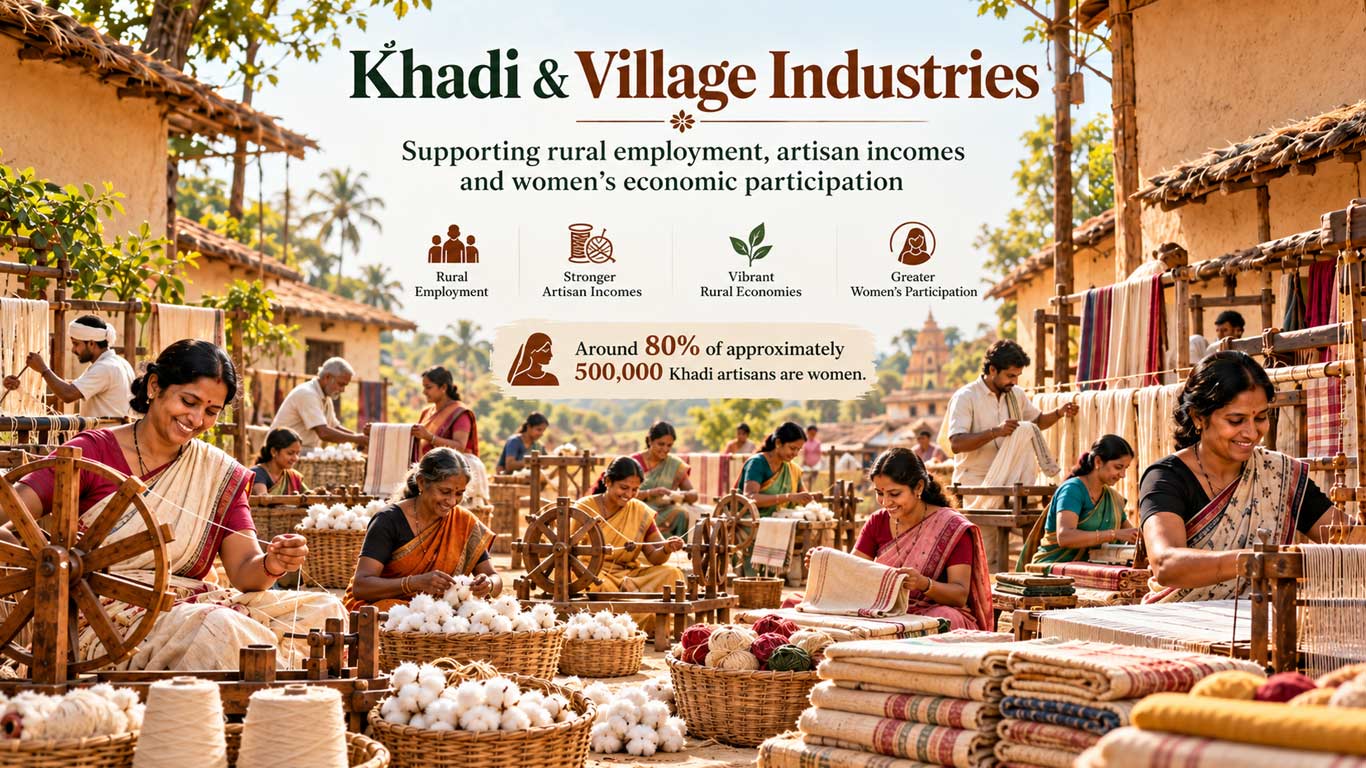
New Delhi, Oct 9 (KNN) The Khadi and Village Industries sector supports rural employment, artisan incomes and women’s economic participation, with around 80 per cent of approximately 500,000 Khadi artisans being women, according to information shared by the government.
The Khadi and Village Industries Commission (KVIC) supports artisans through skill development, improved tools, infrastructure and marketing initiatives. Spinning and weaving wages were increased from April 2025 to improve artisan earnings.
The government supports the sector through schemes including Khadi Vikas Yojana, Gramodyog Vikas Yojana and the Prime Minister’s Employment Generation Programme (PMEGP).
An evaluation by the Entrepreneurship Development Institute of India (EDII), Ahmedabad, found that more than 75 per cent of artisans covered by the schemes experienced an increase in income following the interventions.
Khadi products have expanded beyond traditional garments to include denim, designer saris, bridal wear and contemporary clothing. The Centre of Excellence for Khadi at the National Institute of Fashion Technology, Delhi, has developed 2,129 design collections. Navyug Khadi has introduced 710 products, while the Svadha collection focuses on wellness and yoga wear.
KVIC has also registered as an Export Promotion Council on the Trade Portal of the Consulate General of India in New York to facilitate international exposure for Khadi institutions. Ponduru Khadi has received a Geographical Indication (GI) tag, while Ponduru Khadi, Bharat Kasturi Cotton, Bengal Muslin and naturally coloured cotton products were showcased at the inaugural BRICS MSME Forum in Agra.
Technology upgrades are underway at KVIC’s Central Sliver Plants. Facilities at Chittadurga in Karnataka and Kuttur in Kerala have completed modernisation and become operational. The Chittadurga plant uses solar energy for 50 per cent of its energy requirements.
KVIC, in collaboration with ICAR-CIRCOT, is also exploring naturally coloured cotton varieties to reduce water use and the environmental impact associated with conventional dyeing.
The commission is proposing technology-based Common Facility Centres to support Village Industries clusters.
The sector’s decentralised production model and use of natural fibres are also linked to rural livelihood generation, responsible consumption and sustainable production.
(KNN Bureau)







 Loading...