Trend of going green catches up among business units, banks, educational institutions
Updated: Mar 15, 2014 02:38:38pm

New Delhi, Mar 15 (KNN) Even as global headlines scream about pollution, bad air quality and depletion of natural resources, the situation is compounded with high costs of overheads, forcing more and more businesses to look at green trends to reduce costs and increase sustainability.
Here in India, a cross section of institutions, be it banks, government institutions, educational or business units, are taking various initiatives to lower their carbon foot print and in compliance of environmental management principles.
Take the example of the Syndicate Bank which is planning to install 15 solar power units in its branches in the Nellore region of Andhra Pradesh.
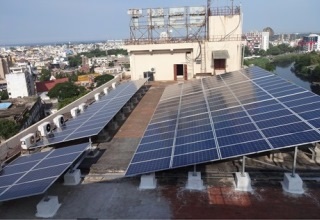
Meanwhile, Avinashilingam, an Institute for Home Science and Higher Education for Women in Coimbatore has commissioned the supply and installation of a 100 Kwp solar power plant in the second largest city and urban agglomeration in the state of Tamil Nadu, after Chennai.
According to reports, last month, Pondicherry University had invented a solar-powered drier which can be boon to the food processing industry as it can be used to dry agricultural produce, poultry and sea food.
Following suit, the Tirupati temple which is considered the world’s richest temple is planning to set up its own wind farm plant at Kakulakonda at Tirumala Hills. Tirumala Tirupati Devasthanams has already taken several initiatives to go the green way. In 2010, it had introduced non-conventional sources of energy, both for gardening and cooking, by installing solar powered lights, solar cooking system, windmills and a water recycling station, relying entirely on clear energy to feed the 60,000 odd visitors to the temple each day. Last year, the hill shrine had also installed solar panels atop its administrative building, to minimise its dependence on the grid.
Not wanting to be left behind, the government too is keeping up with the trend. Among others, the Madhya Pradesh government, according to a notice today wants to set up biomass and wind energy plants in various regions of the state under Madhya Pradesh Biomass based Electricity (Power) Project Implementation Policy 2011 and Non-conventional Energy Sources (2006).
Evidently, there is a growing consumer interest in environmentally friendly business practices and products. That consumers are becoming better educated about the need to conserve natural resources while looking for ways to lessen their impact on the environment, is certainly encouraging. (KNN/ES)
Here in India, a cross section of institutions, be it banks, government institutions, educational or business units, are taking various initiatives to lower their carbon foot print and in compliance of environmental management principles.
Take the example of the Syndicate Bank which is planning to install 15 solar power units in its branches in the Nellore region of Andhra Pradesh.
Meanwhile, Avinashilingam, an Institute for Home Science and Higher Education for Women in Coimbatore has commissioned the supply and installation of a 100 Kwp solar power plant in the second largest city and urban agglomeration in the state of Tamil Nadu, after Chennai.
According to reports, last month, Pondicherry University had invented a solar-powered drier which can be boon to the food processing industry as it can be used to dry agricultural produce, poultry and sea food.
Following suit, the Tirupati temple which is considered the world’s richest temple is planning to set up its own wind farm plant at Kakulakonda at Tirumala Hills. Tirumala Tirupati Devasthanams has already taken several initiatives to go the green way. In 2010, it had introduced non-conventional sources of energy, both for gardening and cooking, by installing solar powered lights, solar cooking system, windmills and a water recycling station, relying entirely on clear energy to feed the 60,000 odd visitors to the temple each day. Last year, the hill shrine had also installed solar panels atop its administrative building, to minimise its dependence on the grid.
Not wanting to be left behind, the government too is keeping up with the trend. Among others, the Madhya Pradesh government, according to a notice today wants to set up biomass and wind energy plants in various regions of the state under Madhya Pradesh Biomass based Electricity (Power) Project Implementation Policy 2011 and Non-conventional Energy Sources (2006).
Evidently, there is a growing consumer interest in environmentally friendly business practices and products. That consumers are becoming better educated about the need to conserve natural resources while looking for ways to lessen their impact on the environment, is certainly encouraging. (KNN/ES)










 Loading...