Value of Indian milk output to touch USD 140 bn by 2020
Updated: Apr 04, 2014 03:29:36pm

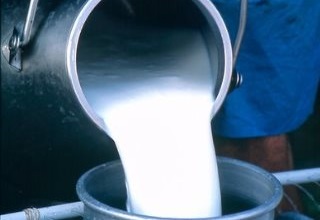
New Delhi, Apr 4 (KNN) With growth of milk production constant, value of Indian milk output is likely to touch USD 140 billion by 2020, taking into account both the organised and unorganised sector, a report said.
Post white revolution Indian dairy industry has shown a constant growth in milk production as well as in per capita milk availability – from 51.4 million tons in 1990 to about 127 million tons in 2011-12.
“…with current growth rate of approximately 3 per cent to 4 per cent it is thought to grow to 185 million tons and become a USD 24 billion (Rs 144000 Crore) organised industry by 2020 and USD 140 billion (Rs 840000 Crore) including unorganised sector,” Dairy Industry – Vision 2030 paper said.
However, it said that such volumes could only be attained if the system wakes up and begins to act fast by focussing on farmer’s groups, societies and associations rather than individuals.
The white paper on Indian Dairy released in February 2014 by Suruchi Consultants said that India is set to become world’s most populated country by 2030 with around 1.53 billion people and 19 per cent+ of world’s population by the same time.
Dairy Industry Vision 2030 is second in series of the white papers published by Suruchi Consultants in association with PCSL (Pixie Consulting Solutions Ltd). It is an attempt to reimagine dairying in India for the perspective of 2030.
The research has brought out a 5I model consisting of Identification, Inventorization, Integration, Institutionalization and Investment as a mantra for developing a national level strategy to meet the humongous demand of milk and milk products through sustainable dairying in India through community mobilization.
“India, with current approximately 18 per cent of world population which is growing with the rate of 1.3 per cent annually, has only 7.3 per cent of global arable land faces a huge challenge ahead for its agricultural sector to feed these extra mouths. This task becomes more challenging against climate change and tightening natural resource constraints (water and soil foot print) and reducing cultivable land in wake of magnums unplanned urbanisation. There is clearly a massive challenge facing the Indian industry,” it said.
With global populations set to rise from 7 billion today, to 8 billion by 2030 and 9 billion by 2050, opportunities for Indian food producers to respond to this growing market place are considerable. FAO has analysed global dairy trends as far as 2050.
Their analysis predicts that as incomes rises, people generally prefer to spend a higher share of their food budget on animal protein, so meat and dairy consumption tends to grow faster than that of food crops. As a result, the past three decades have seen buoyant growth in the consumption of livestock products, especially in newly industrialising countries and emerging markets.
Interestingly, based on extrapolations of mega Indian economic story and analysis of domestic growth, India will shoot ahead of Japan in mid 2030s to become the world’s third biggest economy. Consequently a huge surge in GDP and PPP is expected, reflecting in enhanced protein consumption in form of dairy products in India.
“During next few years till 2030 the demand of dairy products is expected to grow at a rate of 9 per cent-12 per cent and industry at a rate of 4-5 per cent. Clearly Indian industry will struggle to maintain 100 per cent self-sufficiency due to huge local demand, between 160 to 170 Million Tonnes of milk at would be required by 2030. The industry will have to overhaul to meet ends. With the potential to accommodate imports with home produced dairy products Indian industry will present to be a very lucrative market,” it said.
Net area sown has not grown in proportion to the rate of growth of population, the document said. There could be marked decline in the area allocated for pastures and animal grazing from 7 per cent to 6 per cent by 2020 and with the increased pressure of urbanization and modified land bills it could further reduce to below 5 per cent by 2030.
The land for green fodder production will only grow from 5 to 6 per cent by 2030 if strong measures to induce contract farming or focus on commercial fodder production by corporate for captive or group usage are not taken up.
“A lot of investments need to be directed towards building this capacity as well as to incentivise and subsidise cattle feed manufacturers to set up mineral mix plants also. This will ensure better nutrition to the animal over and above the feed for health,” it said.
The current deficit for green fodder, dry fodder and concentrates have a deficit of 63 per cent , 24 per cent and 76 per cent (2010 data) respectively which means that even at today’s demand level for milk production there is a need to double up the land for fodder growing and pastures feed lots for dairy . There has been large gap in production of medicines and vaccines for animal industry.
A robust plan to raise the current home delivered AI levels for animal breeding from around 20 per cent to 80 per cent needs to be implemented. Farmers in interior are perceptually not ready to accept AI as a technique for their animal breeding .It puts more pressure on the system to develop large scale capacity building programs at community levels over and above looking out for establishing bull breeding farms or semen production.
Male calves and stray bulls of poor pedigree are considered to be the biggest impediment to the sustainability of the Indian dairy industry. Both of these categories put a lot of pressure on limited resources therefore some pragmatic solution by using latest technologies like sexed semen and injection based sterilisation could be evaluated and implemented. The same problems could also be better handled through a community led approach rather than an individual farmer focus, it said.
A one day conference on “Dairy Industry Vision 2030: A Plausible future” is also being organised to bring together eminent dairy plant owners from private and public sector, bureaucrats, investor bankers, financial Institutions, consultants, decision maker and key actors in the dairy sector, researchers, academia and dairy stakeholders from all over the world to come and deliberate on their insights for future of dairying in India. (KNN)
Post white revolution Indian dairy industry has shown a constant growth in milk production as well as in per capita milk availability – from 51.4 million tons in 1990 to about 127 million tons in 2011-12.
“…with current growth rate of approximately 3 per cent to 4 per cent it is thought to grow to 185 million tons and become a USD 24 billion (Rs 144000 Crore) organised industry by 2020 and USD 140 billion (Rs 840000 Crore) including unorganised sector,” Dairy Industry – Vision 2030 paper said.
However, it said that such volumes could only be attained if the system wakes up and begins to act fast by focussing on farmer’s groups, societies and associations rather than individuals.
The white paper on Indian Dairy released in February 2014 by Suruchi Consultants said that India is set to become world’s most populated country by 2030 with around 1.53 billion people and 19 per cent+ of world’s population by the same time.
Dairy Industry Vision 2030 is second in series of the white papers published by Suruchi Consultants in association with PCSL (Pixie Consulting Solutions Ltd). It is an attempt to reimagine dairying in India for the perspective of 2030.
The research has brought out a 5I model consisting of Identification, Inventorization, Integration, Institutionalization and Investment as a mantra for developing a national level strategy to meet the humongous demand of milk and milk products through sustainable dairying in India through community mobilization.
“India, with current approximately 18 per cent of world population which is growing with the rate of 1.3 per cent annually, has only 7.3 per cent of global arable land faces a huge challenge ahead for its agricultural sector to feed these extra mouths. This task becomes more challenging against climate change and tightening natural resource constraints (water and soil foot print) and reducing cultivable land in wake of magnums unplanned urbanisation. There is clearly a massive challenge facing the Indian industry,” it said.
With global populations set to rise from 7 billion today, to 8 billion by 2030 and 9 billion by 2050, opportunities for Indian food producers to respond to this growing market place are considerable. FAO has analysed global dairy trends as far as 2050.
Their analysis predicts that as incomes rises, people generally prefer to spend a higher share of their food budget on animal protein, so meat and dairy consumption tends to grow faster than that of food crops. As a result, the past three decades have seen buoyant growth in the consumption of livestock products, especially in newly industrialising countries and emerging markets.
Interestingly, based on extrapolations of mega Indian economic story and analysis of domestic growth, India will shoot ahead of Japan in mid 2030s to become the world’s third biggest economy. Consequently a huge surge in GDP and PPP is expected, reflecting in enhanced protein consumption in form of dairy products in India.
“During next few years till 2030 the demand of dairy products is expected to grow at a rate of 9 per cent-12 per cent and industry at a rate of 4-5 per cent. Clearly Indian industry will struggle to maintain 100 per cent self-sufficiency due to huge local demand, between 160 to 170 Million Tonnes of milk at would be required by 2030. The industry will have to overhaul to meet ends. With the potential to accommodate imports with home produced dairy products Indian industry will present to be a very lucrative market,” it said.
Net area sown has not grown in proportion to the rate of growth of population, the document said. There could be marked decline in the area allocated for pastures and animal grazing from 7 per cent to 6 per cent by 2020 and with the increased pressure of urbanization and modified land bills it could further reduce to below 5 per cent by 2030.
The land for green fodder production will only grow from 5 to 6 per cent by 2030 if strong measures to induce contract farming or focus on commercial fodder production by corporate for captive or group usage are not taken up.
“A lot of investments need to be directed towards building this capacity as well as to incentivise and subsidise cattle feed manufacturers to set up mineral mix plants also. This will ensure better nutrition to the animal over and above the feed for health,” it said.
The current deficit for green fodder, dry fodder and concentrates have a deficit of 63 per cent , 24 per cent and 76 per cent (2010 data) respectively which means that even at today’s demand level for milk production there is a need to double up the land for fodder growing and pastures feed lots for dairy . There has been large gap in production of medicines and vaccines for animal industry.
A robust plan to raise the current home delivered AI levels for animal breeding from around 20 per cent to 80 per cent needs to be implemented. Farmers in interior are perceptually not ready to accept AI as a technique for their animal breeding .It puts more pressure on the system to develop large scale capacity building programs at community levels over and above looking out for establishing bull breeding farms or semen production.
Male calves and stray bulls of poor pedigree are considered to be the biggest impediment to the sustainability of the Indian dairy industry. Both of these categories put a lot of pressure on limited resources therefore some pragmatic solution by using latest technologies like sexed semen and injection based sterilisation could be evaluated and implemented. The same problems could also be better handled through a community led approach rather than an individual farmer focus, it said.
A one day conference on “Dairy Industry Vision 2030: A Plausible future” is also being organised to bring together eminent dairy plant owners from private and public sector, bureaucrats, investor bankers, financial Institutions, consultants, decision maker and key actors in the dairy sector, researchers, academia and dairy stakeholders from all over the world to come and deliberate on their insights for future of dairying in India. (KNN)







 Loading...


