Delhi Master Plan 2047 Targets 40 Lakh New Homes, 695-km Metro Network And Major Infrastructure Expansion
Updated: Aug 21, 2026 04:59:05pm

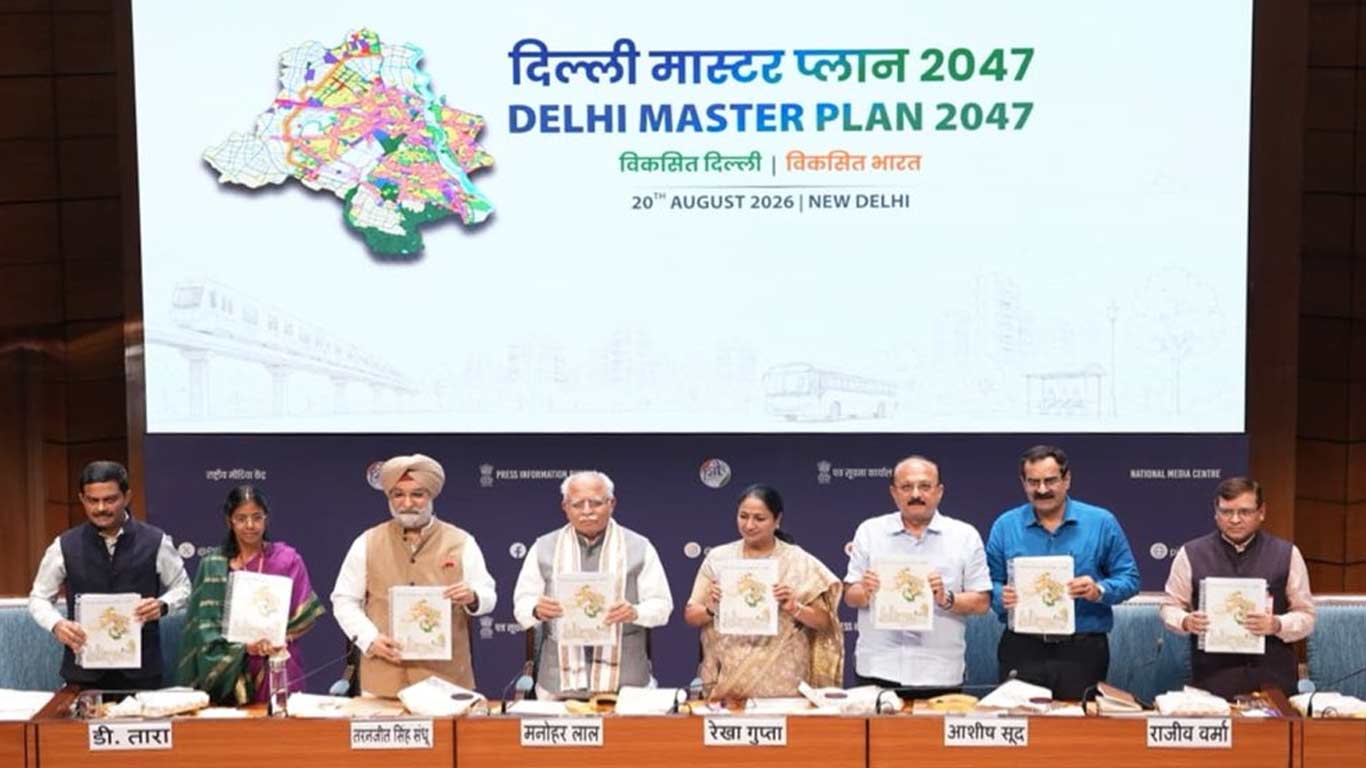
Delhi Master Plan 2047 Targets 40 Lakh New Homes, 695-km Metro Network And Major Infrastructure Expansion
New Delhi, Aug 21 (KNN) The Union government has notified the Master Plan for Delhi 2047 (MPD-2047), a long-term blueprint for housing, transport, infrastructure, economic development and environmental sustainability as Delhi’s population is projected to reach around 3.2 crore by 2047.
Approved by the Ministry of Housing and Urban Affairs (MoHUA) as an extensive modification of the Master Plan for Delhi 2021, the plan estimates a requirement for nearly 40 lakh additional homes, including affordable housing, to accommodate population growth.
Housing and Planned Expansion
MPD-2047 adopts two approaches: area-based redevelopment of existing or brownfield areas and road-network-based planning for greenfield development.
The minimum area requirement for redevelopment of group, DDA and government housing has been reduced from 40,000 sq m to 3,000 sq m, potentially enabling around 7 lakh additional dwelling units.
Around 18 lakh affordable homes are proposed in Transit-Oriented Development (TOD) zones, while in-situ rehabilitation of jhuggi-jhopri clusters is expected to benefit more than 17 lakh residents.
The plan also provides a 15 per cent additional FAR for workers’ housing on industrial plots of 5,000 sq m and above and a 50 per cent FAR incentive for affordable rental housing.
Nearly 200 sq km has been earmarked for land-pooling-led expansion, with around 12 lakh homes and a planned 600-km road network. The DDA will follow an infrastructure-first approach, developing 30-metre and wider roads before major development.
Transit-Oriented Development
TOD is central to the plan, with higher-density mixed-use development proposed within 500 metres of Metro corridors and major regional and interstate transit stations.
Delhi’s Metro network is proposed to expand from around 416 km to 695 km, supported by RRTS expansion, buses and multimodal hubs integrating public transport, walking and cycling.
A High-Density Corridor along UER-II will permit residential, commercial, warehousing and logistics activities, with FAR of up to 400 in the identified corridor.
Infrastructure and Economy
MPD-2047 links new development to the availability of roads, public transport, water, sewerage, drainage, electricity and digital connectivity.
Water demand is projected at around 1,600 MGD by 2047, while sewage treatment capacity is targeted at 1,285 MGD, up from 814 MGD. Solid waste generation is expected to rise from about 13,500 tonnes per day in 2026 to 25,764 tonnes per day by 2047, with peak power demand projected at 25,500 MW.
The plan allows greater flexibility in industrial areas, including e-commerce, warehousing, big-box retail, co-working spaces and data centres. Commercial centres can be redeveloped on plots of at least 1,000 sq m with higher FAR incentives.
Narela has been earmarked for a 138-hectare education hub, while Dwarka is proposed as an international investment and business hub for IT, start-ups, data centres and other emerging industries.
Yamuna and Environment
The plan proposes ecological restoration of nearly 1,700 hectares of the Yamuna floodplain through 13 projects and a 52-km cycling track along the floodplain. It also seeks to develop a green-blue network connecting the Ridge, Yamuna, wetlands, lakes, drains, biodiversity parks and urban forests.
Measures include ecological restoration, increased green cover, rainwater harvesting, water recycling, waste-to-resource initiatives and low-carbon development.
Heritage and Governance
MPD-2047 provides for conservation of around 1,500 heritage assets, with adaptive reuse allowed for uses such as museums, hotels, offices and cultural facilities.
The plan also promotes GIS-based planning, digital platforms, AI and data-driven governance, with annual monitoring and a detailed review every five years.
However, implementation challenges remain, including restrictions on mixed-use roads, the need for wider participation in land pooling, road-width constraints in low-density areas and the slow pace of in-situ rehabilitation of jhuggi-jhopri clusters.
The success of MPD-2047 will ultimately depend on coordinated implementation, timely infrastructure creation, land assembly, financing and translating its planning provisions into projects on the ground.
(KNN Bureau)







 Loading...